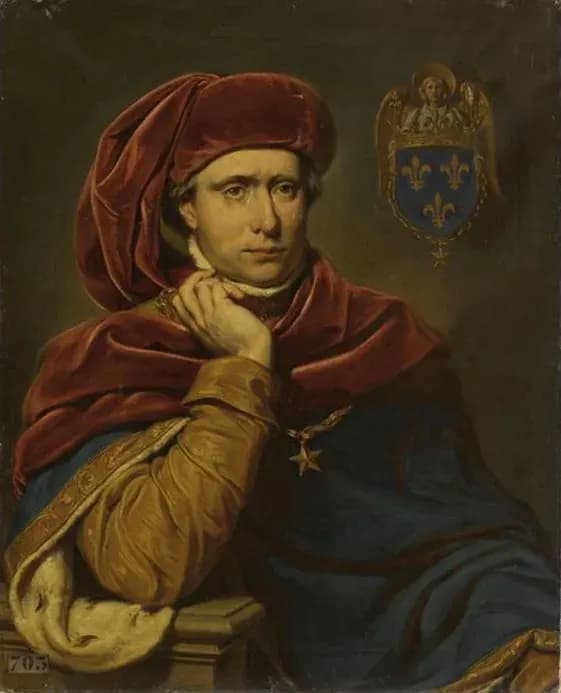

Charles VI was born in Paris and was the first French king believed to have received the title “Dauphin” and the province of Dauphiné at birth. His father, Charles V the Wise, died when the boy was only twelve, plunging the kingdom into a regency crisis and power struggle among his uncles.
According to the Ordinance of 1374, Charles VI was to reach majority at thirteen. However, his father distrusting his ambitious brother, Louis I of Anjou entrusted guardianship to his other two brothers, John of Berry and Philip the Bold. After the king’s death in 1380, fierce rivalry erupted for control of the regency. Eventually, Louis of Anjou obtained limited authority as regent, while effective power passed to the Grand Council of fifty members.
Louis immediately plundered the royal treasury, embezzling about 17 million francs and seizing the state’s reserve jewels.
Despite the turmoil, on November 3, 1380, the young Charles VI was knighted and solemnly crowned at Reims. During the banquet, his uncles quarreled openly when Philip the Bold claimed the seat of honor at the king’s right hand.


At the coronation it was proclaimed, per his father’s will, that taxes would be reduced. Yet the regents needing funds for their ambitions quickly broke that promise. Philip of Burgundy imposed a new indirect tax, sparking the Maillotins Revolt in Paris, where furious mobs attacked tax collectors and Jewish households.
The boy-king’s education was neglected; the regents preferred to distract the twelve-year-old with banquets, hunts, and pageants to keep him from politics. Chroniclers nevertheless noted his spirited and warlike nature.
In 1382, a new uprising in Paris was suppressed with brutality. After a successful Flemish campaign, the royal uncles returned and unleashed a reign of terror executing about 300 people and levying crushing fines and new taxes on rebellious cities. The regency (1380–1388) became infamous for the uncles’ greed and extravagance, financed by the royal treasury.
Abroad, policy was chaotic: Louis of Anjou departed to conquer Naples but died two years later; Philip the Bold dragged the king into the Flemish campaign of 1382. At the Battle of Roosebeke, the French won a complete victory, though the impetuous young king narrowly escaped death. The triumph yielded little for the crown beyond heavy fines on Flemish towns.


By late 1387 Charles VI began preparing a massive invasion of England, building a fleet of 1,287 ships, but the expedition was aborted because John of Berry delayed until autumn storms set in.
On November 3, 1388, the twenty-year-old Charles suddenly declared at council that he would govern personally. His uncles were dismissed, and power passed to the so-called “Marmousets” reform-minded advisers of his late father. They restored order to finances, partly repealed regency taxes, and concluded a three-year truce with England.
At this time Charles VI was in his prime a vigorous, handsome youth. In 1385 his uncles arranged his marriage to Isabeau of Bavaria to secure German support against England. The king insisted on meeting her in person; they were wed and she was crowned on July 18, 1385, at Amiens.


The Marmouset administration restored calm to Paris and revived river commerce. Yet the rising influence of the king’s brother Louis of Orléans soon caused tension. Lavish celebrations for the birth of a dauphin in 1392 strained finances, prompting renewed taxation.
Then tragedy struck. In April 1392, Charles showed the first symptoms of the madness that would shape his reign fever, extreme irritability, and bursts of violent behavior.
The first major psychotic episode occurred that August 5, near Le Mans. The king, already agitated after the attempted assassination of his constable Olivier de Clisson, was startled by a ragged man shouting, “Stop, King! You are betrayed!” Moments later, a page dropped a lance; the clang sent Charles into frenzy. Shouting “Forward, traitors!” he drew his sword and attacked his own escort, killing the bastard de Polignac, wounding three others, and chasing his brother until his sword broke. Subdued and unconscious for three days, he awoke deranged. Control of government reverted to his uncles.


A second breakdown followed on January 28, 1393, during the infamous “Bal des Ardents” (Ball of the Burning Men), when the king and courtiers, costumed as “wild men” in wax-coated flax, caught fire after Louis of Orléans approached too closely with a torch.
The horror deepened the king’s madness: he no longer recognized anyone, denied his name and crown, and screamed to “drive away that woman,” meaning Queen Isabeau. The illness became cyclical periods of insanity, during which he believed himself made of glass or demanded isolation, alternated with brief lucidity. Eventually the court grew accustomed to the “king’s illness.” Queen Isabeau withdrew for safety, and only his mistress Odette de Champdivers, who bore him a daughter and remained by his side for sixteen years, could calm him.


Paradoxically, the king’s incapacity brought temporary external stability. His uncles resumed power and renewed an Anglo-French truce in 1389, repeatedly extended. The fall of Richard II in 1399 plunged England into turmoil, preventing new invasions. France emerged as Europe’s leading power, actively mediating in the Great Western Schism: French theologians championed conciliar authority over papal supremacy.
After Philip the Bold’s death in 1404, unity at court collapsed into a bitter feud:
The Burgundians, led by John the Fearless (Philip’s son), drew strength from Netherlandish wealth and Parisian support.
The Armagnacs, led by the king’s brother Louis of Orléans and backed by Queen Isabeau.
The crisis peaked in November 1407, when Louis of Orléans was assassinated on John the Fearless’s orders. His enemies rallied under Bernard VII of Armagnac, giving their faction its name.


John the Fearless seized control but ruled precariously. Civil war between Armagnacs and Burgundians flared anew, both courting English aid.
In August 1415, Henry V of England reopened the Hundred Years’ War. The Armagnac government mustered a vast army, yet on October 25, 1415, at the Battle of Agincourt, French knights were annihilated by English archers. The defeat compounded by bankruptcy and noble deaths proved disastrous.

The civil war raged on. The Armagnacs fatally expelled Queen Isabeau, accusing her of debauchery. She reconciled with John the Fearless and in 1417 declared herself regent. In 1418 the Burgundians seized Paris and massacred Armagnac leaders.
The tragedy’s climax came on September 10, 1419, when followers of the Dauphin Charles murdered John the Fearless on the Bridge of Montereau. The act discredited the Dauphin and drove Philip the Good, the new Duke of Burgundy, into alliance with Henry V.
On May 21, 1420, the Treaty of Troyes sealed France’s humiliation: Henry V, newly married to Catherine of Valois (Charles VI’s daughter), was recognized as heir to the French crown and regent of France, while the Dauphin was disinherited. The kingdom effectively split in two.
Charles VI outlived his son-in-law by two months and died in Paris on October 21, 1422, of malaria, abandoned by nearly everyone. His mind reportedly cleared before death, but his funeral at Saint-Denis was “far too modest for a king of France.”

Under the Treaty of Troyes, the infant Henry VI of England was proclaimed King of France, while the Dauphin’s supporters simultaneously declared him King Charles VII.
The forty-two-year reign of Charles VI ended with the disintegration of France. His successors faced the immense task of expelling the English, subduing the princes, and rebuilding the shattered monarchy.


