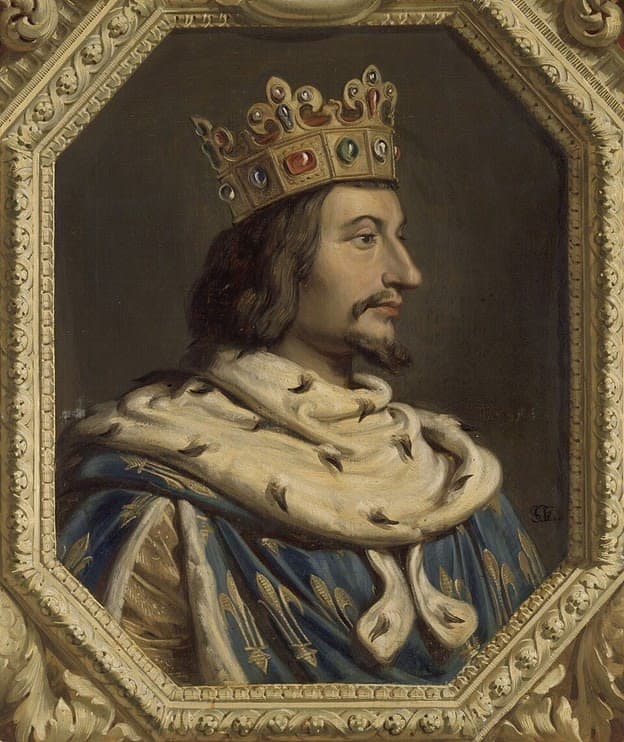
Charles V the Wise occupies a special place among the French monarchs. Unlike his brave but impulsive father, John II the Good, Charles was a prudent, shrewd, and legally meticulous ruler, whose fragile health concealed a sharp intellect and firm will.
In his youth, around 1349, Charles V suffered a serious illness that left him physically weak. Because of a swollen right hand, he could not wield heavy weapons and thus became the first French king who, even nominally, did not command his troops in battle. He delegated this exceptional royal duty to professional soldiers the greatest among them being Constable Bertrand du Guesclin.


Charles compensated for his weakness with intellect and education. The writer Christine de Pizan described him as a “wise and cunning man” (sage et visseux), a scholar who mastered all seven liberal arts.
Charles V was deeply pious, which helped him endure his chronic ailments. He patronized the Celestine monks and had a strong interest in astrology and occult sciences, though his political decisions always remained within the bounds of law and reason. Like Saint Louis IX, he clearly understood the grandeur and responsibility of kingship, always striving to ensure that his actions including wars and taxation were just and lawful.

Charles became the first Dauphin of France when his grandfather, Philip VI, purchased the province of Dauphiné in the Rhône Valley. This gave the 11-year-old prince his first experience of administration.
After the catastrophic defeat at Poitiers in 1356, where his father was captured by the English, the 18-year-old Charles assumed the duties of regent. The country was half occupied by the enemy, and royal authority was gravely weakened.
Charles’s regency coincided with a period of internal turmoil. The Estates-General, led by Paris provost Étienne Marcel and supporters of Charles II the Bad of Navarre, demanded reforms.
In 1357, the Dauphin was forced to issue the Great March Ordinance, which drastically limited royal power and transferred control of finances and officials to the Estates.


In the spring of 1358, a spontaneous peasant uprising, known as the Jacquerie, broke out. Charles V skillfully exploited internal divisions. He fled from Paris, convened loyal Estates, and, after Charles the Bad crushed the Jacquerie, he provoked conflicts between Paris and Étienne Marcel. On July 31, 1358, Marcel was killed by townspeople. On August 3, the Dauphin returned to Paris, proclaimed an amnesty, and repealed the Ordinance. The monarchy emerged from the crisis morally victorious.

Charles’s main goal was to free his father and secure peace. He managed to nullify the catastrophic terms of the First and Second London Treaties signed by John II in captivity. On May 8, 1360, the Treaty of Brétigny was concluded. France ceded vast territories including Guienne and Poitou to Edward the Black Prince and agreed to pay three million gold écus.
Cleverly, Charles included in the treaty an important clause: a mutual renunciation (Edward III renouncing the French crown and John II renouncing sovereignty over Aquitaine) would only take effect after the complete transfer of territories. Since the transfer was delayed, the renunciations were never exchanged, and the French crown legally retained suzerainty over the ceded lands.
After John II’s death in captivity in April 1364, Charles V was crowned king.


As king, Charles V proved himself a master strategist who, through diplomacy and careful military planning, solved France’s major problems. When Charles II the Bad started a war to seize the Burgundian inheritance, Charles V ordered Du Guesclin to crush him. On May 16, 1364, at Cocherel, Du Guesclin defeated Charles of Navarre, forcing him to surrender.

Charles diplomatically recognized John IV of Montfort as Duke of Brittany, but secured his homage, keeping Brittany a French vassal.
He also dealt with the menace of mercenary bands (routiers) by sending them, under Du Guesclin’s command, to Castile to aid Henry of Trastámara.
Charles V strengthened France’s northern frontier by arranging the marriage of his brother Philip II the Bold to Margaret of Flanders in 1369 a union that ended the Anglo-Flemish alliance.
By 1368, the renunciations of Brétigny still had not been exchanged. Charles used complaints from the Gascon vassals about the Black Prince’s new hearth tax as a legal pretext. Acting as their feudal overlord, he summoned the prince to court, and when the summons was ignored, on November 30, 1369, he declared the confiscation of the English holdings, thereby resuming the Hundred Years’ War.
Charles instructed Du Guesclin to employ an unorthodox strategy—avoiding pitched battles, attacking small garrisons, and exhausting the enemy through maneuver. Within five years, the French reconquered most of Great Aquitaine. By 1374, only Bordeaux and Bayonne remained under English control.
The last years of Charles V’s reign were overshadowed by the Great Western Schism, during which he supported the antipope Clement VII in Avignon, hindering the conclusion of the war. In 1378, after uncovering a conspiracy to assassinate him, Charles confiscated the lands of Charles the Bad.


On his deathbed, Charles V abolished the hated hearth tax, easing the people’s burden. He left the throne to his minor son, Charles VI, but his will outlining the governance of the realm was ignored immediately after his death in 1380.
Charles V the Wise left behind a rich cultural legacy. His personal library in the Louvre contained 973 volumes, and his court was home to the poet Eustache Deschamps and the educated writer Christine de Pizan.


