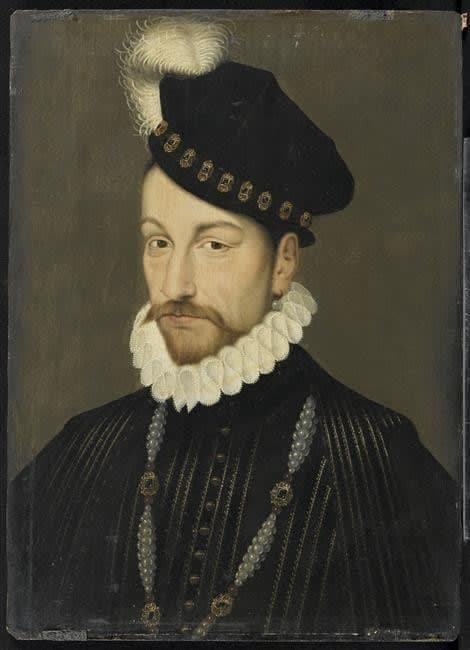

Charles IX, born Charles de Valois in 1550, ascended the French throne at the age of 10 in 1560 after the sudden death of his elder brother Francis II. He was crowned in Reims on May 15, 1561. His brief reign coincided with the most violent phase of the French Wars of Religion.

During the early years of his reign, until he reached legal majority in 1563, real power belonged to his mother, Catherine de’ Medici. The queen mother, seeking reconciliation, attempted to mediate between Catholics and Protestants (Huguenots).
Catherine organized a meeting between Catholic and Protestant leaders Cardinal Charles de Guise and Theodore Beza hoping for compromise. The negotiations failed, and the massacre at Cahors, in which 30 Protestants were killed, made further reconciliation impossible.
The Edict of Saint-Germain-en-Laye (1562) attempted to stabilize the situation by allowing Protestant worship outside city walls. However, the Massacre of Vassy (1562), in which Catholic troops slaughtered Huguenots, triggered open war. The Prince of Condé, leader of the Protestants, took up arms, marking the start of the First War of Religion.
The Catholics won at Dreux (December 19, 1562), but their leader François de Guise was assassinated during the siege of Orléans. On March 19, 1563, the fragile Edict of Amboise established a temporary truce.


In March 1564, Catherine de’ Medici organized the Great Royal Progress, a two-year-long tour across France meant to display royal authority, pacify unrest, and strengthen the monarchy.
The royal entourage visited conflict regions, including Protestant cities in Gascony and Languedoc.
While stopping in Roussillon, the king signed the Edict of Roussillon, officially declaring January 1 as the first day of the year throughout the kingdom. A later stay in Moulins resulted in the Edict of Moulins, confirming the inalienability of royal domains.
Despite these efforts, peace did not last. In August 1567, Protestants plotted to kidnap the king and his mother. On September 24, Charles and Catherine fled to Meaux. War resumed, and though the Protestants suffered defeats at Saint-Denis, Jarnac, and Moncontour, the Peace of Saint-Germain (1570) brought another fragile truce.

In November 1570, the 20-year-old king married Elisabeth of Austria, daughter of Emperor Maximilian II, strengthening ties with the Holy Roman Empire.
The climax of Charles IX’s reign was the St. Bartholomew’s Day Massacre, which forever stained his name. The marriage of his sister Margaret of Valois to Henry of Navarre, a young Protestant leader, was meant to seal reconciliation between the two faiths.
However, on August 22, 1572, just days after the wedding, an assassination attempt on Admiral Gaspard de Coligny, leader of the Huguenots, inflamed tensions. Fearing an uprising, the king under pressure from his mother and advisers made the fateful decision to eliminate Protestant leaders.
This decision unleashed the St. Bartholomew’s Day Massacre (August 24, 1572), which led to the slaughter of thousands of Huguenots in Paris and across France. Despite his later attempts to stop the bloodshed, Charles failed to restore order.


The massacre marked a turning point: it destroyed Protestant trust in the monarchy, ended all hopes of peaceful coexistence, and reignited full-scale war. For centuries, some chroniclers even claimed that the king himself shot at Huguenots from his palace windows a legend reflecting the trauma of the event.
The horrors of 1572 worsened the king’s fragile health. Soon after, a plot to place his younger brother, Francis of Alençon, on the throne was discovered. Deeply shaken, Charles withdrew to Vincennes, where his illness rapidly worsened.
Charles IX died on May 30, 1574, just shy of his 24th birthday. The autopsy, conducted by Ambroise Paré, revealed secondary pleurisy caused by tuberculosis.
His successor was his younger brother Henry III, who renounced the throne of Poland to rule France. Rumors spread that Charles had been poisoned, possibly by Henry or on Catherine de’ Medici’s orders.
Charles IX left behind a treatise on royal hunting and a few poems, but his reign is remembered above all as the darkest period of religious division and violence in French history.


