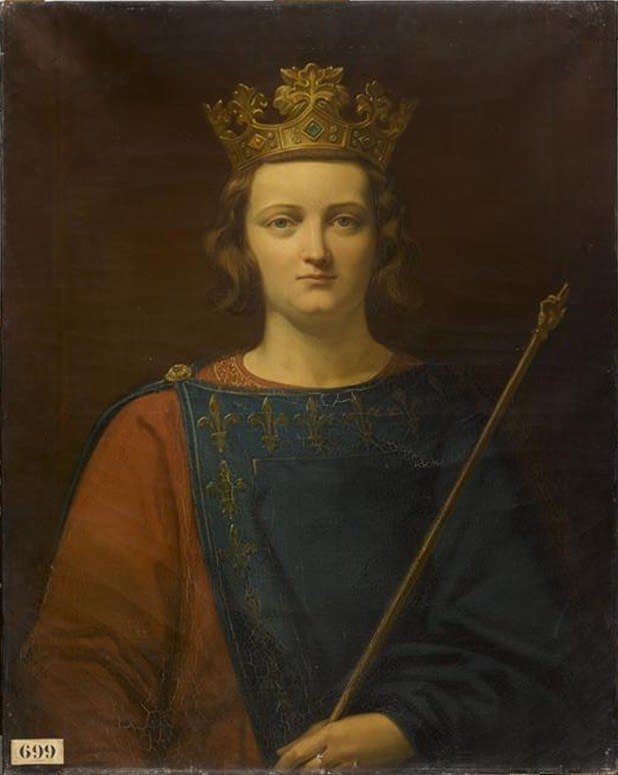

Charles IV the Fair was the youngest of the three sons of Philip IV the Fair, who successively occupied the French throne. He succeeded his brother Philip V the Tall in 1322. Before ascending the throne, he held the title of Count of La Marche.
Charles, who received the nickname the Fair (le Bel) because of his resemblance to his father, was a weak-willed and indecisive man, not distinguished by intelligence. During the lifetime of his father and elder brothers, he played no significant political role. Before his death in 1314, Philip IV granted him the County of La Marche.

In political matters, Charles was always a staunch supporter of his beloved uncle, Charles of Valois. After the death of Louis X in 1316, he supported his uncle’s unsuccessful attempt to seize the regency. In 1317, when Philip V became king, Charles made his brother a peer of France.
When Charles became king in 1322, the kingdom was effectively governed by Charles of Valois, who had already overseen France’s administration under Louis X.
Charles IV sought to strengthen the kingdom through a despotic internal policy. He assisted the Count of Flanders against his rebellious subjects and supported his sister, Queen Isabella of England, in her struggle against her husband, King Edward II. In exchange for help which led to Edward II’s defeat and assassination Isabella ceded Agenais to Charles and paid him 50,000 silver marks.


After the death of his uncle Charles of Valois in 1325, Charles IV had to rule independently. He relied heavily on the advice of his cousin Robert of Artois, who exerted great influence over the king.
Charles IV’s personal life was marked by scandal. His first marriage, to Blanche of Burgundy, ended in 1314 with a notorious scandal when Blanche was accused of adultery and sentenced to life imprisonment in Château-Gaillard. For Charles, who sincerely loved his wife, it was a heavy blow.

After the divorce, he married Maria of Luxembourg, whose brother, John of Luxembourg, he supported in his bid for the throne of the Holy Roman Empire. For his third marriage, Charles chose Jeanne d’Évreux.
Charles IV died on February 1, 1328. Of his seven children, only one daughter from his third marriage survived to adulthood, but she could not claim the throne.
His death repeated the situation of twelve years earlier, since his widow Jeanne d’Évreux was pregnant. His cousin Philip of Valois immediately declared himself regent until the child’s birth.
When the widow gave birth to a daughter, the male line of the senior Capetians became extinct. On that same day, Philip of Valois ascended the throne as Philip VI.
However, the deceased king’s nephew, Edward III of England, son of Isabella of France, also laid claim to the throne. The French nobility, relying on the Salic Law, rejected his claim an act that became the formal pretext for the beginning of the Hundred Years’ War.


