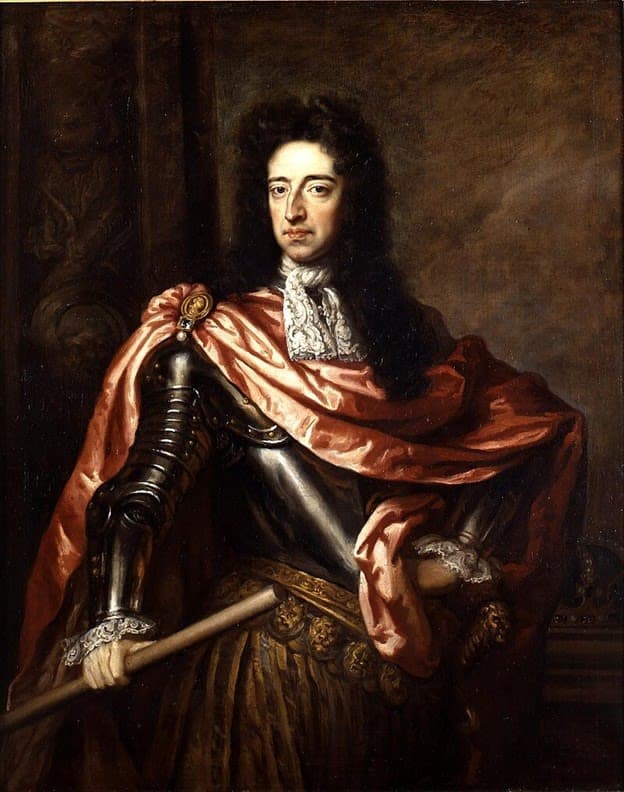

William Henry of Orange was born on 4 November 1650 in The Hague. He was the only son of Stadtholder William II of Orange and Mary Henrietta Stuart, the eldest daughter of the executed King Charles I of England. Eight days before his birth his father died of smallpox, and the newborn prince found himself at the center of political intrigue.
His childhood and education unfolded under the close scrutiny of both the Orangists (dynastic supporters) and the Republicans, led by Johan de Witt. William was raised in a strict Calvinist atmosphere. His mother paid him little attention, and his guardianship was shared by his grandmother and the Elector of Brandenburg. After his mother’s death in 1660, his uncle, King Charles II, oversaw his upbringing.

In 1666 the States of Holland declared him a “child of the state,” and Johan de Witt himself supervised his education in affairs of government. This was intended to exclude English influence and prepare the prince for public service.

After William’s father died, most provinces declined to appoint a new stadtholder. In 1667 the States of Holland adopted the Perpetual Edict, which forbade one person from holding both the offices of stadtholder and captain-general meant to weaken the House of Orange.
In 1672 the Dutch Republic faced invasion by the combined forces of England and France. Confronted with this danger, the 21-year-old William was proclaimed stadtholder and commander-in-chief. His Orangist supporters brutally murdered the De Witt brothers, including William’s tutor Johan de Witt, leaders of the Republicans. Although William’s complicity was never proven, he did not punish the instigators, damaging his reputation.
During this period William showed remarkable abilities as both commander and statesman. He halted the French advance, forged a strong coalition with Austria and Spain, and forced England out of the war. In 1677 he married his first cousin Mary Stuart, daughter of the Duke of York the future King James II of England.
In 1685 William’s uncle, the Catholic James II, ascended the English throne. His policies aimed at restoring Catholic influence aroused profound hostility among the Protestant majority. James dissolved parliament, created a standing army, and began persecuting Anglican clergy.
The crisis peaked in 1688, when the 55-year-old James II had a son. The birth of a Catholic heir shattered Protestant hopes for a peaceful succession. Leaders of both parties Whigs and Tories united and secretly invited William and Mary to the English throne.
In November 1688 William landed in England with an army of 40,000. He met no real resistance: James II’s army deserted, and the king’s closest advisers went over to William. James fled to France. In January 1689 parliament proclaimed William and Mary joint sovereigns of England and Scotland an event remembered as the Glorious Revolution.


William III’s reign marked a decisive shift to constitutional monarchy. In 1689 the Bill of Rights was enacted, finally limiting the monarch’s power and enshrining the supremacy of parliament. The Toleration Act was also passed, granting rights to Protestant dissenters while maintaining discrimination against Catholics.
William was an implacable opponent of the French king Louis XIV. He built a powerful fleet and army that won victories over France. In 1697 Louis XIV was compelled to recognize William as the lawful king of England. Under William the Bank of England was founded, and England began its rise as a formidable world power.

William III died on 8 March 1702 of pneumonia that developed after a fall from his horse. Shortly before his death he approved the Act of Settlement, under which the British throne could not be occupied by Catholics or by those married to Catholics. William left no children, and the crown passed to Mary’s sister, Anne. The orange color on the flag of Ireland remains a memory of him, symbolizing the Irish Protestants known as Orangemen.


