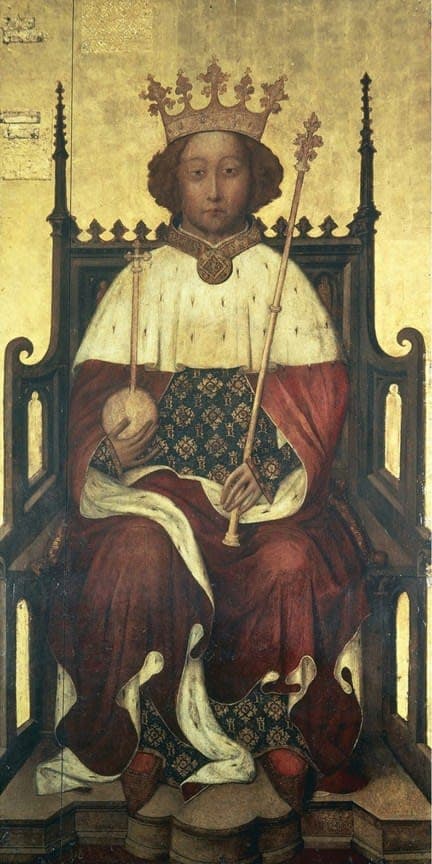
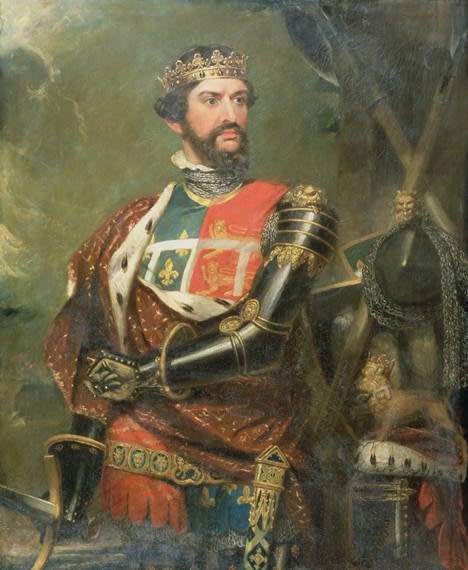
The future king Richard II was born on 6 January 1367 at the Abbey of St Andrew in Bordeaux, Gascony. His father was the famed commander Edward “the Black Prince,” eldest son of King Edward III and heir to the English throne. Richard’s mother was Joan, the “Fair Maid of Kent,” daughter of Earl Edmund of Woodstock, who had been executed on the orders of the regent Roger Mortimer.
In his early years Richard lived with his parents at their residence in Bordeaux, where the Black Prince administered his domains. In 1371 the family returned to England, to Berkhamsted Castle. Soon after, in 1372, Richard’s elder brother died, leaving Richard the sole heir. As the Black Prince was already gravely ill with dysentery and lived in seclusion, Richard’s upbringing was largely overseen by his mother.
A legendary warrior himself, the father was disappointed by Richard’s indifferent physical constitution and tried to make a fighter of him. According to historians, this upbringing only deepened the prince’s sense of inadequacy. He was forced to watch his older maternal half-brothers from his mother’s first marriage, Thomas and John Holland already acclaimed for their valor win glory while he remained in their shadow.
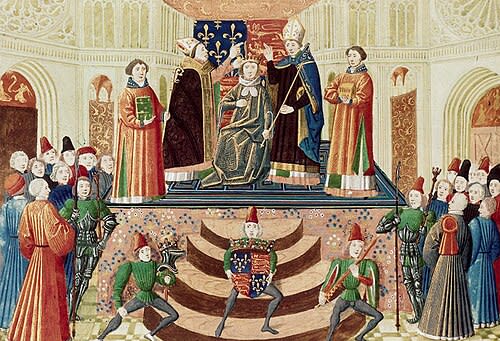
After the Black Prince’s death on 8 June 1376, the question of the succession arose. Richard’s grandfather, King Edward III, was already infirm, and Richard had no brothers to compete with his uncles the sons of Edward III. The most powerful of them was John of Gaunt, Duke of Lancaster, who might have claimed the crown. Fearing public outrage, however, he did not challenge his nephew’s right. Foreseeing a potential crisis, Edward III compelled the barons, knights, and bishops to swear fealty to his grandson. As a result, on 16 July 1377, at only ten years old, Richard was crowned at Westminster.


A regency council of twelve was set up, but real power lay with John of Gaunt. Though immensely wealthy and influential, his rule was unpopular owing to rising taxes and public discontent. Richard himself despite his youth showed prudence, reconciling his uncle with the Londoners and earning a reputation as a peacemaker. His mother, Joan of Kent, exerted great influence over him and guided him in the arts of governance until her death in 1385.
Richard’s first years on the throne were overshadowed by external and internal strain. The war with France required vast sums. To refill the treasury, the government imposed an unpopular poll tax, provoking widespread anger.
In the spring of 1381 the Peasants’ Revolt broke out in England under the leadership of Wat Tyler. The rebels marched on London, sacking the archbishop’s residence along the way. They demanded the abolition of serfdom, lower taxes, and amnesty. Richard then only fourteen displayed remarkable courage and composure. He went to negotiate with the rebels and agreed to their demands, hoping to calm the crowd. Yet that same day the Tower was seized, and the insurgents executed the Archbishop of Canterbury and other royal ministers.

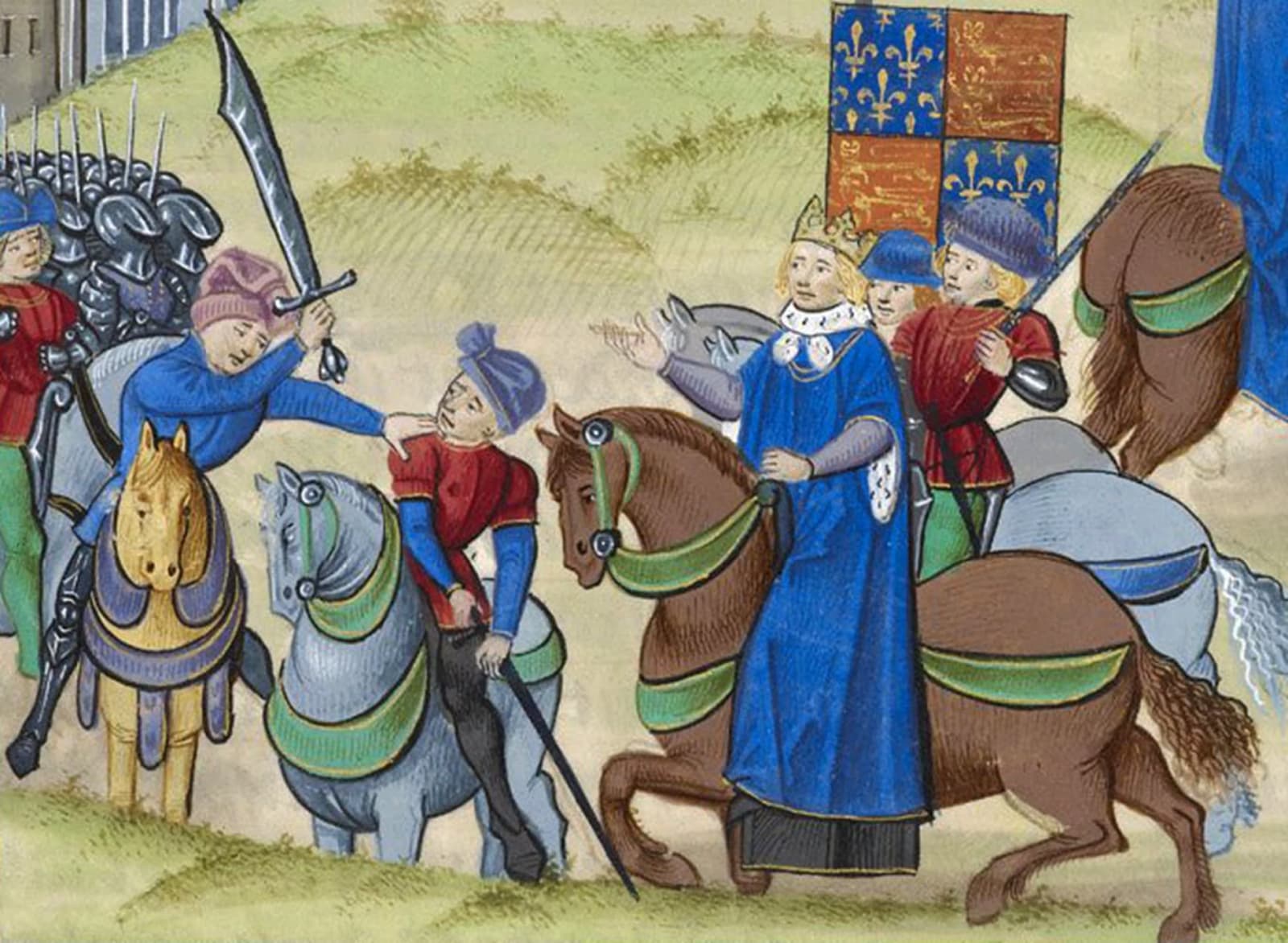
The next day, 15 June, Richard met Wat Tyler again. When Tyler behaved insolently, the mayor of London, William Walworth, killed him. The rebels were enraged, but Richard stepped forward and boldly addressed them: “I am your captain! Follow me!” He promised to fulfill all demands and persuaded the crowd to disperse. Once the danger had passed, however, Richard revoked his promises and brutally suppressed the remaining centers of revolt, though many insurgents received milder punishments. The episode revealed both his bravery and his perfidy.

Soon after the revolt, in 1382, Richard married Anne of Bohemia, daughter of the Holy Roman Emperor Charles IV. The match was political but proved happy. Richard loved his wife sincerely, and she came to exercise great influence over him.
With the start of his personal rule, Richard’s character changed markedly. He grew haughty, capricious, and self-regarding, surrounding himself with favorites such as Robert de Vere, Earl of Oxford, and Michael de la Pole, Earl of Suffolk. These favorites used the king’s favor for personal enrichment, provoking the ire of the old nobility, including Richard’s uncle Thomas of Woodstock, Duke of Gloucester.
In 1385 Richard led a campaign into Scotland, but it achieved nothing and only deepened the nobility’s frustration. After the campaign, John of Gaunt—the chief military leader—departed for Spain, leaving the king alone with his favorites and a hostile aristocracy.
In 1386 the conflict between the king and parliament reached its height. Outraged by royal extravagance and the influence of favorites, parliament demanded the dismissal of Chancellor Michael de la Pole. Richard at first refused, but under threat of deposition was forced to yield. Parliament appointed a “Great Continual Council” to oversee finance and administration; the king, seeing this as an encroachment on his prerogatives, secretly procured a judges’ opinion declaring parliament’s actions unlawful.
When they learned of the judges’ verdict, the Duke of Gloucester and the Earls of Arundel and Warwick raised an army. They were joined by Henry Bolingbroke (John of Gaunt’s son) and Thomas Mowbray. This coalition, known as the Lords Appellant, brought formal “appeals” (charges) against the king’s favorites. In December 1387 the Appellants’ forces defeated Robert de Vere’s troops at the Battle of Radcot Bridge and then marched on London.
Richard had to submit. In February 1388 the “Merciless Parliament” convened and condemned and executed several royal favorites. Robert de Vere and Michael de la Pole managed to flee the realm, but their property was confiscated. Queen Anne begged in vain for the life of one of the condemned, Sir Simon Burley.
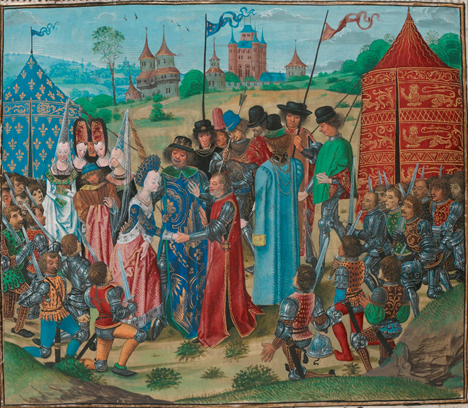
Thereafter Richard was forced to bide his time. He governed through the Appellants’ council and kept a low profile. In 1389, at twenty-two, he declared his full majority and readiness to rule alone. Thinking they had taught him a lesson, the Appellants allowed him to resume power, and Richard summoned his uncle John of Gaunt back from Gascony; Gaunt returned and became his right-hand man.
The next years were comparatively calm, but the king’s disposition did not change. After Queen Anne’s death in 1394, Richard grew even more capricious. In 1396 he married the seven-year-old Isabella of France to secure peace with France. The match scandalized the nobility, who feared the king would use the French against his opponents.
In September 1397 Richard, determined to avenge the humiliation of 1388, treacherously seized and accused of treason the former Lords Appellant: the Duke of Gloucester and the Earls of Arundel and Warwick. A parliament wholly subservient to the king condemned them. Arundel was executed, Gloucester murdered in custody at Calais, and Warwick exiled for life. Richard lavishly rewarded his supporters with new titles.
In January 1398 Richard annulled all acts of the Merciless Parliament. Soon, however, a quarrel broke out between two former Appellants whom the king had pardoned Henry Bolingbroke and Thomas Mowbray. Bolingbroke accused Mowbray of conspiracy, and the king ordered a trial by combat between them. At the last moment Richard halted the duel and banished both men Bolingbroke for ten years and Mowbray for life.

The banishment of Bolingbroke proved a fatal mistake. When John of Gaunt died in February 1399, Richard confiscated his vast estates which by right should have passed to Henry and converted Bolingbroke’s term into lifelong exile. This move, showing the king’s disregard for the law of inheritance, caused universal outrage. That same year, 1399, Richard departed on a military expedition to Ireland, leaving England unattended.
The king’s absence created perfect conditions for his overthrow. Learning that his lands had been seized, Henry Bolingbroke returned to England with a small force; powerful barons including the Earl of Northumberland and thousands of commoners quickly joined him. In Ireland, Richard could not respond in time. His army melted away, and he fell into an ambush and became Bolingbroke’s prisoner.
In September 1399 Richard was brought to London and confined in the Tower. On 29 September he signed an instrument of abdication. The next day parliament (or “assembly,” as Bolingbroke called it) formally accepted the abdication, listing his “crimes,” including incompetence, prodigality, and tyranny. Henry Bolingbroke advanced his claim to the throne on the basis of conquest and parliamentary support. On 13 October he was crowned as Henry IV.
The fate of Richard II remains a mystery. He was imprisoned in Pontefract Castle, where he likely died in early 1400. The official version was death by starvation, but most historians believe he was murdered perhaps strangled to prevent future plots in his name. To quell rumors, his body was displayed publicly and then buried.
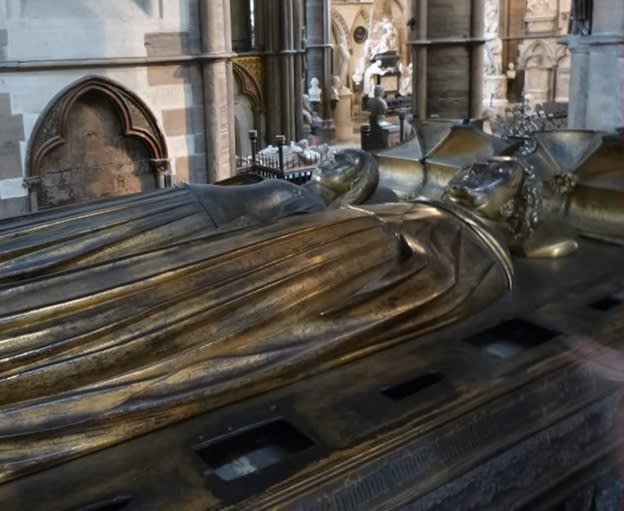
Richard II left a contradictory legacy. His unwise policies and tyranny undermined the prestige of the monarchy, and his deposition set a precedent that would later lead to the Wars of the Roses. At the same time, his reign saw a cultural flowering. Richard was a patron of the arts and letters. Poets prospered at his court, including Geoffrey Chaucer, the shaper of literary English; and Richard himself is regarded by historians as the first English king to speak the vernacular fluently. Under him, the royal court became more refined, elegant, and welcoming to women, and men’s fashion changed dramatically. Richard was also the first English king for whom lifetime portraits were made.


