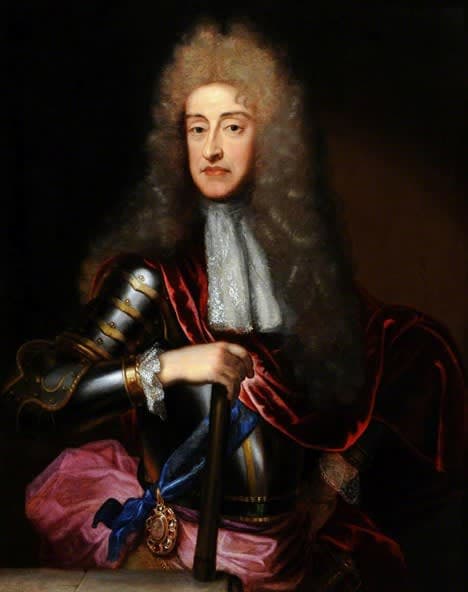

James II was born on 14 October 1633. He was the second surviving son of King Charles I and Henrietta Maria. In youth he received from his father the title Duke of York. During the Civil War he was imprisoned, but in 1648 he escaped to the Continent.
In exile James proved himself a capable commander. He served in the French army under Marshal Turenne and then, when his brother Charles II allied with Spain, fought against France. After the Stuart Restoration in 1660 James returned to England and received the Scottish title Duke of Albany. Charles II made him Lord High Admiral, and in 1665 he defeated the Dutch at the Battle of Lowestoft.


During this period James inclined ever more toward Catholicism, alarming Protestant England. After the death of his first wife, Anne Hyde, he openly embraced Catholicism. In 1673 parliament, seeking to curb Catholic influence, passed the Test Act, requiring all officeholders publicly to renounce Catholic doctrine. James refused and was forced to resign from public office.
Despite growing discontent, James enjoyed Charles II’s support. In 1679 a dynastic crisis erupted when parliament introduced the Exclusion Bill to bar James from the succession because of his Catholic faith. The bill failed, and on Charles II’s death in 1685 James ascended the throne without hindrance.
His reign began with the firm suppression of the risings of his opponents—the Monmouth Rebellion in England and Argyll’s Rising in Scotland. The participants were harshly punished, and Judge Jeffreys displayed particular savagery in the trials.

Emboldened by success, James II pursued a policy aimed at establishing an absolute Catholic monarchy. He appointed Catholics to key civil and military posts, contrary to English law. His policy provoked protests even among loyal Anglican clergy. The people, however, kept their discontent in check, hoping that after the childless James’s death the throne would pass to his elder daughter, Mary, a Protestant.
Everything changed in June 1688, when James II’s second wife, the devout Catholic Mary of Modena, bore him a son. The birth of a Catholic heir shattered Protestant hopes of a peaceful transition. Leaders of both parties Whigs and Tories secretly invited the Dutch prince William of Orange, husband of James’s elder daughter Mary, to take the English throne.
In November 1688 William landed in England with an army. Betrayed by his closest advisers and even his daughter Anne, James offered no resistance and fled to France in December 1688. In February 1689 parliament proclaimed William and Mary king and queen of England. These events entered history as the Glorious Revolution.

In exile James II never abandoned hope of restoration. He actively backed his supporters, the Jacobites, who rose in Scotland and Ireland. In 1689 he personally led the insurgents in Ireland, but in 1690 he was defeated at the Battle of the Boyne. James II died on 16 September 1701 in France and was buried in the Church of Saint-Germain. His descendants continued to press their claims to the English and Scottish thrones for many years.


