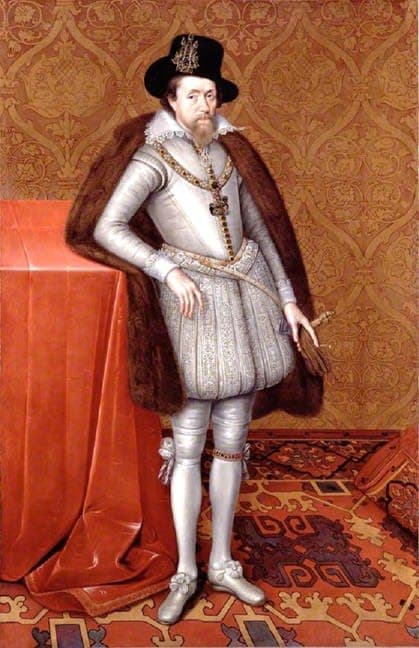

James I was born on 19 June 1566. He was the son of Mary Stuart, Queen of Scots, and Henry Stuart, Lord Darnley. Through both his father and his mother he was a great-grandson of King Henry VII of England, which gave him a claim to the English throne. A few months after his birth his father was murdered, leading to a rebellion against Mary Stuart.

In July 1567 the one-year-old James was crowned King of Scotland after his mother’s abdication. He never knew Mary Stuart, as she fled to England. His upbringing was overseen by a stern tutor, George Buchanan, who aimed to make him a Protestant king. Buchanan instilled in James a love of theology and argument, but also punished him regularly, which likely affected his character.

James’s early years as king unfolded amid chaos and civil war between the “king’s party” (Protestants) and the “queen’s party” (Catholics). The country was shaken by frequent changes of regent and coups d’état. Only by the mid-1580s, as he came of age, did James begin to pursue his own “Middle Way.”
He sought to reconcile the warring factions by bringing both conservatives and Presbyterians into his council. His policy aimed to strengthen royal authority and national unity. In 1586 James concluded an alliance with England, receiving an annual subsidy from Queen Elizabeth I and de facto recognition of his rights to the English throne. He showed prudence and restraint, declining to go to war with England after the execution of his mother, Mary Stuart, in 1587.
In 1589 James married Anne of Denmark, which bolstered his position. He suppressed both Catholic plots and rebellions by radical Presbyterians who sought to limit royal power in the church. In 1592 he endorsed a Presbyterian reform, but later after becoming King of England he returned to the idea of restoring the episcopate. His policy of “Jacobean compromise” helped stabilize the religious situation for a time.
On 24 March 1603 Queen Elizabeth I died. She left no direct heirs, and James, having secured the support of her councillors, was proclaimed King of England. On 25 July 1603 he was crowned in Westminster Abbey as James I. Scotland and England came under the rule of a single monarch, forming a personal union.


The beginning of his reign was marked by generous grants of titles and favors. The king’s chief adviser was Robert Cecil. James faced complex religious problems at home: Puritans demanded a deeper Reformation, while Catholics led by Guy Fawkes and other nobles, dissatisfied with half-measures organized the Gunpowder Plot in 1605 to kill the king and blow-up parliament. The plot was uncovered, leading to harsher repression of Catholics.

James I’s rule was also clouded by constant conflicts with the English Parliament. Believing his power to be absolute, he often clashed with parliament over finance. When parliament refused subsidies, James resorted to increasing feudal dues and selling titles, which only heightened discontent.
After Robert Cecil’s death in 1612, James I began to rely on young favorites, the most famous being George Villiers, Duke of Buckingham. The king, known for his homosexual inclinations, effectively delegated much of his power to Buckingham and to his son Charles.
In foreign policy James I strove for peace. He ended the Anglo-Spanish war that had begun under Elizabeth I and tried to avoid involvement in the Thirty Years’ War in Germany. He planned a marriage between his son Charles and the Spanish Infanta, but negotiations collapsed. Under pressure from parliament and Buckingham he nevertheless declared war on Spain, but died amid preparations for the campaign on 27 March 1625.

It was under James that the English colonial system began to take shape. In 1607 Virginia was founded as the first colony in North America, followed by other settlements, laying the foundations of the future British Empire.
James I was among the most learned monarchs of his age. He wrote poetry, theological treatises, and works justifying the idea of absolute monarchy. Culture flourished at his court; Shakespeare and Francis Bacon worked in his time. Yet his unwillingness to compromise with parliament and his partiality toward favorites left a legacy that helped set the stage for future conflicts between crown and parliament, culminating in the English Revolution.


