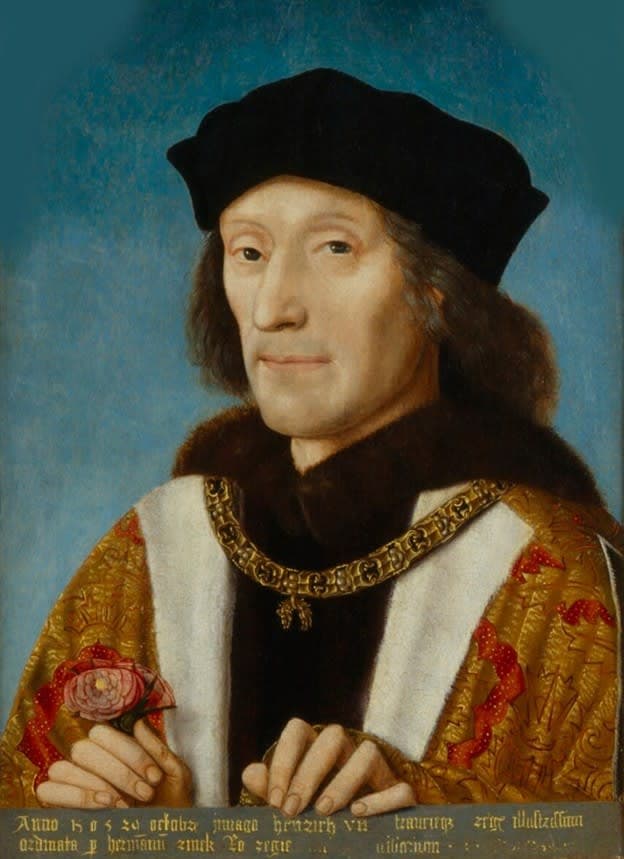

The future king, Henry Tudor, was born on 28 January 1457 in Wales, at Carmarthen Castle. His lineage was complex and far from straightforwardly royal. On his father’s side he belonged to the ancient Welsh house of Tudor, founded by his grandfather, Owen Tudor. Owen, who had served the dowager queen Catherine of Valois, mother of Henry VI, secretly married her. Their son, Edmund Tudor Henry VI’s half-brother married Margaret Beaufort, granddaughter of the illegitimate but later legitimized son of John of Gaunt, founder of the Lancastrian line. Thus, Henry’s claim to the throne was quite tenuous.
Henry was born two months after the death of his father, Edmund, who had succumbed to the plague. His childhood unfolded amid the ongoing Wars of the Roses. After the deaths of Henry VI and his son in 1471, Henry Tudor, then in exile in France, found himself the last legitimate Lancastrian claimant to the throne. He spent many years in the custody of Francis II, Duke of Brittany, though he was kept in good conditions.

After Richard III seized the throne in 1483 and, according to rumor, killed his nephews, rebellion flared in England. Seizing the moment, Henry Tudor promised that, if victorious, he would marry Elizabeth of York, daughter of Edward IV, to unite the warring houses.

In 1485, with French support, he landed in Wales, where his Welsh origin helped him gather many supporters.
At the Battle of Bosworth on 22 August 1485, Henry’s army defeated the forces of Richard III, who was killed in combat. Henry was proclaimed king on the battlefield itself. He became king by right of conquest, underscored by his proclaiming 21 August as the official start of his reign thereby making all who had fought against him traitors.


The beginning of Henry VII’s reign was marked by an outbreak of “sweating sickness,” brought by his mercenaries, which was taken as a bad omen. After the coronation, in fulfillment of his promise, Henry married Elizabeth of York, formally uniting the houses of Lancaster and York. As the emblem of the new Tudor dynasty, the red-and-white Tudor Rose was adopted.

The first years of Henry VII’s rule were filled with struggles against Yorkist pretenders who challenged his right to the crown. Lambert Simnel and Perkin Warbeck posed as the nephews of Edward IV. Henry showed clemency sparing Simnel and Warbeck but later executed them when they attempted to escape from the Tower together with the Earl of Warwick, the last Plantagenet, thereby ending Yorkist claims.
Henry VII proved a frugal and skillful monarch who greatly strengthened England’s finances after decades of war. He streamlined the financial system, instituted the Star Chamber to try overmighty nobles, and encouraged trade.
To bolster his international position, Henry pursued advantageous dynastic alliances. His eldest son, Arthur, married the Spanish princess Catherine of Aragon. His daughter, Margaret, married James IV of Scotland, which led to the union of the two crowns a century later. After Arthur’s early death, Catherine of Aragon remained in England and later married Henry VII’s second son, Henry VIII.

Henry VII’s reign is often seen as the end of the Middle Ages in England and the beginning of the Renaissance. He patronized the arts, and at his request the noted humanist Polydore Vergil began writing a “History of England.” He also sponsored maritime ventures, including John Cabot’s voyage to the Americas.
Henry VII died of tuberculosis on 21 April 1509 and was buried in Westminster Abbey. He was succeeded by his second son, Henry VIII, who inherited a strong and stable kingdom laying the groundwork for the far-reaching transformations to come in England.


