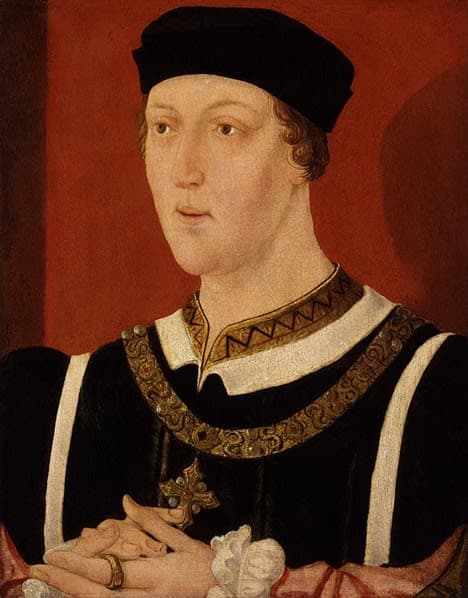

Henry VI was born on 6 December 1421 at Windsor. He was the only son and heir of the famed King Henry V. His father died suddenly on 31 August 1422, when Henry was only eight months old. Soon after, on 21 October 1422, his maternal grandfather, King Charles VI of France, also died. Under the Treaty of Troyes concluded in 1420, the infant Henry VI thus became king of both England and France.
Since the king was an infant, England was governed by a regency council. His uncle John, Duke of Bedford, was appointed chief regent and continued the war in France. In his absence the government in England was headed by the younger brother, Humphrey, Duke of Gloucester, who received the style “Support and Mainstay of the Realm.” Another influential figure on the council was Henry V’s uncle, Cardinal Henry Beaufort. The king’s mother, Catherine of Valois—being the daughter of the French king—was excluded from her son’s upbringing to prevent foreign influence.
Henry was crowned King of England on 6 November 1429, a month before his eighth birthday, and King of France on 16 December 1431 in Notre-Dame Cathedral in Paris, in order to legalize his claim to the French throne.


In 1437, after his mother’s death, Henry VI was declared of age and assumed the reins of power. He was a man far removed from war and politics: deeply pious, peace-loving, and lacking force of character, which made him easy prey for court factions.
The war in France begun by his father was in decline. England squandered the military advantage achieved by Henry V, while the victories of Joan of Arc strengthened the French crown.

Henry VI, having no military ambition, leaned toward a peaceful settlement. He was supported by a faction led by Cardinal Beaufort and William de la Pole, Earl of Suffolk, who pursued negotiations, while the Duke of Gloucester and Richard, Duke of York, argued for continuing the war.
In 1445 Henry VI married Margaret of Anjou, the French queen’s niece. The match formed part of a peace arrangement under which England secretly agreed to cede Anjou and Maine to France. When this concession kept from parliament became known, it provoked enormous anger. Queen Margaret, a woman of strong and determined character, became a key figure at court and an active champion of the peace faction.
The rise of Suffolk and Cardinal Beaufort was accompanied by the fall of their opponents. In 1447 the Duke of Gloucester was accused of treason and then died suddenly widely believed to have been murdered. The Duke of York was sent to govern Ireland, while Suffolk and Beaufort were raised still higher both becoming dukes and gaining even more influence.
Government incompetence and corruption led to popular unrest. In 1450 Normandy was lost, a grave blow to the prestige of the English crown. Unpaid soldiers returning from France and increasingly frequent raids by French pirates worsened the situation. This culminated in Jack Cade’s rebellion in Kent in May 1450. The rebels briefly seized London and executed several unpopular officials, but the rising was quickly suppressed.


In 1453 defeat at the Battle of Castillon ended the Hundred Years’ War and finally stripped England of its continental possessions. News of the disaster triggered a mental breakdown in Henry VI, who became apathetic for a full year. During this time the Duke of York returned to England and, taking advantage of the king’s incapacity, was proclaimed protector, while his chief rival, the Duke of Somerset, was imprisoned in the Tower.

By late 1454, however, Henry VI unexpectedly recovered. York’s party lost power, making armed confrontation inevitable.
In 1455 the First Battle of St Albans marked the beginning of the Wars of the Roses. In 1460, after victory at the Battle of Northampton, the Duke of York had himself declared heir to the throne, but he soon fell at the Battle of Wakefield. His son, Edward IV, carried on the struggle and, after the victory at Towton in 1461, took the English throne.

Henry VI was captured and confined in the Tower. In 1470, however, his old ally, the “Kingmaker” Richard Neville, Earl of Warwick, defected to the Lancastrians, freed Henry, and restored him to the throne. Henry’s second reign was brief and nominal, with Warwick ruling in his name.

In the spring of 1471 Edward IV returned to England. At the Battle of Barnet Warwick’s army was defeated and Warwick himself was killed. Soon after, on 4 May 1471, Margaret of Anjou’s army was crushed at the Battle of Tewkesbury, and Henry’s heir, Edward of Westminster, was slain.
After the defeat Henry VI was once more confined to the Tower. On 21 May 1471 he died in his cell. Although the official cause was listed as “melancholy,” modern historians agree he was murdered on the orders of Edward IV, who sought to end Lancastrian claims to the throne once and for all. With his death the Lancastrians were left without any legitimate claimant. Henry VI was buried at Chertsey Abbey, and his remains were later translated to Windsor Castle.


