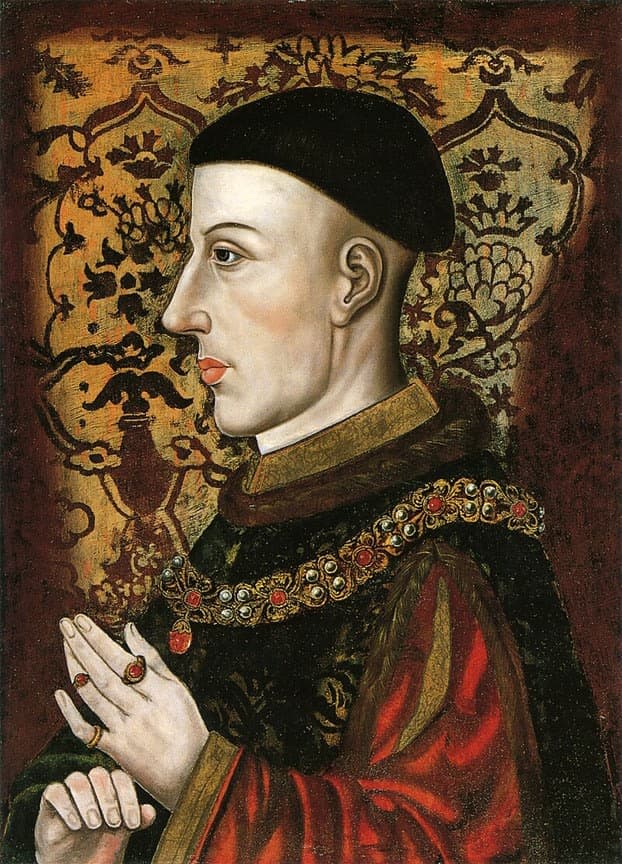

Henry V was born in the gatehouse of Monmouth Castle, whence his byname Henry of Monmouth. The exact date of his birth is debated, but most historians favor 1386 or 1387. He belonged to the Lancastrian branch of the Plantagenet dynasty. His father, Henry Bolingbroke, was the only surviving son of John of Gaunt, and his mother, Mary de Bohun, was the heiress to extensive estates.

Henry was not destined for the throne. He spent his childhood on his father’s and grandmother’s estates, where he received a good education. In 1398, when his father was exiled by King Richard II, Henry was taken into royal wardship. Richard even took the boy with him on campaign in Ireland and knighted him. When Henry Bolingbroke returned to England to reclaim his lands, the young Henry found himself in a difficult position and was effectively taken as a hostage.
After his father deposed Richard II and was crowned as Henry IV on 13 October 1399, Henry’s life changed dramatically. At the age of about twelve or thirteen he received the titles Prince of Wales, Duke of Cornwall, Earl of Chester, and Duke of Lancaster, becoming heir apparent.
The first years of Henry IV’s reign were unstable. In 1400 a plot by Richard II’s supporters was uncovered. The affair strengthened the new dynasty’s position, but also showed that as long as Richard lived, Henry IV’s throne would be at risk. Soon afterward Richard II was presumably killed in captivity.
One of Henry IV’s chief problems was the uprising in Wales led by Owain Glyndŵr. As Prince of Wales and the nominal ruler there, Henry was charged with suppressing the revolt. He served under Henry “Hotspur” Percy and gained vast military experience, leading troops in the conditions of a guerrilla war. During one campaign in 1403 the prince was wounded in the face by an arrow, but survived thanks to the skill of the royal surgeon John Bradmore. The wound left Henry with a prominent scar, yet hardened his resolve and stamina.
By 1406, having completed the Welsh campaign, Henry became active on the royal council. He headed a group of reformers seeking better financial management and more efficient government. This brought him into conflict with his father. When Henry IV recovered from illness, he dismissed his son from power in November 1411, suspecting him of aiming at the crown.
These disagreements also stemmed from foreign policy: Henry (the future Henry V) backed the Burgundian faction in France, while his father leaned toward alliance with the Armagnacs. Relations between father and son were tense, and rumor had it that Henry once took the crown from his father’s bedside.
After Henry IV’s death on 20 March 1413, Henry V ascended the throne. His coronation on 9 April 1413 was greeted as the start of a new era. He ruled as the head of a united nation, drawing a line under past conflicts. Henry V restored the rights of heirs who had suffered under Richard II and reinterred the deposed king’s remains with honor. At the same time, he acted firmly and ruthlessly against any threat, as in the case of the Lollard rising, whose leaders he had executed.
Henry V had ambitious plans to revive English power in France. On 12 August 1415 he sailed for France, where his army besieged and captured Harfleur. He then marched toward Calais. The French army intercepted him near the village of Agincourt. Despite the enemy’s numerical superiority and his army’s exhaustion, Henry V led his men into battle. On 25 October 1415, at the Battle of Agincourt, the English won one of the greatest victories of the Hundred Years’ War. Brilliant tactics, the use of longbows, and the muddy ground that hindered the French cavalry enabled him to rout the foe and inflict massive losses. The victory made Henry V one of the most celebrated commanders in history.


After Agincourt, Henry continued his conquest. In 1417 he subdued Lower Normandy, and in 1419 he took Rouen. His successes compelled King Charles VI “the Mad” of France to conclude the Treaty of Troyes on 21 May 1420, by which Henry V became heir to the French throne. To cement the alliance, Henry married Charles VI’s daughter Catherine of Valois on 2 June 1420. In December 1421 they had a son, also named Henry.

Henry’s triumph, however, was short-lived. While he was in England, his brother, the Duke of Clarence, was killed in France, jeopardizing the English gains. Henry V returned to France but fell ill during the siege of Meaux. On 31 August 1422, at the age of about thirty-six, he died of dysentery.
Henry V was buried in Westminster Abbey. Though brief, his reign was epochal. He not only consolidated the Lancastrian dynasty and unified England, but also restored the country’s status as a great European power, bringing France to the brink of collapse. His son, Henry VI, inherited both crowns but could not hold what his father had won.


