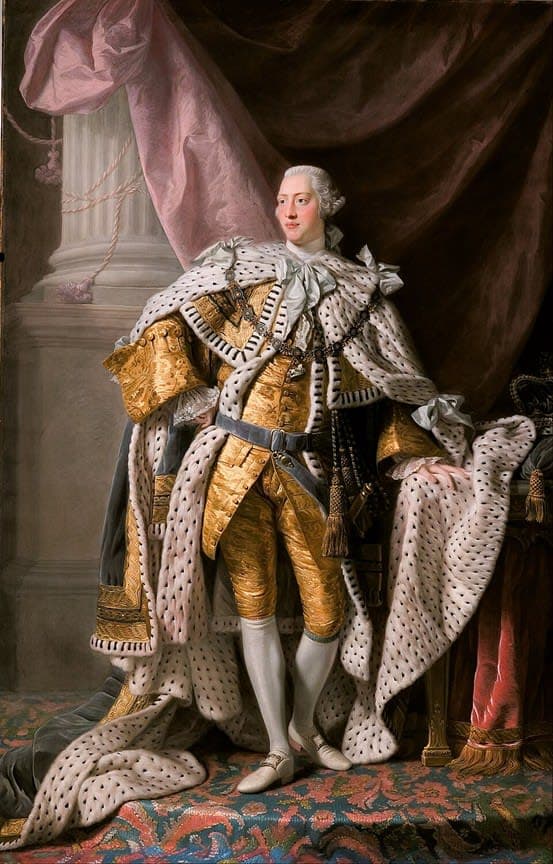

George III was born on 4 June 1738 at Norfolk House in London. He was the grandson of King George II and the eldest son of Frederick, Prince of Wales, who died when George was still young. George III was the first monarch of the Hanoverian dynasty to be born in Britain, and the first for whom English was a native language; he never visited Germany.
George was a healthy, shy child. He received a systematic education covering a wide range of subjects from mathematics and astronomy to history and agronomy. He was raised under the strict moral guidance of his mother and of Lord Bute, who would later become his prime minister. In youth he fell in love with Lady Sarah Lennox but renounced the match, feeling he was “born for the happiness or unhappiness of a great nation.”
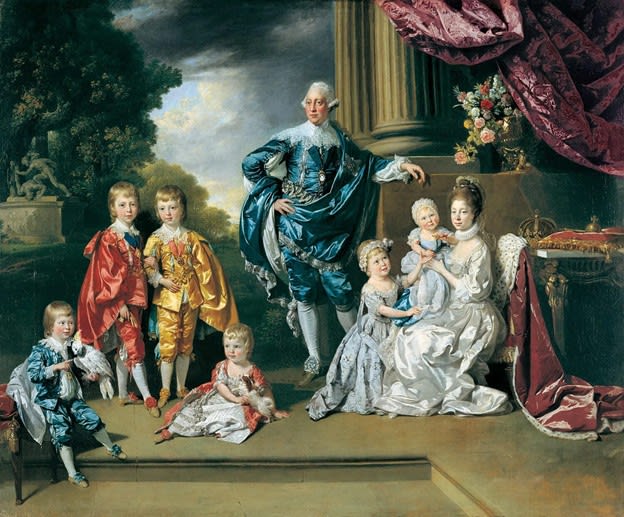
After George II’s death in 1760, the 22-year-old George III inherited the throne. A bride was chosen for him 17-year-old Princess Charlotte of Mecklenburg-Strelitz who was thought unlikely to interfere in politics. They were married on 8 September 1761, and their marriage proved happy. They had fifteen children. George III was the first monarch not to take a mistress.

Brought up in anti-Whig traditions, George III sought to break the power of the Whig party and to strengthen the crown. He appointed Lord North as prime minister, who became a pliant instrument in his hands.
The king’s and Lord North’s repressive policy toward the American colonists was popular in England until the American Revolution began. After the British defeat at Saratoga in 1777 and France’s entry into the war, public discontent surged. The king, however, refused to recognize the colonies’ independence, believing it would make him “a ghost in chains.”


In 1782 Lord North was forced to resign. The king fell under the power of the Whigs, but in 1783 he used personal threats to bring down the Fox–North coalition. The new prime minister was William Pitt the Younger, who enjoyed great popularity and helped the king restore the monarchy’s authority.

After the outbreak of the French Revolution in 1789, George III and his ministers joined the European coalition against France. The war was deeply unpopular in England and fueled public dissatisfaction.
In 1788 the king first showed signs of mental illness. As his condition worsened, a conflict arose over the regency between his wife Charlotte and his heir, the Prince of Wales.
In 1810, when his health sharply deteriorated, parliament passed the Regency Act and government passed to the Prince of Wales. The king went blind, suffered from rheumatism, and lived in seclusion at Windsor Castle for the rest of his days.
George III died on 29 January 1820 at the age of 81, after nearly sixty years on the throne. He was buried in St George’s Chapel at Windsor Castle.


