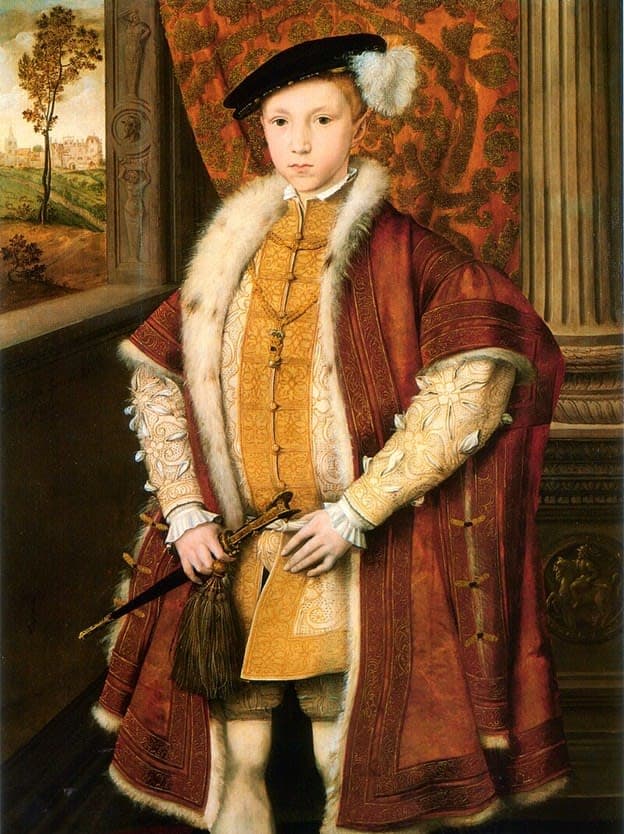

Prince Edward was born on 12 October 1537 at Hampton Court. He was the only legitimate son of King Henry VIII by his third wife, Jane Seymour. The birth of a male heir was a momentous event that was greeted with joy and relief across the realm. The king’s happiness was clouded by grief, however: Jane Seymour died just two weeks after the birth, probably from postpartum complications.

From birth Edward was a healthy, sturdy child. Contrary to the common belief, he was not sickly apart from the usual childhood illnesses. King Henry VIII adored his son calling him “the greatest jewel in the whole realm” and ensured exceptional safety and cleanliness at court.
At six, Edward began systematic instruction under tutors such as Richard Cox and John Cheke, with special emphasis on languages, philosophy, and the natural sciences. He spoke French, Spanish, and Italian with ease, and he was fond of mathematics and music. His stepmother, Catherine Parr, played a major role in his upbringing and shaped his religious outlook. Edward’s education was steeped in Protestantism, and he embraced Reformation ideas early. As soon as 1549 he wrote a tract in which he called the Pope the Antichrist evidence of his intense engagement with the religious controversies of the age.

On 28 January 1547 Henry VIII died, and the nine-year-old Edward VI became king. Under Henry’s will, a regency council of sixteen executors was to govern until Edward came of age. Seizing the moment, the king’s uncle, Edward Seymour, Earl of Hertford, quickly took sole control and was proclaimed Lord Protector of the Realm and Duke of Somerset.
In the early years Edward Seymour ruled autocratically, relying on a close circle of supporters. This bred resentment among other councillors, and in October 1549 he was overthrown; in 1552 he was executed. The young King Edward, deeply influenced by his tutors, recorded his uncle’s execution matter-of-factly in his diary.
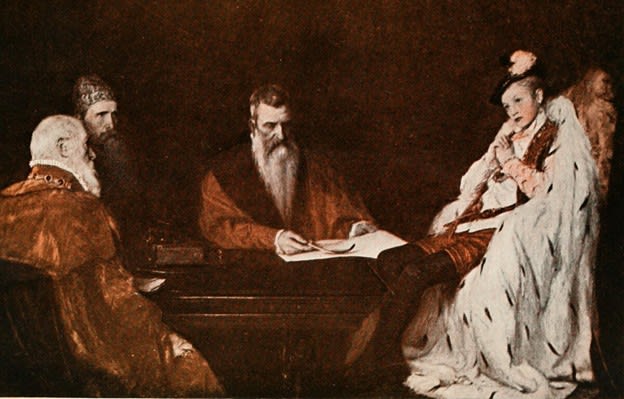

Edward VI’s reign was marked by the continuation of the Reformation. A convinced Protestant, he fully backed and deepened the ecclesiastical changes begun under his father. His court became a center of religious transformation, and his advisers most notably Thomas Cranmer sought to entrench Protestantism in England.
His reign, however, was brief. In January 1553 Edward fell ill. By summer his condition had sharply worsened: he was emaciated and short of breath. On 6 July 1553, at the age of fifteen, Edward VI died. The official cause was given as a disease of the lungs possibly tuberculosis or pneumonia.
Edward’s death ended the Tudor male line and triggered a succession crisis, for in his “device for the succession,” influenced by his counsellors, he excluded his sisters Mary and Elizabeth. This opened the way for Lady Jane Grey who was, however, deposed after just nine days.


