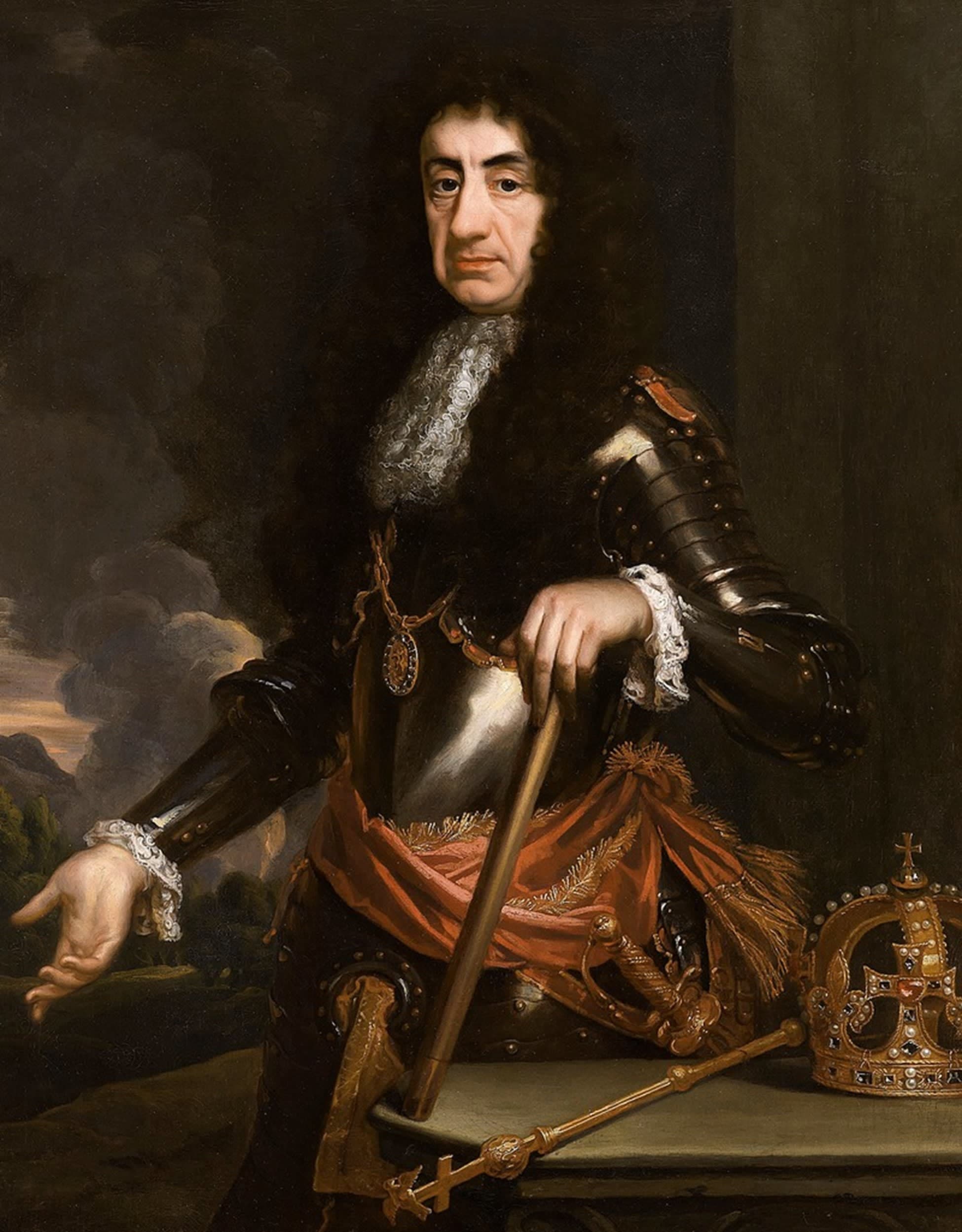

Charles II was born on 29 May 1630, the second son of King Charles I and the French princess Henrietta Maria. His childhood unfolded against the backdrop of the growing conflict between king and parliament. From the mid-1640s he lived in exile on the Continent with his mother and brothers.

After his father’s execution in 1649, Charles II was proclaimed King of Scotland. In 1650 he came to Scotland, but his forces were defeated by Oliver Cromwell’s army at the Battle of Worcester in 1651. A huge reward was set on Charles’s head, and he was forced to hide in England for several months before fleeing to France, where he spent many years in exile.
In 1660, after Cromwell’s death and the collapse of the republic, General George Monck orchestrated the Stuart Restoration. Charles II returned to England and took the throne on 29 May 1660. On the advice of his first minister, Edward Hyde, he proclaimed a general amnesty for all except those who had voted for his father’s execution. Ten regicides were executed, and the bodies of Cromwell and other republican leaders were exhumed and subjected to posthumous execution.
Charles II’s reign was a period of political and social change. Though known as “the Merry King,” famed for numerous mistresses and illegitimate children, he faced serious challenges.
In 1665 London was struck by a terrible plague that claimed more than 100,000 lives. Charles fled the city with his family but returned once the plague ebbed. In September 1666 came the Great Fire of London, which destroyed much of the capital. The king personally helped direct firefighting and relief for the homeless. Ironically, by burning the old timber houses the fire also killed the rats and fleas that spread the plague, helping end the epidemic.


Under Charles II two political parties took shape: Tories and Whigs. A major achievement was the passage in 1679 of the Habeas Corpus Act, protecting citizens from unlawful arrest.
The king’s foreign policy was complex and often contradictory. He fought several wars with the Dutch in an effort to undermine their economic supremacy. After the Second Anglo-Dutch War, England acquired New Netherland (the future New York), though at heavy cost.

In 1670 Charles II, sympathetic to Catholicism, concluded a secret treaty with the French king Louis XIV, promising reconciliation with Rome in exchange for annual payments. This provoked anger in England, and when in 1672 he joined France in war against Protestant Holland, public discontent only grew.
Charles II also pursued an active colonial policy. In 1670 the Hudson’s Bay Company was founded and granted a monopoly over the fur trade. Two years later the Royal African Company was established to conduct the slave trade.


Charles II was called “the Merry King” for his extravagant lifestyle and many love affairs. He acknowledged fathering fourteen illegitimate children, many of whom he ennobled. His lawful wife, the Portuguese princess Catherine of Braganza, was a Catholic and unpopular in England, and their marriage was childless.
In his later years Charles II spent more and more time in his alchemical laboratory, experimenting with mercury. This may have harmed his health: analysis of his hair in 1966 revealed mercury levels ten times the norm.
Charles II died of apoplexy on 6 February 1685. Shortly before his death he embraced Catholicism. He was buried in Westminster Abbey, and the throne passed to his unpopular Catholic younger brother, James II.


