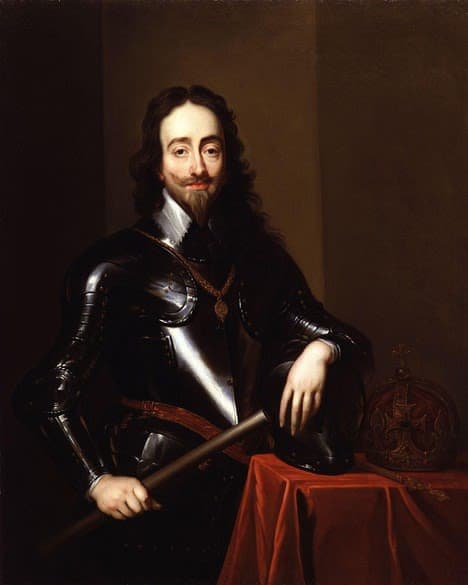
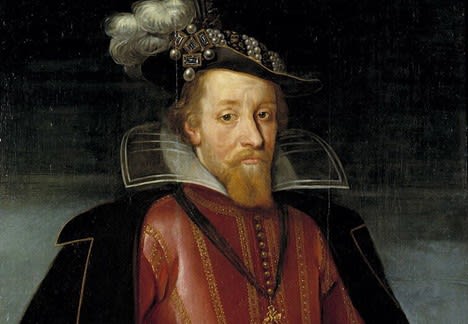
Charles I was born on 19 November 1600 in Scotland. He was the second son of King James VI and Anne of Denmark. As a child Charles was weak and sickly, and unlike his elder brother Henry the heir to the throne little was expected of him. In 1612, however, Henry died suddenly, and Charles became Prince of Wales, heir to the kingdoms of England and Scotland.
In 1623 Charles, together with his father’s favorite George Villiers, Duke of Buckingham, undertook a reckless journey to Madrid to negotiate a marriage with the Spanish Infanta. The talks failed, and on returning to England Charles and Buckingham advocated war with Spain. In 1624 an English corps was sent to the Low Countries to fight Spain. Negotiations soon began for Charles to marry Henrietta Maria of France.
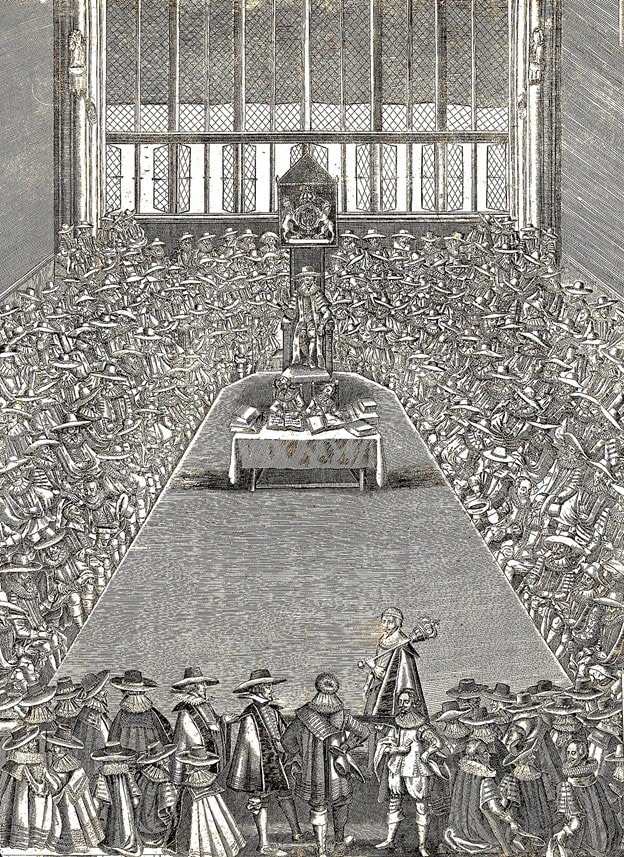
In 1625, after the death of James I, Charles I came to the throne. To finance war on the Continent he demanded subsidies from parliament. Parliament, however angered by illegal taxation and royal religious policy refused. Charles dissolved parliament twice, but lacking money was forced to summon it again and to approve the Petition of Right, which limited his power.


In 1628 the influential Duke of Buckingham was assassinated, after which Charles began to rule alone. For eleven years, from 1629 to 1640, he did without parliament, raising funds through illegal levies, fines, and monopolies. During this period Thomas Wentworth, Earl of Strafford, rose to prominence and devised the Thorough policy for imposing absolute royal power.

Like his father, Charles I sought to strengthen royal authority and to create a unified Anglican Church. He persecuted Puritans and introduced religious reforms that drew the Church of England closer to Catholicism, arousing deep resentment among Protestants.
Particular trouble arose in Scotland, where Charles poorly acquainted with local conditions pursued an aggressive religious policy. In 1637 he tried to introduce a new liturgy, provoking riots in Edinburgh and sparking a mass movement against episcopacy and the king’s authoritarianism.
In 1638 the Scots signed the National Covenant a manifesto condemning the king’s reforms and calling for the defense of religion. This marked the start of the Bishops’ Wars. Lacking funds to suppress the revolt, Charles was forced to summon the English parliament what became the Long Parliament.
Seizing on the king’s weakness, parliament annulled all illegal edicts, abolished ship money, and demanded that the Earl of Strafford be tried; he was later executed. The members also insisted on control of the army and on ministerial appointments, but Charles indignantly refused, declaring this would make him “a ghost, an empty shadow of a king.”

On 23 August 1642 Charles I raised the royal standard at Nottingham, beginning the Civil War. After several years of fierce fighting the royal army suffered a crushing defeat at the Battle of Naseby on 14 June 1645. Papers captured from the king revealed his secret dealings with Catholics and appeals for foreign aid, further undermining his authority.

In 1646 Charles I fled to the Scots’ camp, but was handed over to the English parliament and placed under arrest. In November 1647 he escaped to the Isle of Wight, only to be captured again. His repeated attempts to foment uprisings even from prison led parliament, under army pressure, to put him on trial.
In January 1649 Charles I appeared before a court that found him guilty of treason and tyranny. On 30 January 1649 he was beheaded on a scaffold before the Banqueting House at Whitehall. In his final speech he continued to defend the idea of absolute monarchy. The executioner raised his head but did not utter the traditional words declaring the victim a traitor, and the crowd was shocked. As a mark of respect his head was sewn back onto his body so that his family could bury him with dignity.
The execution of Charles I was an unprecedented event in English history and symbolized the end of the age of absolutism. After his death England was proclaimed a republic, known as the Commonwealth of England.


