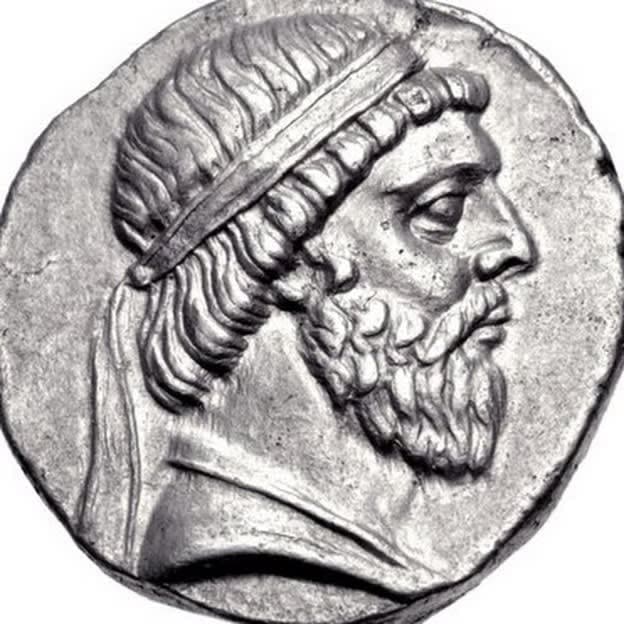

The story of Mithridates I’s ascent to the throne begins with an act of political wisdom rare for the ancient world. Around 171 BCE (the traditional dating, coinciding with the accession of Eucratides in Bactria), King Phraates I, as he lay dying, passed the diadem not to one of his many sons but to his brother Mithridates. Phraates understood that Parthia, surrounded by enemies, needed not a youthful heir but an experienced man of exceptional valor. This choice determined the fate of the East for centuries to come.
Mithridates’ accession coincided with a unique geopolitical moment. The two giants that had squeezed Parthia in a vise — the Seleucid state in the west and the Greco-Bactrian Kingdom in the east — began to weaken. Mithridates, having assumed the title, immediately set about implementing an ambitious plan to transform a small kingdom into a world empire.
The first blow was struck against Bactria, exhausted by internal strife. Parthian cataphracts invaded Aspionus (the region of Ariana) and Tapuria (east of the Tejen), detaching these wealthy areas.

The king’s ambitions may have extended much further. The historian Paulus Orosius, writing six centuries later, claimed that Mithridates reached India itself, subduing tribes between the rivers Hydaspes and Indus. Although modern historians treat this testimony with skepticism due to the lack of reliable evidence, the very existence of such a legend speaks to the scale of Mithridates’ personality in the eyes of posterity.
While Mithridates was strengthening the eastern borders, the old world in the west was collapsing. The Seleucid king Antiochus IV Epiphanes, trying to save the empire, vacillated between the Maccabean revolt in Palestine and the rebellious East. In 166–165 BCE he undertook a desperate campaign, crossed the Euphrates, captured the Armenian king Artaxias I, but became entangled in conflicts. His attempt to plunder the temples of Elymais and Persepolis met fierce resistance from the local population.
The death of Antiochus IV in 164 BCE at Gabai became the signal for complete disintegration. The eastern satrapies proclaimed independence one after another: Elymais under Kamnaskires had seceded even earlier. Media revolted under the leadership of the satrap Timarchus (from 161 BCE). Persis and Characene (at the mouth of the Tigris and Euphrates) became independent. Armenia split into Sophene and Greater Armenia.
Iran turned into a patchwork quilt of warring principalities. A force was needed to stitch these patches together. That force was the Parthians.
Between 161 and 155 BCE Mithridates began a difficult war for Media. Overcoming resistance (likely led by Timarchus), he annexed this key region and appointed a certain Bagasis as its governor. The road to the heart of civilization — Mesopotamia — was open.
In 141 BCE the central drama of the era unfolded. The Seleucid king Demetrius II Nicator, recognizing the threat, gathered a levy and marched to meet the Parthians. However, Mithridates’ military genius surpassed Greek strategy. The Parthian king outmaneuvered Demetrius, defeated his generals, and triumphantly entered Seleucia on the Tigris.
Cuneiform tablets (astronomical diaries) have preserved for us the exact dates of this triumph: July 8, 141 BCE — Mithridates was officially proclaimed king in Seleucia. October 141 BCE — his authority was recognized by ancient Uruk.
Mithridates I became lord of Babylonia, assuming the title “Great King.” The local population, exhausted by chaos, often welcomed him as a liberator and restorer of order.


At the end of 141 BCE, at the zenith of his glory, Mithridates was forced to leave Babylonia urgently. On the eastern frontiers, in Hyrcania, the Saka — nomads driven from Turkestan by the Yuezhi — had appeared. Leaving garrisons in the west, the king rushed to defend his native lands.
Demetrius II seized this moment. Supported by Bactria, Elymais, and Greek poleis, he launched a counteroffensive, winning a series of victories. It seemed that fortune had turned against the Parthians. But Mithridates, having dealt with the Saka, returned and delivered a decisive blow. Demetrius was captured (by force or by stratagem).
The Parthian king treated his captive with calculated sophistication. Demetrius was paraded through the streets of the cities that had supported him, as a lesson to rebels, and then sent into honorable exile in Hyrcania. There the Seleucid monarch lived in luxury and even married Mithridates’ daughter, Rhodogune, becoming a political puppet in the hands of the Great King.
Having secured his rear, Mithridates unleashed his wrath upon Elymais, which had aided Demetrius. This was not merely a punitive campaign but also a means of replenishing the treasury. The Parthians captured the cities of Susa and Seleucia on the Hedyphon, plundering the immensely wealthy temples of Athena and Artemis (the spoils amounted to a colossal 10,000 talents). Elymais was definitively incorporated into the empire, and the Parthians entrenched themselves in Susa.
The rock relief at Khong-e Ashdar (Izeh) immortalized this moment of triumph: a mounted king, blessed by the winged goddess of victory Nike, receives the submission of nobles. This is the first truly Parthian rock relief, symbolizing the new authority over ancient Iran.

Mithridates I died “in peace and tranquility” (as Justin writes) in 138 or 137 BCE. By the time of his death, Parthia had transformed from a regional principality into a world power stretching from the Euphrates to the Hindu Kush.
His reign became a point of cultural synthesis. On his coins, minted in Seleucia, he appears wearing a Hellenistic diadem, with the title “Philhellene” (lover of the Greeks), a gesture of reconciliation with his Greek subjects. On the reverse was depicted Heracles, identified with the Iranian god of victory Verethragna.
However, the essence of the state remained Iranian. Under Mithridates, Parthian (Pahlavi, written in Aramaic script) became the official language of the chancery, Zoroastrian cults were revived, including that of the god Mithra, whose name the king himself bore. He took control of the Great Silk Road, ensuring the prosperity of the empire, and permanently severed Greek Bactria from the West, condemning Hellenism in the East to gradual decline.
Mithridates I did not merely conquer lands; he also created the foundation upon which the Parthian Empire would stand for nearly four more centuries, rivaling Rome itself.


