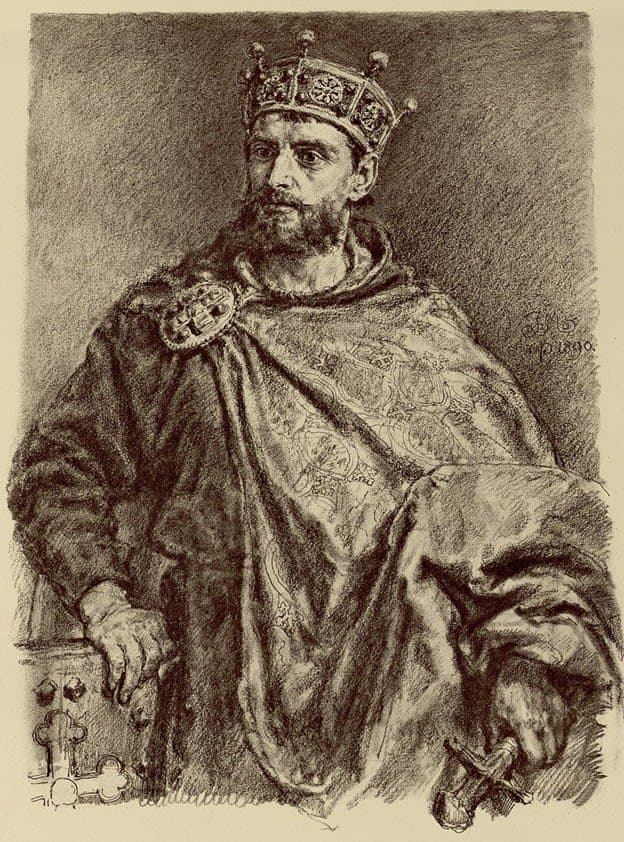

The era of Mieszko II Lambert became a period of severe trials for the young Polish state. While his father, Bolesław the Brave, had forged the country’s greatness through the sword and political cunning, his son inherited a difficult legacy: a kingdom at the height of its territorial expansion, yet simultaneously exhausted internally and isolated externally.
Mieszko II, born from the marriage of Bolesław and Emnilda, the daughter of a Lusatian prince, was crowned in Gniezno in 1025. Although he was not the eldest son, his accession to the throne appeared outwardly smooth. Beneath this calm surface, however, a storm was already brewing. His brothers, Bezprym and Otto, refused to accept their position and were driven into exile, eventually finding refuge at the court of the Kievan prince Yaroslav the Wise. This created a dangerous precedent for future foreign intervention.

Mieszko II began his reign amid a profound social and political crisis. The aggressive expansion pursued by his predecessor had turned nearly all of Poland’s neighbors against the kingdom. Seeking to continue his father’s policies and preserve Poland’s royal status, Mieszko encountered fierce opposition from the new Holy Roman Emperor, Conrad II.

Recognizing the danger posed by the ring of hostile powers surrounding Poland, Mieszko II attempted a diplomatic maneuver. In 1027, he made territorial concessions to Hungary, transferring lands in Slovakia to the Hungarian kingdom. Although painful, this step enabled him to establish a Polish-Hungarian alliance directed against the Empire.
At the same time, the king had to suppress internal revolts. In particular, he decisively crushed an uprising led by the Western Pomeranian prince Dietrich, while simultaneously accelerating the Christianization of Pomerania and Kuyavia in order to bind these territories more closely to the central government.
The Polish king’s activity did not go unanswered. In 1028, Mieszko II launched bold raids into Bohemia and Saxony in an effort to seize the strategic initiative. The response came quickly: in 1029, Emperor Conrad II invaded Silesia.
The real collapse, however, came in 1031, when the geopolitical situation changed dramatically. Hungary, Poland’s only significant ally, concluded a separate peace with the emperor, leaving Mieszko isolated against his enemies.
At this critical moment, the army of Yaroslav the Wise invaded Poland from the east. The Kievan prince was not merely waging a war of conquest; he presented himself as the defender of the rights of Bezprym, Mieszko’s exiled brother. Poland found itself trapped between the German hammer and the Kievan anvil.
Mieszko II attempted to rescue the situation by offering Conrad II the renunciation of all the territorial gains made by his father, including Lusatia and Moravia, hoping in return to secure imperial support against the Rus’ forces. Conrad, however, rejected these proposals. Abandoned by his allies, Mieszko was forced to flee to Bohemia.
Bezprym seized the throne and immediately recognized himself as a vassal of the emperor, effectively destroying the sovereignty for which two generations of the Piast dynasty had struggled.
Bezprym’s rule was short-lived and marked by extreme brutality, which quickly turned the Polish nobility against him. In 1032, Mieszko II, relying on the support of Bohemian forces, managed to return to the country and overthrow his brother, restoring his authority. However, this was no longer the powerful kingdom he had inherited in 1025.
The tragic culmination of his political ambitions came at the Merseburg assembly in 1033. In the presence of the imperial princes, Mieszko II was forced to accept humiliating conditions:
Official renunciation of the royal title: from that point onward, he was recognized only as a duke.
Territorial losses: Poland definitively abandoned its claims to Lusatia and Moravia.
Vassal dependence: the supremacy of the emperor over the Polish lands was confirmed.
Mieszko II’s life came to an abrupt end. On May 10 or 11, 1034, he died, leaving the country in ruins. Two principal versions of his death have survived. Polish chronicles tend to attribute it to natural causes, while Godfrey of Viterbo explicitly claims that Mieszko was murdered in a conspiracy organized by Polish feudal lords dissatisfied with both the strengthening of central authority and the king’s political failures.
The death of Mieszko II became the catalyst for a national catastrophe. The country descended into a period sometimes described as a “pagan reaction” or “pagan revival” — a large-scale popular uprising against Christianity and feudal oppression. Chaos, disorder, and the collapse of state institutions placed the very existence of Poland in question.
Mieszko II Lambert remained in history as a tragic figure: a ruler who possessed ability and determination, yet was unable to overcome the momentum of a crisis rooted in the very foundations of the state created by his great father.
He was buried in Poznań Cathedral, a place that became a silent witness to both the greatness and the decline of the earliest Piast rulers.



