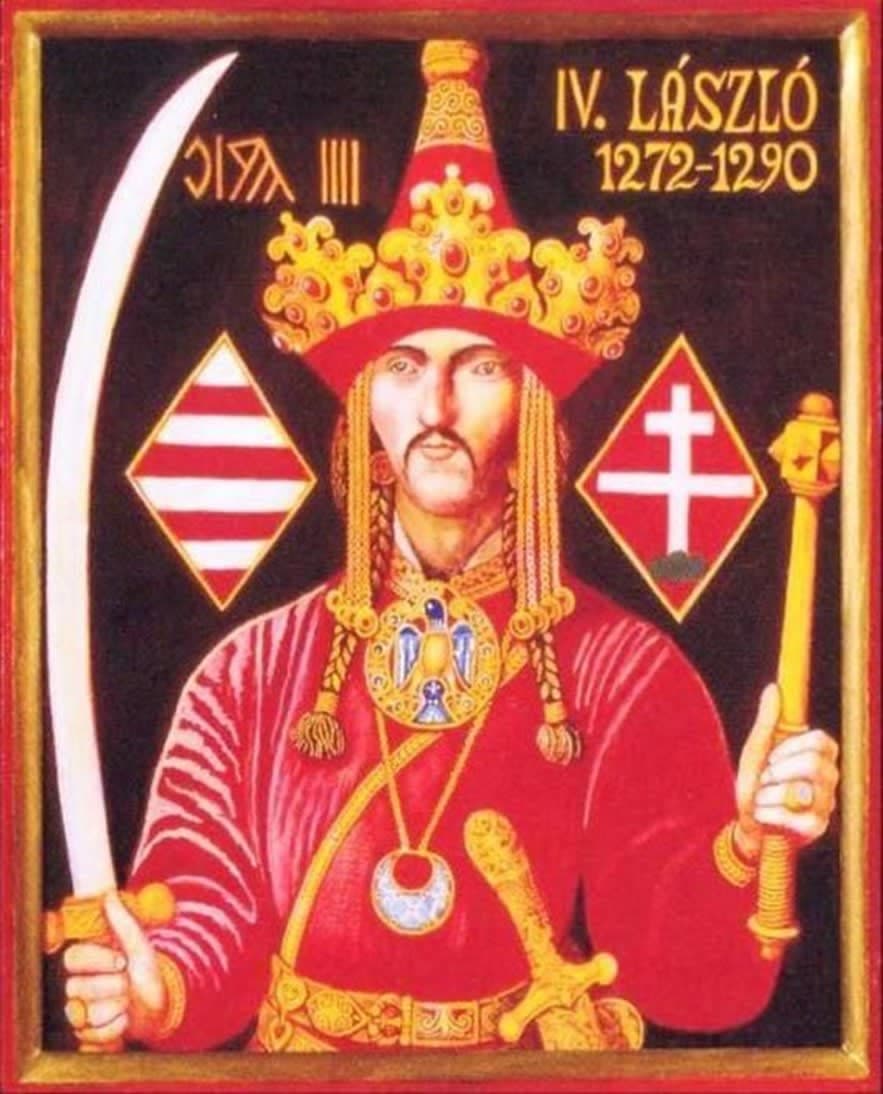

Prince Ladislaus spent his childhood in the shadow of a brutal and exhausting civil war.
The kingdom had effectively split into two parts because of the ambitions of his father, the "Junior King" Stephen V, who was engaged in an uncompromising struggle for power against his own father — Ladislaus's grandfather, King Béla IV of Hungary.
The entire Hungarian nobility had been drawn into this conflict.

In 1264, his grandfather delivered a merciless blow: the troops of Béla IV captured the young Ladislaus and his mother Elizabeth (Erzsébet the Cuman, daughter of a Cuman khan) at Sárospatak Castle.
The child and his mother became bargaining chips, effectively held hostage by Ladislaus's own grandfather.
However, this did not stop Stephen V.
In March 1265, the "Junior King," relying on the powerful feudal Csák clan, decisively defeated the army of Béla IV, commanded by Béla Rostislavich, ruler of Macsó.

This resounding victory forced the warring parties to sit down at the negotiating table on Rabbit Island, later renamed Margaret Island in honor of Béla IV's daughter.
The division of the kingdom along the Danube was formally established by law.
The king was forced to return Stephen's wife and young heir, but the peace remained fragile.
Seeking to strengthen his position on the European political stage, Stephen V arranged the marriage of his eight-year-old son Ladislaus in 1270 to a girl of the same age — Isabella of Anjou, known in Hungary as Elizabeth, daughter of the powerful Charles I of Sicily.

On May 3 of that same year, 1270, the aging King Béla IV died.
Stephen V finally became the sovereign ruler of Hungary, while young Ladislaus became first in line to the throne.
But fate was preparing another blow.
Stephen's reign proved short-lived.
On June 24, 1272, the powerful and treacherous feudal lord Joachim Gutkeled abducted Prince Ladislaus and took him to the impregnable fortress of Kapronca (Koprivnica).
Enraged, Stephen V immediately pursued the kidnapper and laid siege to the stronghold, but his heart could not withstand the strain.
On August 6, 1272, the king died suddenly — according to contemporary accounts, from a devastating nervous shock caused by Gutkeled's betrayal.
The king's death set the machinery of uncontrollable chaos in motion.
Events unfolded with terrifying speed.
The kidnapper Joachim Gutkeled, accompanied by his ten-year-old captive Ladislaus, hurried to Székesfehérvár, the traditional coronation site of Hungarian monarchs.
The widowed queen mother, Elizabeth the Cuman, had already arrived there.
This strange coincidence has forever left historians with a troubling suspicion: could the Cuman princess have been secretly conspiring with her own son's kidnapper?

Their objective was the immediate coronation of the ten-year-old boy.
However, the faction loyal to the late Béla IV had no intention of surrendering without a fight.
They put forward their own candidate — the twenty-year-old Prince Béla of Macsó.
This young man belonged to the Rurikid dynasty. His father was Rostislav, son of the Grand Prince of Kiev, Mikhail Vsevolodovich the Saint, who had fled to Hungary during the Mongol invasion, while his mother was a daughter of King Béla IV.
Béla Rostislavich's supporters even launched a daring armed attack against the residence of the widowed Queen Elizabeth.
However, their assault was repelled by a detachment commanded by the loyal magnate Nicholas Pok.
On September 3, 1272, the heavy Crown of Saint Stephen was placed upon the head of the ten-year-old Ladislaus IV.
But the celebrations descended into bloodshed.
In November of that same year, during the festivities, Prince Henry I Kőszegi (Németújvári), nicknamed "the Great," who had returned from exile, burst into the royal chambers and accused the rival claimant, Béla of Macsó, of treason.
Before the eyes of the court, he hacked the twenty-year-old Rurikid prince to pieces with his sword so brutally that the murdered man's sister, the nun Margaret, had to gather her brother's remains piece by piece.
With this horrifying death, the supporters of Béla IV disappeared from the historical stage forever.

Yet peace did not return to Hungary.
The kingdom descended into the depths of feudal anarchy, with the young king reduced to a mere puppet.
A colossal struggle unfolded between two coalitions.
On one side stood the alliance of the Kőszegi and Gutkeled families; on the other stood the powerful Csák clan.
The Csáks remained loyal to the memory of Stephen V, while the Gutkeleds held the widowed Queen Elizabeth firmly within their "iron embrace."
Only in 1274 did Elizabeth the Cuman manage to escape the control of the domineering Joachim Gutkeled, who, according to rumors, had been not only her political ally but also an increasingly unwelcome lover.
In retaliation, the furious Joachim abducted the young King Ladislaus once again.
Then something extraordinary happened.
The king was rescued by the kidnappers' longtime enemy, the ambitious and determined magnate Peter I Csák.
A conservative "Old Hungarian," Peter Csák despised both the "Swabian" Gutkeleds and the Cumans equally.
Nevertheless, for the sake of power, he agreed to ally himself with the latter.
The balance of forces changed dramatically: the Csáks and Cumans united against the alliance of the Gutkeleds and Kőszegis.
That same year, 1274, Henry Kőszegi (Güssing) replaced Matthew II Csák as Ban of Slavonia.
In response, Peter Csák mobilized his troops and inflicted a crushing defeat upon the combined Gutkeled-Kőszegi army.
The surviving rebels decided that requesting peace from the queen was their wisest option.
The resourceful Joachim Gutkeled once again managed to obtain Elizabeth's forgiveness.

The turning point came in April 1277.
The restless Joachim Gutkeled met his death in battle against the Croatian Babonić magnates, who had rebelled against Elizabeth in Slavonia.
His considerable inheritance immediately sparked another war, this time between the Babonić family and the Kőszegi princes.
The queen mother, Elizabeth, brilliantly exploited this conflict.
She convened a major national assembly on the Rákos Field near Buda, attended by representatives of every estate and region of the kingdom.
The assembly adopted an unprecedented decision: contrary to established tradition, the fifteen-year-old Ladislaus was declared to have reached adulthood.
The people, exhausted by years of bloodshed, unanimously gave the young monarch their blessing to restore the "common good."
Feeling the support of the country behind him, Ladislaus demonstrated extraordinary determination.
He began ruthlessly suppressing the lawlessness of the feudal lords.
Although he failed to capture the impregnable Kőszeg Castle, by the summer of 1278 he had succeeded, at least nominally, in uniting Hungary under his authority.
Recognizing the danger, the Kőszegi clan hastily reconciled with the Babonić family, dividing territories along the Sava River, and attempted to make another political move.
They proclaimed a rival king — Duke Andrew, who was living in Venice and would later become King Andrew III.
But Ladislaus unexpectedly received assistance from the wider currents of European politics.
Hungary concluded an alliance with the German king Rudolf I of Habsburg against the ambitious Bohemian king Ottokar.
On August 26, 1278, the combined Hungarian-German army confronted the Bohemians in the historic Battle on the Marchfeld.
Ottokar's army was utterly crushed, and the Bohemian king himself fell in battle.
This tremendous victory elevated the prestige of Ladislaus IV to extraordinary heights.
The frightened Kőszegi magnates came crawling back to swear loyalty to him, while the unsuccessful rival king Andrew was hastily sent back to the Venetian lagoons.
This was the pinnacle of the Hungarian monarch's glory.


However, catastrophe soon followed.
It began in early 1279, when Philip, Bishop of Fermo and plenipotentiary legate of Pope Nicholas III, arrived in Hungary.
Officially, he had come to "strengthen the king's position," but the real reason for his visit was a series of denunciations submitted by the magnates.
The king was accused of having abandoned Christ, surrounded himself with pagans, and adopted the customs of his Cuman ancestors.

Having convened a national assembly in Buda, Philip delivered an angry speech proclaiming the supremacy of the pope and dictated the harsh "Cuman Laws."
From that moment onward, the Cumans were required to accept Christian baptism, abandon their nomadic way of life, dismantle their tents, and settle in strictly designated territories.
Cornered by diplomatic pressure, Ladislaus was forced to sign these laws.
However, he deliberately obstructed their implementation, fully understanding that the people of the steppes would never tolerate such restrictions.
Seeing the king's disobedience, the papal legate Philip resorted to an extreme measure in October 1279.
He imposed an interdict, prohibiting the administration of church sacraments, upon Ladislaus himself and the entire Kingdom of Hungary.
The enraged monarch responded with an almost unimaginable act: he ordered the papal legate to be seized and handed him over to the Cumans.
In retaliation, the Transylvanian voivode Finta Aba treacherously captured the king himself.
Humiliating negotiations followed.
Both the legate and the king eventually regained their freedom, but Philip achieved his objective: Ladislaus was forced to publicly demand that the Cumans abandon their nomadic lifestyle and settle permanently.
As the king had predicted, the reaction was terrible.
The Cumans launched a massive uprising, devastating the eastern regions of the kingdom with fire and sword.
Having destroyed everything Ladislaus had struggled so hard to build, and having transformed the throne's principal supporters into its bitterest enemies, the legate Philip coldly departed from the burning country.
The king's heart was broken, but duty demanded action.
Ladislaus marched against his own kinsmen and defeated the Cuman army at Slankamen in Serbia.
Meanwhile, Finta Aba had usurped power in Buda.
To overthrow him, the king was forced to take a humiliating step — reconcile with his longtime enemies, the Kőszegi clan.
In 1281, he appointed Ivan Kőszegi as Palatine of the kingdom.
Finta was defeated, and in 1282, in Csongrád County, Ladislaus inflicted a final defeat upon the Cumans.
Following this battle, some of the Cumans permanently abandoned Hungary and migrated to the Balkans.

Victory on the battlefield marked the king's moral collapse.
Ladislaus came to believe that his kingdom was already dead and that the greed of the magnates could never be overcome.
Disillusioned with European politics, his Christian allies, and the very idea of royal authority, Ladislaus took an unprecedented step.
He abandoned the capital, turned his back on his lawful wife, and withdrew permanently into the steppes to live among the subdued Cumans.
He dressed in Cuman clothing and completely adopted their language and customs.
Only in the tents of the nomads, surrounded by his beloved Cuman concubines — Edua, Köpchech, and Mandula — did he feel at home.
The affairs of state were abandoned.
The king lived solely for his personal pleasures and emotions, attempting to forget the ruins of his kingdom.
The consequences of weakened royal authority became apparent in February 1285.
The Golden Horde launched a devastating attack.
Mongol tümens under the command of the military leader Nogai and Khan Töde Möngke's successor, Tulabuga, invaded eastern Hungary, advancing as far as Pest.
Although Pest was miraculously defended, the country was left devastated.
The king's authority had collapsed so completely that the grief-stricken population readily believed a horrifying rumor: that Ladislaus himself had invited the Tatars to invade his homeland.

The kingdom was visibly disintegrating.
In the northwest, counties were seized by Albert I, son of Rudolf of Habsburg.
The king's mind seemed clouded by despair.
In 1286, he threw his wife, Elizabeth of Anjou, into prison.
In 1287, he committed an unprecedented act of sacrilege: he abducted his own sister Elizabeth from a monastery and forcibly married her to the Bohemian magnate Záviš of Falkenstein.
The Church's patience finally ran out.
Lodomer, Archbishop of Esztergom, once again excommunicated Ladislaus.
Pope Nicholas IV began seriously preparing a Crusade against Hungary, planning to install Ladislaus's nephew, Charles Martel of Anjou, upon the throne.
In the summer of 1289, during a moment of apparent clarity, Ladislaus attempted to remedy the situation.
He reconciled with his wife and begged forgiveness from the archbishop.
But the call of the steppes proved stronger.
Realizing that the royal crown had become nothing more than an empty title, he once again fled to the Cuman encampments.

The final chapter of Ladislaus IV the Cuman's life was as tragic as it was symbolic.
The king, who had sacrificed his kingdom, his faith, and his reputation for his love of the Cuman people, met his death at their hands.
On the summer night of July 10, 1290, while the king was sleeping in his tent, three noble Cumans — Arboc, Törtel, and Kemence — burst inside, accompanied by armed men.
They mercilessly hacked the sleeping monarch to death.
What motivated the assassins?
Historians continue to debate this question.
Perhaps the murder was a belated and brutal act of revenge for the king's signing of the "Cuman Laws" and for the blood of the steppe warriors shed during the suppression of their uprising.
Or perhaps Arboc and his accomplices were merely hired killers, whose blades had been generously paid for by the magnate Kopasz Borsa of Bihar, who wished to rid himself permanently of the troublesome king.
Thus, at the age of only twenty-eight, the life of Ladislaus the Cuman came to an end.


