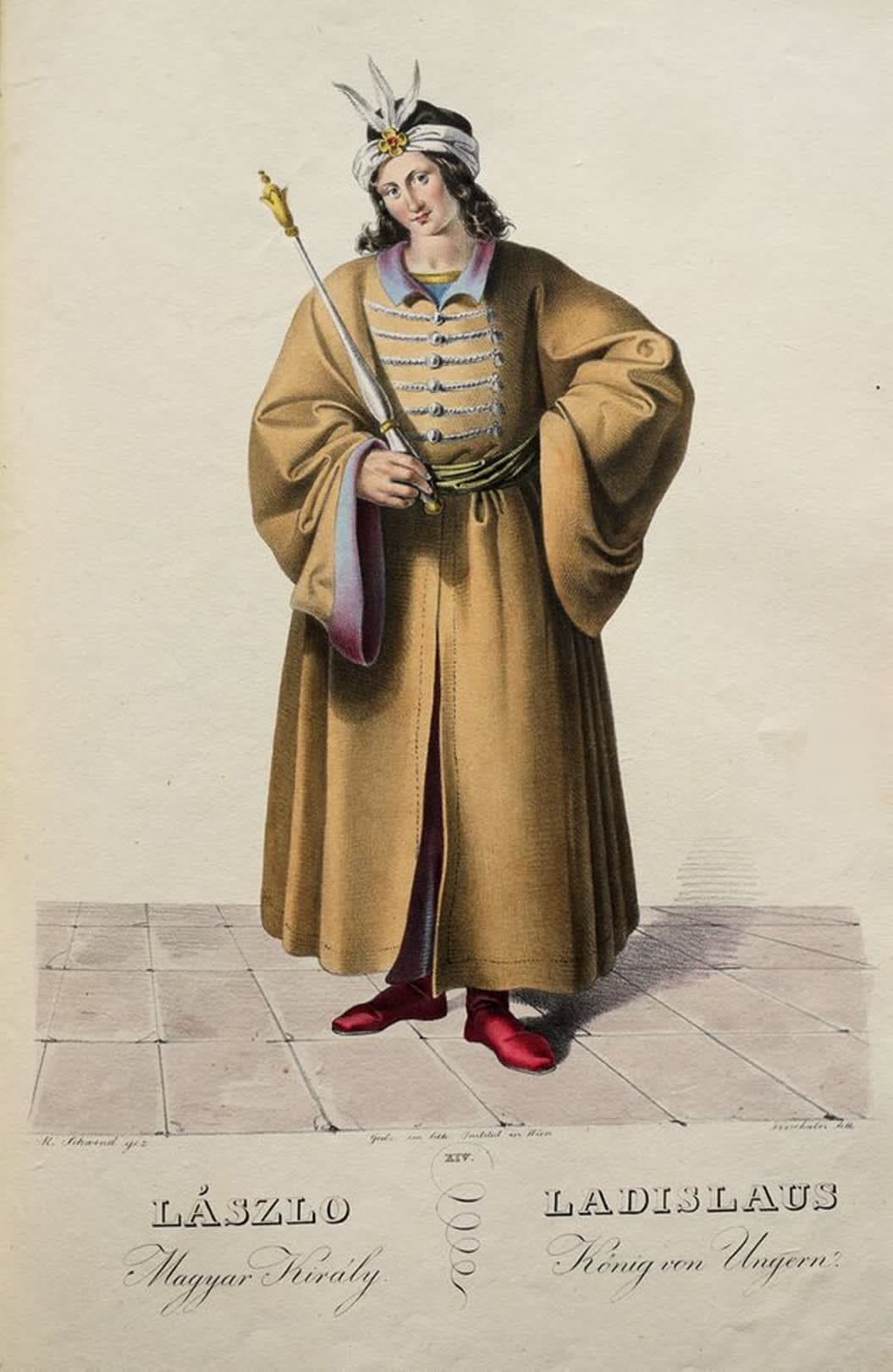

The life of Prince Ladislaus, the second son of King Béla II the Blind of Hungary and his wife Helena Vukanović (daughter of the powerful Grand Župan of Raška, Uroš I), was inseparably connected with the brutal and uncompromising struggle for power from his earliest days.
While still a helpless infant, he found himself at the very center of a bloody political drama.
Queen Helena, a woman of iron will, presented little Ladislaus and his elder brother Géza before an assembly of barons convened in Arad.
Using her children as living reminders of their royal blood and the suffering their family had endured, she persuaded the aristocracy to mercilessly execute all the opponents who had persecuted her blind husband since his earliest childhood.
This brutal massacre became the tragic prelude to the young prince's destiny.

Shortly after the Hungarian crown conquered Bosnia, Ladislaus's father decided to secure the future of his second son.
In 1137, the young Ladislaus was solemnly granted the prestigious title of Duke of this newly acquired province.
However, the child possessed no real authority. All administrative power in Bosnia remained in the hands of a special governor appointed directly by the king.
On February 13, 1141, King Béla II died, and the Hungarian throne naturally passed to Ladislaus's elder brother, Géza II.
Initially, relations between the brothers remained stable.
Seeking to provide his relatives with positions worthy of their royal status, King Géza even established two separate, wealthy ducal domains in 1152: one for Ladislaus and the other for their younger brother Stephen.
However, this prosperity proved fragile.
The main source of conflict emerged when Géza II made the firm decision to pass the throne to his own son, the future Stephen III, bypassing his brothers.
This intention directly contradicted the ambitions of the dukes, and their relations with the king deteriorated rapidly.

The younger brother was the first to launch an open rebellion.
In 1156, Duke Stephen, with the active support of their maternal uncle, the influential Ban Beloš, attempted to organize a conspiracy against the king.
Géza II acted preemptively, decisively crushing the conspirators.
Duke Stephen was forced to seek safety in exile, finding refuge at the magnificent court of Byzantine Emperor Manuel I Komnenos.
Ladislaus witnessed the failure of this rebellion, but ambition eventually overcame his caution as well.
In 1160, he himself attempted to organize a conspiracy against his royal brother.
After suffering a predictable failure, he followed Stephen's example and fled to Constantinople.
Miniature portrait of Manuel I Komnenos.

However, the brothers' paths diverged during their exile.
At the imperial court in Constantinople, Ladislaus demonstrated a stubborn and proud character.
In complete contrast to his younger brother, who willingly played by Byzantine rules, Ladislaus categorically refused to submit fully to the will of Manuel I Komnenos.
He also firmly rejected the proposed political marriage to the emperor's niece.
The decisive turning point in the exile's life came when King Géza II died on May 31, 1162, and his son Stephen III was hastily crowned.
Emperor Manuel Komnenos, who had long awaited an opportunity to intervene in the affairs of the neighboring kingdom, recognized his chance.
He decided to launch a major military campaign against Hungary to forcibly install his loyal candidate on the throne — Duke Stephen, the husband of his niece.

Faced with the Byzantine invasion, the Hungarian barons resorted to a sophisticated diplomatic maneuver.
They dispatched an authorized embassy directly to the emperor's military camp.
The barons proposed a compromise: abandon the candidacy of the pro-Byzantine Stephen, but transfer the crown to Ladislaus instead.
They justified their choice by invoking ancient Hungarian traditions, particularly the principle of seniority, which strictly required that a deceased ruler be succeeded not by his son but by the eldest surviving male member of the royal dynasty.
At that moment, Ladislaus was precisely that man.
The pragmatic emperor, considering this arrangement acceptable for preserving his influence, agreed to the barons' proposal and sent Ladislaus to Hungary to claim the crown.
By the time Ladislaus triumphantly arrived in Székesfehérvár, his young nephew, the legitimate King Stephen III, had been unable to withstand the pressure and had fled to Bratislava.
Ladislaus was immediately proclaimed the new monarch.
However, the Church stood in the way of his full legitimacy.
Lucas, the principled and uncompromising Archbishop of Esztergom, who had remained unwaveringly loyal to the young exiled king, categorically refused to place the crown upon the usurper's head.
Forced to circumvent the ancient rules, Ladislaus had to seek another senior church official.
In July 1162, he was crowned by Mikó, Archbishop of Kalocsa.
Attempting to strengthen his authority and reward his younger brother for his support, Ladislaus granted Stephen the right to govern one-third of the Kingdom of Hungary — the Tercia Pars Regni — on the occasion of his coronation.
Despite the coronation, the religious conflict continued to intensify.
Archbishop Lucas still openly denied the legitimacy of Ladislaus's reign and took an extreme step: he formally excommunicated the newly crowned king from the Church.
Enraged, the monarch responded with repression, ordering the rebellious archbishop to be imprisoned.
Only intervention at the highest level succeeded in easing the crisis.
On December 25, 1162, obeying a direct demand from Pope Alexander III, Ladislaus was forced to release Lucas from captivity.
However, the stubborn prelate remained faithful to his principles and categorically refused to absolve the king of his sins.

The reign of Ladislaus II proved as brief as it was controversial.
He soon died suddenly. Many contemporaries and later historians believed, with some justification, that his death had been caused by poisoning.
He was buried in Székesfehérvár, the traditional burial place of the Hungarian monarchs.
Yet history delivered its own harsh judgment upon him.
During the Middle Ages, Ladislaus was never fully recognized as a legitimate king and was permanently branded a usurper.
This gave rise to a remarkable historical confusion.
When another legitimate monarch bearing the same name, Ladislaus III, ascended the throne in the thirteenth century, his contemporaries officially referred to him as Ladislaus II, as though they had completely erased the central figure of these turbulent events from the official history of the Kingdom of Hungary.


