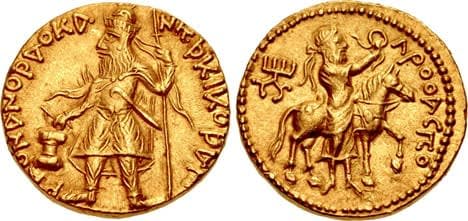
By origin, Kanishka belonged to the nomadic Yuezhi people, and his native language was most likely Tocharian. However, the origins of his personal authority long remained the subject of heated debate among historians, giving rise to two principal theories. The first held that Kanishka came from Khotan and rose to power as an ethnic ally of the Kushans during a period of turmoil that followed the reign of King Vima. The second interpretation was based on Tibetan traditions describing a Khotanese military campaign into India around 120 CE, led by King Vijayakirti in alliance with a certain King Kanika and King Guzana.
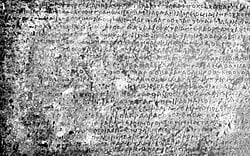
True clarity regarding his genealogy, however, came with the discovery of the monumental Rabatak Inscription. It not only refuted many earlier assumptions but also established a clear dynastic succession. In the inscription, Kanishka honors his illustrious ancestors: his great-grandfather Kujula Kadphises, his grandfather Vima Takto, his father Vima Kadphises, and finally himself. Thus, Kanishka I emerged as the direct and legitimate heir to the throne of the Kushan Empire.

Having inherited the throne, Kanishka expanded the borders of his realm to extraordinary proportions. In the northwest, his empire included the lands of southern Uzbekistan and Tajikistan, extending north of the Amu Darya, the ancient Oxus, while in the southeast it reached northern India and Mathura. According to the Rabatak Inscription, important cities such as Pataliputra and Sri-Champa were under Kushan rule. The conquest of Pataliputra is also supported by the Buddhist text Sridharmapitaka-nidana-sutra, which survives in a Chinese translation dating to 472 CE. Kashmir likewise became an integral part of the empire. Near the Baramulla Pass, the king founded a city named in his honor—Kanishkapura, modern Kanispora—whose ruins, including the foundation of a great stupa, have survived to the present day.
Kanishka’s ambitions, however, extended far beyond the Indian subcontinent, reaching deep into the rugged lands of Central Asia. The Chinese chronicle Hou Hanshu preserves the memory of a confrontation between two great powers: in 90 CE, near Khotan, the Chinese general Ban Chao faced a 70,000-strong Kushan army commanded by a governor named Xie (謝). By employing a scorched-earth strategy, Ban Chao forced the Kushans to retreat. At that time, Kashgar, Khotan, and Yarkand, located in the Tarim Basin of present-day Xinjiang, were dependent on China. Nevertheless, the abundance of Kanishka’s coins discovered in the Tarim Basin demonstrates deep Kushan penetration into the region. Moreover, according to a Chinese translation of the lost Sanskrit work History of the Successors of the Buddha, Kanishka also fought successful wars in the west and managed to repel a major invasion by the powerful Parthian Empire. Evidence of his authority in the north is further provided by an inscription bearing Kanishka’s symbols carved into the Sacred Rock of Hunza.
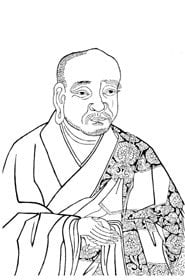
Despite the breadth of his religious outlook and his attachment to Persian traditions, Buddhism played an exceptionally important role in Kanishka’s life. Although some texts claim that he never formally converted to the religion, his personal devotion to the teachings of the Buddha was immense. In Buddhist tradition, Kanishka is portrayed as a figure of extraordinary importance.
In his youth, he was reputed to have been an aggressive, cruel, and uncompromising king. One sutra compares him with a harsh ruler of Pahlava, referred to as the kingdom of Ngan-si. A legend preserved in the Sridharmapitaka-nidana-sutra recounts that a Buddhist arhat, wishing to save the ruler’s soul, once used supernatural powers to show him the torments of hell. Horrified by what he saw, Kanishka bitterly repented and wept, cleansing his mind and thereafter becoming a generous and virtuous ruler.
Having become a great patron of the faith, Kanishka initiated the Fourth Buddhist Council in Kashmir under the leadership of the eminent thinkers Vasumitra and Ashvaghosha, the latter of whom became the king’s personal spiritual adviser in his old age. It was during this period that the canonical image of the Buddha, based on the thirty-two sacred physical characteristics, took shape. The ruler actively financed both the Mathura school of art and the Gandhara school, the latter of which produced the distinctive tradition of Greco-Buddhist art.
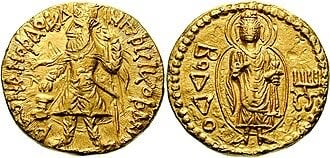
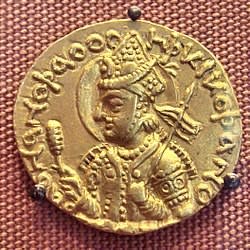
Buddhist imagery also appeared on royal coinage, although such coins represented less than one percent of the total issue. These gold dinars, weighing approximately eight grams and comparable in weight to the Roman aureus, as well as quarter-dinars of around two grams, comparable to the obol, were highly distinctive.
Unlike other deities, who were normally depicted in profile, the Buddha was always shown frontally, suggesting that the images were copied from statues. Three principal types of such coins can be distinguished. The first depicts the Buddha with the inscription ΒΟΔΔΟ. Because of the small size of the coins, his features were exaggerated: enormous ears, a moustache, a massive ushnisha or topknot, the chakra symbol on the palm, and the urna on the forehead. His body was covered by a heavy Gandharan monastic robe consisting of the antaravasaka, uttarasanga, and sanghati. A unique piece of jewelry is known in which such a gold coin of Kanishka is mounted inside a ring of heart-shaped rubies.
The second type consists of copper coins depicting Shakyamuni Buddha (ϷΑΚΑΜΑΝΟ ΒΟΔΔΟ), dressed in thin, almost transparent garments, with one hand raised in the gesture of fearlessness, or abhaya mudra. The third type consists of copper coins depicting the Bodhisattva Maitreya (ΜΕΤΡΑΓΟ ΒΟΔΔΟ), seated on a throne with columns. He holds a water vessel in his hands, while bracelets resembling those of an Indian prince adorn his forearms.
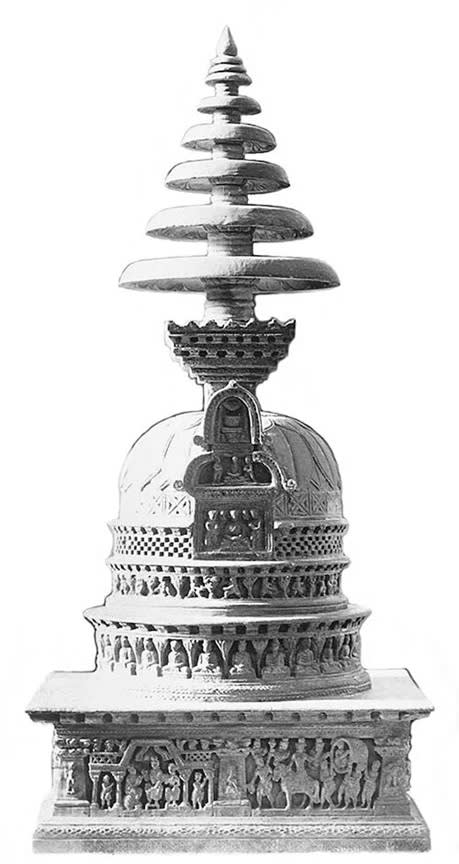
Ancient prophecies claimed that Kanishka’s appearance had been predestined. Both the Vinaya Sutra and ancient Khotanese manuscripts from Dunhuang tell how the Buddha foretold the coming of a great king four hundred years after his death. According to legend, four guardians of the world once assumed the appearance of small boys and began constructing a stupa from clay in order to remind Kanishka of his great destiny.
The famous Chinese pilgrim Xuanzang, who visited India around 630 CE, recorded another tradition according to which Kanishka, while hunting, pursued a white hare that mysteriously vanished into the air at the very place where the king was destined to build a magnificent temple.
And Kanishka did build it. His greatest architectural triumph was the colossal stupa at Purushapura, modern Peshawar. According to Xuanzang, the jewel-decorated tower rose approximately 180–210 meters into the sky, or 600–700 Chinese feet. Archaeologists who excavated its foundations in 1908–1909 confirmed the extraordinary scale of the structure: the foundation measured approximately 87 meters in diameter.
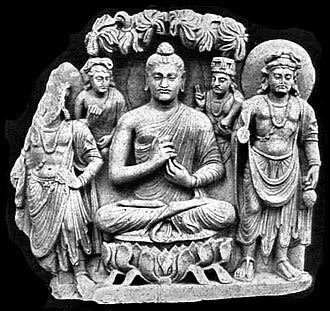
The architectural and sculptural flourishing of Kanishka’s era is well documented. Statues of bodhisattvas and the Buddha carried precise dates calculated either from the Yavana era, which began sometime between 186 and 175 BCE, or from the regnal years of the emperor. Examples include the Bodhisattva from Kaushambi, dated to the “Second Year of Kanishka”; the Bala Bodhisattva from Sarnath, dated to the “Third Year”; the famous “Kimbell Seated Buddha,” dated to 131 CE and the “Fourth Year of Kanishka”; the Buddhist triad from Sahr-i-Bahlol in Gandhara, dated to approximately 132 CE; the statue of a naga between naginis, dated to 135 CE and the “Eighth Year”; and the Buddha from Loriyan Tangai, tentatively dated to 143 CE and the “318th Year” of the Yavana era.
It was during the reign of Kanishka, and to a large extent thanks to his patronage, that Buddhism began its triumphant spread along the Silk Road into China and northern Asia. Monks from Gandhara played a crucial role in this process. By approximately 178 CE, the distinguished Kushan monk Lokakshema had arrived in the Chinese capital of Luoyang, where he established a translation bureau and became the first translator of Mahayana Buddhist scriptures into Chinese.
Through his kindness, righteousness, heightened sense of equality, and modesty—which, according to tradition, replaced the cruelty of his youth—Kanishka earned profound respect among the many peoples of his diverse empire. His great achievements made his name truly immortal. Although the circumstances and exact date of the transfer of power to his successor Huvishka remain obscured by the passage of time, Kanishka I has remained in history as an unparalleled embodiment of the ideal of the “King of Kings.”


