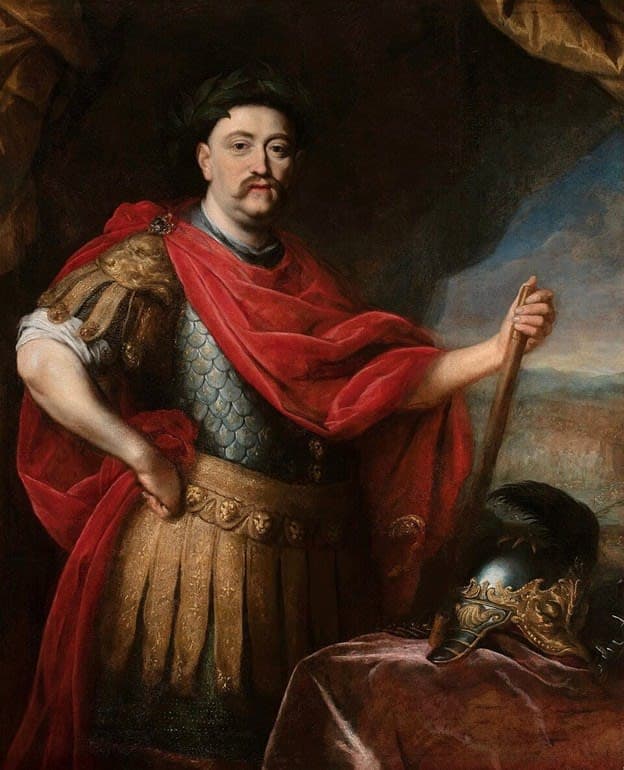

John was born into a family whose political influence and wealth had been acquired through hard work and a fortunate marriage alliance. His father, Jakub Sobieski, rose to the position of Castellan of Kraków thanks to his marriage to Zofia Teofila Daniłowicz, the granddaughter of the legendary hetman Stanisław Żółkiewski.

After receiving a comprehensive education at the Nowodworski College and the Jagiellonian Academy in Kraków, John embarked on a two-year journey across Western Europe with his brother Marek. He became one of the most educated monarchs of his century: fluent in Latin, French, German, and Italian, Sobieski combined the talents of a diplomat, linguist, and military strategist.

The brothers' return in 1648 coincided with the outbreak of the devastating Khmelnytsky Uprising. Both immediately joined the army. Fate treated them cruelly: Marek perished in Tatar captivity, while John, after participating in a diplomatic mission to Turkey, where he studied the Tatar language and the political structure of the Ottoman Empire, became a key figure in the country's defense. During the "Deluge" (1655), he made a complicated political maneuver: initially siding with the Swedes, he eventually recognized the threat to his homeland and switched his allegiance to the legitimate king, John II Casimir. Despite the failure of the Moscow campaign of 1663–1664, during which Sobieski demonstrated his abilities as a talented commander, his authority within the army became unquestionable.

In 1665, John married Marie Casimire de La Grange d'Arquien, affectionately known as Marysieńka. This Frenchwoman became not merely his wife but the principal architect of his political career. Thanks to her connections at court and the queen's patronage, Sobieski was appointed Field Crown Hetman in 1666.

His military genius shone in October 1667 at the Battle of Podhajce, where he defeated the Tatars and Cossacks. In 1668, he deservedly received the ceremonial mace of the Grand Crown Hetman. Marysieńka worked tirelessly to promote his reputation at Versailles, seeking the support of Louis XIV and French financial assistance for future royal elections. The couple's correspondence during their periods of separation remains an invaluable historical record, revealing both the sensitive soul of the warrior and the harsh realities of endless military campaigns.

The turning point came on November 11, 1673. On that very day, when King Wiśniowiecki died in Kraków, John Sobieski achieved a crushing victory over the Ottoman forces at the Battle of Khotyn. This triumph, combined with widespread popular admiration and French financial support, led to his election to the throne on May 19, 1674.
Upon becoming king, John III initially pursued a pro-French foreign policy, formalizing it through the secret Treaty of Jaworów (1675). He hoped to recover Podolia, which had been captured by the Ottomans, and expand Polish influence in the Baltic region. However, Louis XIV regarded Poland merely as an instrument against the Habsburgs and refused to support the dynastic interests of the Sobieski family. Domestic opposition from the nobility, who feared the establishment of absolutism, further restricted the monarch's freedom of action.
Realizing that France would not help him recover the lost territories, Sobieski made a dramatic shift toward Austria. On April 1, 1683, a defensive alliance was signed with Emperor Leopold I. The alliance was immediately put to the test when a massive Ottoman army under Kara Mustafa laid siege to Vienna.
On September 12, 1683, at Kahlenberg, Sobieski, commanding a combined Christian coalition army of 75,000 soldiers, inflicted a decisive defeat on the Ottoman forces, permanently halting Islamic expansion into the heart of Europe. This triumph made him a hero throughout the Christian world, but unfortunately, it brought no direct benefits to the Polish-Lithuanian Commonwealth. His subsequent campaigns in Moldavia, aimed at securing access to the Black Sea, ended in failure.


The final decade of Sobieski's reign was marked by disappointment. Seeking an ally against the Ottomans, he concluded the "Eternal Peace" with Russia in 1686, permanently surrendering Kyiv in exchange for the uncertain hope of forming a broader coalition. Within the Commonwealth, powerful Lithuanian magnate families — the Sapiehas, Radziwiłłs, and Pacs — became entangled in bloody internal conflicts, disregarding the interests of the Crown.
The king's health was steadily deteriorating. His final years at Wilanów Palace — a magnificent French-style residence near Warsaw — were poisoned by family disputes. His wife and sons openly quarreled over their future inheritance, while Marysieńka engaged in the almost undisguised sale of government offices.
John III Sobieski died at his beloved residence, leaving behind a state that still shone with the reflected glory of his victories but was already deeply weakened by internal discord. Shortly after his death, a civil war erupted in the Grand Duchy of Lithuania, foreshadowing the approaching decline of the Polish-Lithuanian Commonwealth.


