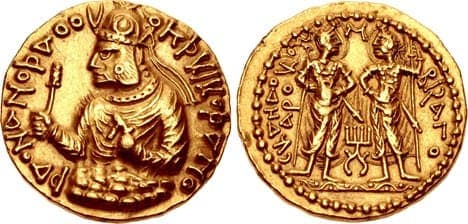
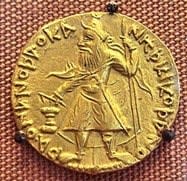
The reign of Huvishka I was not merely another chapter in the history of the Kushan Empire, but rather its true golden age—a period of remarkable cultural synthesis and extraordinary power. The son of the great Kanishka, Huvishka assumed control of the vast empire around 150 CE and ruled for approximately thirty years, until the accession of his successor, Vasudeva I.

His reign became a period of profound consolidation and peaceful prosperity. A native of Peshawar, in present-day Pakistan, Huvishka ruled over territories stretching from Bactrian Balkh in the north to the Indian city of Mathura in the south. Under his rule, Mathura flourished and effectively became the southern capital of the Kushan state, as the political and cultural center of the empire increasingly shifted there. The emperor’s influence extended far to the east as well: gold coins and amulets bearing his image have been discovered at Pataliputra and sacred Bodh Gaya, with one such amulet found as an offering directly beneath the Buddha’s Throne of Enlightenment.
Although Huvishka’s reign was marked by religious tolerance, Buddhism—and more specifically the emerging Mahayana tradition—occupied a particularly important place in his era. Historians have good reason to regard the reign of Huvishka as one of the crucial periods in the development of Mahayana Buddhism. A fragment of an ancient Sanskrit manuscript from the famous Schøyen Collection explicitly describes the emperor as a man who had “entered the path of the Mahayana.”
The earliest known epigraphic reference to Amitabha Buddha dates precisely to the reign of Huvishka. In 153 CE, corresponding to “Year 26” of the Kushan era, an inscription was created on a pedestal containing the words Bu-ddha-sya A-mi-tā-bha-sya in Brahmi script. Shortly afterward, in “Year 28,” a merchant family from Govindo-Nagara dedicated another statue to Amitabha, the lower portion of which is now carefully preserved in the Mathura Museum.
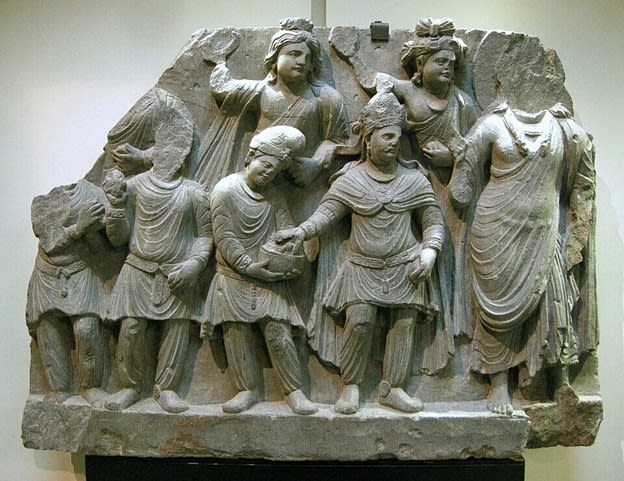
Other unique artifacts have also survived. These include a Mathura sculpture of a bodhisattva dated to the 33rd year of the reign of the “Great King, Son of God, Huvishka” (Mahārājasya Devaputrasya Huviṣka), as well as the pedestal of a Buddha statue from Uttar Pradesh created in Year 45. Gandharan reliefs of this period frequently depict the ruler himself making reverential offerings to the Buddha.
Yet here lies a remarkable paradox: despite his evident patronage of Buddhism, Huvishka never placed an image of the Buddha on his coins. Scholars believe that this was not an act of disregard but, on the contrary, may have reflected profound respect for the Enlightened One, whose image was considered too sacred to be used in ordinary commercial transactions.
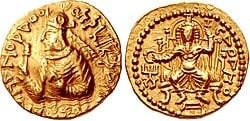
Huvishka became the first and only Kushan ruler to place ϹΑΡΑΠΟ (Sarapo), the Hellenistic-Egyptian god Serapis, on his coinage, depicted wearing his characteristic modius headdress. Serapis was the supreme deity of Alexandria, and his appearance on Kushan currency vividly testifies to the close commercial ties between the Kushan Empire and Roman Egypt, which eagerly imported luxury goods from the East.
Other coins depict Heracles (ΗΡΑΚΙΛΟ) and, according to many scholars, even the goddess Roma—Roma Aeterna, or “Eternal Rome”—whose name may have been rendered as ΡΙΟΜ or ΡΙϷΤ (Rishti).

The Zoroastrian tradition also occupied an important place in the imperial cult. Between approximately 164 and 174 CE, the emperor ordered the construction of a magnificent temple at the fortress of Airtam, near modern Termez in Uzbekistan, dedicated to Pharro, the deity of “Royal Glory,” and to the goddess Ardoksho.
The imperial mints produced large quantities of coins depicting the lunar deity Mao, the solar god Miiro or Mithra, the water goddess Nana, identified with Anahita, and Atsho (ΑΘΟϷΟ), the personification of the sacred royal fire. The supreme Zoroastrian deity Ahura Mazda also appeared on coins under the name ωΡΟΜ (Ooromozdo), together with abstract religious personifications such as Rishti, representing Righteousness; Ashaeixsho, representing the Best Righteousness; and Shaoreoro, representing the Best Royal Authority.
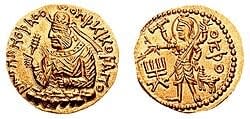
The deeper the Kushan Empire expanded into India, the more actively Huvishka incorporated local cults into the imperial religious system. Unlike his predecessor, he began issuing coins depicting the four-armed god Oesho (ΟΗϷΟ), identified with Shiva and shown with his traditional attributes, as well as his divine consort Ommo, or Uma, holding a flower. In Mathura, Hindu temples were restored under his authority, and provisions were made for the maintenance of Brahmins.
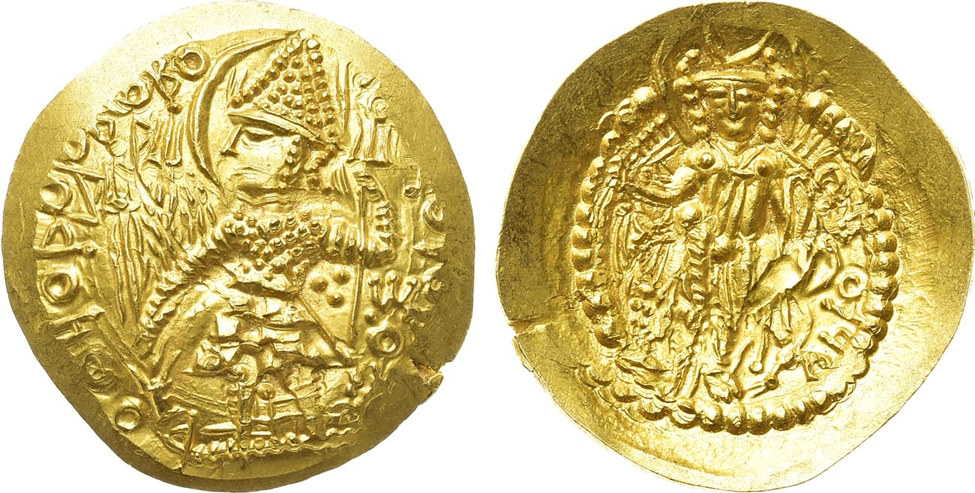
The military propaganda of Huvishka’s reign is particularly interesting. The emperor abandoned the image of the Iranian war god Orlagno in favor of Indian martial deities: Skando, corresponding to Skanda; Komaro, or Kumara; Bizago, or Vishakha; and Maaseno, or Mahasena.
Researchers interpret this not merely as a religious gesture but as a carefully calculated political strategy. The cult of Mahasena was especially popular among the martial Indian tribe of the Yaudheyas. By incorporating their god into the official Kushan pantheon, the rulers may have sought not only to pacify a conquered population but also to encourage the large-scale recruitment of Indian warriors into the imperial army.
Despite the outward splendor and stability of Huvishka’s reign, the economy of the period conceals an intriguing historical mystery. On the one hand, his principal mints at Balkh and Peshawar, together with auxiliary mints in Kashmir and Mathura, produced an unprecedented quantity of gold currency. More gold coins of Huvishka have survived to the present day than those of all the other rulers of the dynasty combined, and their artistic variety is extraordinary.
On the other hand, it was during his reign that copper currency underwent a sudden and large-scale debasement. In the first years of his rule, the weight of the standard copper coin abruptly declined from the traditional sixteen grams to only ten or eleven grams. The decline did not stop there. The reduction in weight and quality continued throughout all three decades of his reign, so that by the time his successor Vasudeva came to power, the copper tetradrachm weighed only about nine grams.
This financial crisis created considerable disorder in the domestic market. The Ganges Valley became flooded with large quantities of crudely produced imitations of the new lightweight currency, while the population began actively hoarding older, full-weight coins issued by previous rulers, creating intense demand for them.
What exactly compelled such a powerful emperor, presiding over enormous quantities of gold, to reduce the value and weight of the copper currency used in everyday transactions remains uncertain. Possible explanations include the depletion of copper mines, inflation, the rising costs of maintaining the army, or deliberate economic disruption. To this day, the causes of this monetary crisis remain one of the major unresolved mysteries of the Kushan Empire.


