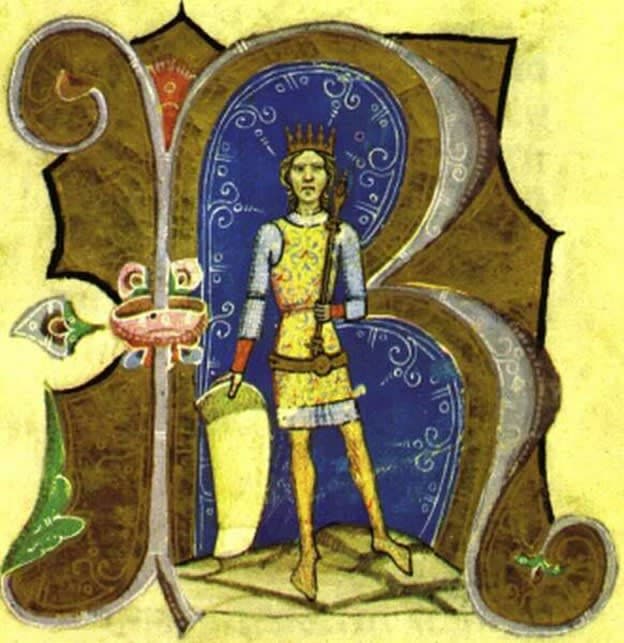

The life of King Géza II of Hungary began in an atmosphere of anxiety and uncertainty.
His father, King Béla II the Blind, whose reign had been overshadowed by severe trials, died prematurely, having been destroyed by his destructive addiction to alcohol.
At that time, Géza, although he was the monarch's eldest son, was barely eleven years old.
The royal court, fully aware of the threat that a child ruler posed to the stability of the kingdom, acted with lightning speed.
To prevent any claims to the Hungarian throne by the numerous ambitious members of the royal family, the boy was crowned just three days after his father's death.
The heavy burden of the regency fell upon the most trusted members of the royal family: his mother, the strong-willed Queen Helena of Serbia, and her brother Beloš, an outstanding statesman serving at the Hungarian court.
Beloš would later become commander-in-chief of the army, receiving the prestigious title of Ban.

The period of regency did not last long.
By 1146, the sixteen-year-old Géza had taken the reins of government into his own hands, and his independent rule began with a severe baptism of fire.
He was forced to personally lead the Hungarian army to repel a large-scale invasion.
Once again, his father's longtime enemy, Boris Kolomanović, the unrecognized son of King Coloman the Learned, appeared on the political stage.
This half-Rus' claimant to the throne, relying on the support of German mercenaries, invaded Hungary and captured the city of Pozsony.
The young king demonstrated political wisdom: in exchange for 3,000 silver marks, he persuaded the Germans to abandon the city.
However, the conflict did not end there.
Boris appealed for military assistance to Henry Jasomirgott, Duke of Bavaria and Margrave of Austria.
Géza responded with a decisive strike. On September 11, 1146, the Hungarian army utterly defeated the margrave's forces in a bloody battle on the Fischa River.

Having strengthened his authority through this victory, Géza soon entered into a dynastic marriage with Euphrosyne, sister of Grand Prince Iziaslav Mstislavich of Kiev.
This union proved remarkably strong and fruitful. The queen would eventually bear him four sons and four daughters.
Nevertheless, even after achieving personal and political maturity, Géza did not remove his former guardians from power.
The queen mother and his uncle Beloš remained his principal royal advisers throughout almost his entire reign.

The spring of 1147 brought new upheavals to Europe.
The German king Conrad III announced the beginning of the Second Crusade against the Muslims of Asia Minor and the Middle East.
The enormous crusading army was to march through Hungarian territory, and the urgent necessity of ensuring its peaceful passage forced the Germans to finally reconcile with King Géza.
The tireless Boris Kolomanović attempted to exploit the crusade for his own purposes.
He joined the army of the French king Louis VII, hoping to provoke a conflict between the French and the Hungarian crown.
His treacherous plans collapsed.
Although Louis VII refused, out of knightly honor, to surrender the intriguer to Géza, he promised to keep him under strict supervision until the crusading army had left Hungary.
Moreover, relations between the French and Hungarian monarchs became so warm that Louis agreed to become the godfather of Géza's firstborn son — the future King Stephen III.
Realizing that he could accomplish nothing further there, Boris fled to Byzantium, where he continued plotting at the court of Emperor Manuel Komnenos.

Géza's marriage to a princess of Kiev inevitably drew him into the complicated web of Eastern European politics.
In the twelfth century, neighboring Rus' was rapidly fragmenting into independent principalities.
Prince Yuri Dolgoruky of Suzdal, who was effectively creating his own state in the Vladimir-Suzdal lands, was obsessively determined to obtain the title of Grand Prince of Kiev.
This ambition led to a prolonged war against his nephew Iziaslav Mstislavich, who was Géza's brother-in-law.
The Principality of Galicia, situated between Hungary and Kiev and desperately struggling for independence, also became involved in the conflict.
In the summer of 1150, Yuri Dolgoruky, in alliance with Prince Vladimirko Volodarevich of Galicia, captured Kiev and expelled Iziaslav, while Galicia secured its independence.

The exiled Iziaslav called upon the Hungarian king for assistance.
However, the situation became considerably more complicated when an ally of the Galician prince, Byzantine Emperor Manuel Komnenos, struck Hungary from behind, devastating the County of Srem.
Géza was forced to temporarily recall his troops.
But by early 1151, a force of ten thousand Magyar horsemen had once again approached Kiev, compelling Yuri Dolgoruky to abandon the city without a fight.
In 1152, Géza dispatched an army to Rus' for the third time — now with the intention of punishing Galicia.
This campaign turned into a tragedy.
Upon hearing of Iziaslav's initial victory over Vladimirko's forces, the Hungarians relaxed and organized an enormous feast that continued well past midnight.
Just before dawn, Vladimirko's vengeful warriors stormed the camp and slaughtered the drunken Magyar army.
The retaliation was devastating.
Soon afterward, seventy fresh Hungarian regiments, fighting alongside the Kievan forces, crushed the Galicians on the San River.
Finding himself in a hopeless situation, Vladimirko resorted to cunning. Pretending to have suffered a mortal wound, he managed to arouse Géza's sympathy and beg for peace, despite Iziaslav's furious objections.
Following Vladimirko's death in 1153, the war was continued by his son, Yaroslav Osmomysl.
However, after Iziaslav Mstislavich himself died in November 1154, King Géza permanently ceased intervening in the internal dynastic conflicts of the princes of Rus'.
Meanwhile, storm clouds were once again gathering along the kingdom's southern borders.
Géza's family ties with the Serbian župans of Raška through his mother's lineage, combined with the relentless subversive activities of Boris Kolomanović, provoked a large-scale war against Byzantium.
In 1149, Serbia attempted to break free from Byzantine control.
Emperor Manuel Komnenos responded with a punitive military campaign in 1150, culminating in the defeat of the combined Serbian-Hungarian forces.
Géza's uncle, Uroš II Primislav, the župan of Raška, was forced to bow before the emperor once again.
Following this victory, the Byzantines invaded Hungary, devastating the territories of Temes and Szerémség with fire and sword.
The same Boris Kolomanović distinguished himself through particular brutality during these raids.

After concluding a temporary truce in early 1151, the Hungarians regrouped and restored their control over Szerémség in 1152.
In 1154, Géza II made a daring attempt to avenge his earlier humiliations.
He entered into a secret conspiracy with the emperor's cousin, Andronikos Komnenos, who governed the frontier territories of Belgrade, Barancs (Braničevo), and Niš.
Promising Andronikos military assistance in his struggle for the Byzantine throne, Géza laid siege to the fortress of Barancs.
The plan collapsed when Emperor Manuel discovered the conspiracy in time and imprisoned his rebellious cousin.
The Hungarians were forced to lift the siege.
Nevertheless, the campaign brought one exceptionally important victory.
During one of the relatively minor border skirmishes, Boris Kolomanović was finally killed — the relentless instigator of both internal and external unrest within the kingdom.
In 1155, a new peace treaty was concluded between Géza and Manuel Komnenos.
Clearly recognizing the precarious position of Hungary, trapped between two powerful empires, Géza II took steps in advance to ensure the continuity of royal power.
As early as 1152, he had prudently proclaimed his eldest son, the five-year-old Stephen, his co-ruler, thereby securing the boy's claim to the throne.
To his younger brothers, Ladislaus and Stephen, the king granted only prestigious ducal titles, without providing them with military forces or landed estates.
However, these precautions failed to protect the crown from betrayal.
In 1156, Duke Stephen organized a conspiracy against his royal brother.
The most devastating blow came when their uncle Beloš joined the rebels. By that time, Beloš held not only the title of Ban but also the office of Palatine, making him the second most powerful official in the kingdom.
The conspiracy was discovered in time.
Stephen fled to Germany, seeking the protection of Frederick I Barbarossa, while Beloš found refuge at the court of his brother, the Serbian ruler Uroš II.
Desperately determined to prevent his younger brother from becoming another "Boris Kolomanović," Géza entered into complex diplomatic negotiations with the German emperor.
As a result, Frederick refused to support the rebel, forcing Stephen to flee to Constantinople.
In gratitude, Géza sent five hundred Hungarian archers to assist Barbarossa during his campaign against Milan in 1158.

In 1160, the ranks of the exiles in Byzantium grew.
Géza's middle brother, Ladislaus, also fled there after being implicated in treason.
In the future, both brothers would briefly succeed in usurping the throne from their nephew, Stephen III.
However, during Géza's lifetime, Emperor Manuel was unable to provide the conspirators with substantial assistance.
Although Manuel arranged for Duke Stephen to marry his niece Maria, he ultimately preferred diplomacy to open warfare, concluding a five-year peace treaty with Géza in 1161.
The king's final major political act was his involvement in resolving a European ecclesiastical crisis.
In 1159, Pope Adrian IV died.
Alexander III, a staunch advocate of the supremacy of spiritual authority over secular power, was elected as his successor.
In opposition to him, Frederick Barbarossa secured the election of the antipope Victor IV.
Catholic Europe was divided into two opposing camps.
In this great confrontation, Géza II sided with Alexander III.
Seeking to gain a reliable ally against Frederick's growing ambitions, the Hungarian king took an unprecedented step.
He officially renounced the right of investiture — the authority to appoint bishops — although this renunciation remained largely a matter of words rather than practice.
In assessing Géza II's reign, one may confidently conclude that although his foreign wars did not bring spectacular territorial acquisitions, his principal historical achievement remains undeniable.
Under enormous pressure from the two most powerful states of the era — the German and Byzantine empires — he successfully defended Hungary's sovereignty.
Thanks to his flexible yet decisive policies, the Kingdom of Hungary, despite its complex ethnic composition, remained internally stable.
It never became a vassal of either empire, both of which had repeatedly attempted, without success, to bring it under their authority.


