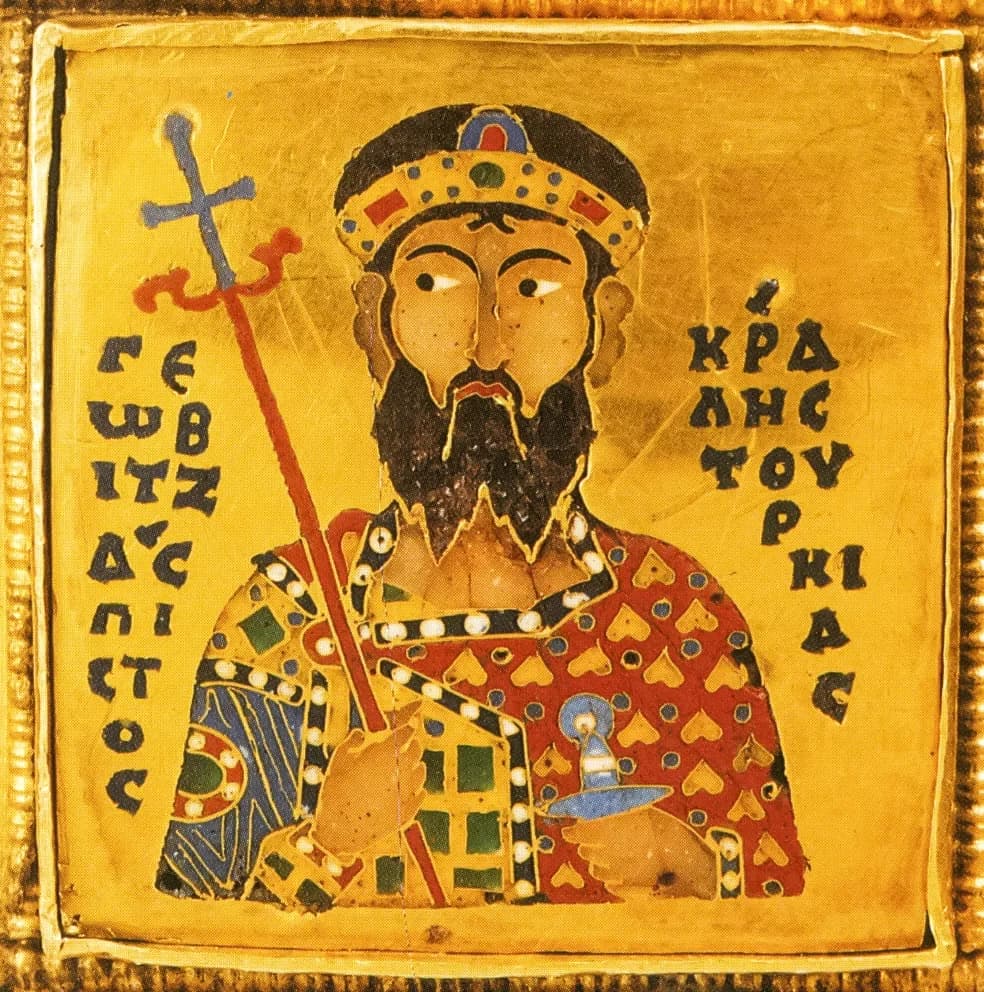

The life of King Géza I began far from the lands he was destined to rule. His homeland was not Hungary, but neighboring Poland.
It was there that his father, Prince Béla, had been forced to flee in 1037, escaping the relentless wrath of Hungary's first king, Stephen I.
The monarch's hands were already stained with blood: he had brutally executed Géza's grandfather, Prince Vazul, for rebellion.
During his Polish exile, at the court of his relative and protector, King Mieszko II the Indolent, Prince Béla established a family. He married Rixa, the daughter of the Polish ruler, whom some chroniclers also call Adelaide.
From this marriage, in the shadow of a foreign throne, three sons were born: Géza, Ladislaus (László), and Lampert.

The family did not receive an opportunity to return to their ancestral homeland until 1046, when Hungary was shaken by the violent anti-Christian Vata Uprising.
The reigning king, Peter Orseolo, who had inherited the throne from Stephen I, was overthrown by an enraged mob and blinded.
Since Béla was the younger son of the executed Vazul, the Hungarian crown passed to his elder brother, Andrew I.
Initially, Andrew, who had no heirs, officially designated Béla as his successor.
However, in 1057, the situation changed dramatically: the king had a son, Solomon.
Driven by paternal affection, Andrew rewrote his succession plans in favor of the infant.
Béla, meanwhile, was forced to renounce his legitimate claim to the throne and was given the Principality of Nitra as compensation — an extensive territory comprising one-third of the Hungarian lands (Tercia Pars Regni).

The offended prince had no intention of accepting such a limited position.
Taking his family with him, Béla once again left Hungary and returned to Poland, where he was welcomed with open arms by his nephew through marriage, the powerful Duke Bolesław II the Bold.
Relying on Polish military support, Béla launched a war against his royal brother.
In 1060, Andrew's army was defeated, and the king himself suffered a fatal wound in battle.
The throne passed to Béla I, while young Géza solemnly acquired the status of crown prince.
Yet the tragic fate hanging over this dynasty would not allow them to find peace.
Géza's claim to the crown, and even his life, soon hung by a thread once again.
Anastasia, the widow of the fallen Andrew and daughter of Grand Prince Yaroslav the Wise of Kiev, appealed to German Emperor Henry IV for assistance.
Responding to her plea, heavily armored imperial forces invaded Hungary in 1063.
On the eve of the decisive battle, a bizarre and fatal accident occurred: King Béla suffered devastating injuries when he fell from his own throne, dying shortly afterward.
Deprived of their leader, his army lost the battle.
Géza and his brothers had no choice but to bow before the young Solomon and recognize him as king.
Under the terms of the humiliating peace agreement, they were forced to retreat, retaining only their positions as rulers of Nitra and one-third of the kingdom.

Having accepted his fate, Prince Géza sincerely attempted to become a loyal vassal.
Eager to demonstrate his loyalty and restore peace to a country exhausted by civil wars, Géza personally placed the crown upon Solomon's head on April 11, 1064, during the joyful celebration of Easter in the city of Pécs.
Around the same time, he strengthened his position by marrying Sophia (Zsófia), daughter of Count Giselbert of Looz.
Over the following years, Géza fought alongside Solomon in every major military campaign, and this became a period of remarkable victories.
Hungarian banners flew triumphantly during the Croatian campaign against Venice in 1067, while the united army utterly defeated the Pechenegs at the Battle of Kerlés in Transylvania in 1068.
However, the decisive turning point in the cousins' relationship came in 1071, during an exhausting war against Byzantium that culminated in the triumphant capture of Belgrade.

It was beneath the walls of the defeated Belgrade that the alliance between the king and the prince suffered its first serious rupture.
The Byzantine commander of the fortress, Niketas, assessed the situation and chose to surrender not to the king, but to the noble Prince Géza, who had given his solemn knightly word that he would release the Greek prisoners and protect them from plunder.
Wounded in his pride, Solomon interpreted this as an outrageous act of defiance.
In his anger, the king ordered Géza's share of the spoils to be reduced by the amount that the royal treasury had lost because of the prince's mercy.
In reality, however, the Greek commander had carried out a brilliant provocation. Aware of the long-standing rivalry within the dynasty, he had struck at its most vulnerable point.
What truly infuriated Solomon was not so much the lost treasure, but the fact that the Byzantines were treating his cousin as an equal sovereign.
Court intriguers skillfully added fuel to the fire.
Hungarian history would forever remember the sinister influence of King Solomon's adviser, the German Duke Vid, who constantly incited hostility between the monarch and the sons of Béla.
The chroniclers preserved a vivid and deeply symbolic scene.
When Byzantine ambassadors, paying little attention to the king, respectfully presented Géza with letters of gratitude from their emperor, Duke Vid, standing beside the throne, placed two blades into a single scabbard with a mocking smile.
This insolent gesture was a direct mockery of the dual authority within the kingdom, which Solomon was forced to tolerate.
The conflict escalated rapidly.
When the Byzantines recaptured Belgrade in 1072, Solomon announced a new military campaign.
The Hungarian army advanced successfully southward, reaching the city of Niš in present-day southern Serbia.
But here, paranoia prevailed.
Fearing that the king's supporters would seize the Principality of Nitra in his absence, Géza deserted the campaign and withdrew his troops.
Enraged by this betrayal, Solomon turned his army around, determined to crush his cousin completely.
Only through the desperate appeals of the Hungarian bishops were the relatives temporarily reconciled in 1073, on a small island in the Danube near Esztergom.
But their declarations of peace were merely a façade — both sides were feverishly sharpening their swords.
Solomon struck first.
He caught Géza by surprise while the prince was hunting in the dense Igfán Forest.
The prince's camp was brutally destroyed, and Géza himself barely escaped the deadly encirclement, fleeing north toward his brother Ladislaus.
On February 26, 1074, on the Kemej Plain north of present-day Karcag, the royal army caught up with the fugitives.
Géza's detachment was almost completely annihilated, but the wounded prince once again managed to survive and join Ladislaus.
His brother was rushing to his aid not alone, but at the head of Polish forces and Bohemian detachments commanded by Otto I the Fair, Prince of Northern Moravia, who was married to Euphemia, the sister of Géza and Ladislaus.
On March 14, 1074, near Mogyoród, in the vicinity of present-day Budapest, the final confrontation took place.
In a ferocious battle, the army of Béla's sons utterly crushed Solomon's forces. Duke Vid, the instigator of the conflict, also met his death on the battlefield.
Solomon fled in panic toward the northwest, while Géza was proclaimed the rightful king of Hungary.

However, his reign, which lasted only three years, did not bring peace.
Géza I, popularly known as the Pious, was a tragic figure.
A sincerely devout man, who is credited with the construction of the magnificent cathedral in Vác, he devoted all his efforts to strengthening Christianity throughout the country.
The very necessity of waging a fratricidal war against Solomon tormented his soul.
Géza had never desired this power and for a long time even refused to be crowned.
There was also a practical reason for this: during his hasty escape, Solomon had somehow managed to lose the sacred Hungarian crown, a relic that would not be discovered in the lands of Slovakia until several centuries later.
Only in 1075 did Géza acquire the status of an anointed monarch.
Remembering Géza's knightly generosity during the siege of Belgrade, Byzantine Emperor Michael VII Doukas sent him a new crown — a genuine masterpiece of jewelry.
In the future, this crown would be combined with the crown of Saint Stephen to form the lower section of the famous Holy Crown of the Hungarian kings (Szent Korona).
Relations with Byzantium were strengthened even further when the widowed Géza married Synadene, the niece of the Greek aristocrat Nikephoros Botaneiates, who would himself ascend the Byzantine throne in 1078.
The new king also enjoyed the support of Pope Gregory VII, who was engaged in an uncompromising struggle against the principal ally of the exiled Solomon — Emperor Henry IV.

And yet, despite possessing powerful protectors and firmly established authority, the king continued to suffer under the burden of the bloodshed within his own family.
At Christmas in 1076, in Szekszárd, Géza the Pious assembled the highest-ranking leaders of the Hungarian Church and made an astonishing announcement.
For the sake of ending the war, he was prepared to take an unprecedented step: to return two-thirds of Hungary's territory to Solomon, retaining only one-third of the kingdom and the formal royal title for himself.
However, Solomon either rejected this generous proposal or simply failed to send a response in time.
On April 25, 1077, the life of Géza I came to a sudden end.
He had not yet reached the age of forty.
The chronicles offer conflicting accounts of his death. Some describe a mysterious, debilitating illness, while others, including Villermus, abbot of the Monastery of the Holy Saviour, explicitly claim that the healthy and energetic king was treacherously poisoned.
Official historiography tends to favor natural causes, since acknowledging the possibility of murder would cast a shadow over the king's closest associates.
The bitter truth was that Géza's untimely death was far more advantageous to his own "friends" than to his enemies.
The court aristocracy and supporters of the House of Béla had no desire to see Solomon return to power, especially given the extraordinary mercy Géza had shown him.
They needed a leader prepared to resolve conflicts through force rather than peace treaties.
Géza's sons from his first marriage to Sophia, Princes Coloman and Álmos, were still far too young to ascend the throne.
Therefore, the Hungarian crown immediately passed to the deceased king's younger brother, the determined and warlike Ladislaus I.
The new king did not share his brother's excessive inclination toward peace.
Peace negotiations were immediately abandoned.
The exiled Solomon continued attempting to resist Ladislaus's iron will, but four years later he was forced to capitulate once and for all.
This brought an end to the long and bloody dynastic conflict that Géza the Pious had so desperately sought to resolve.


