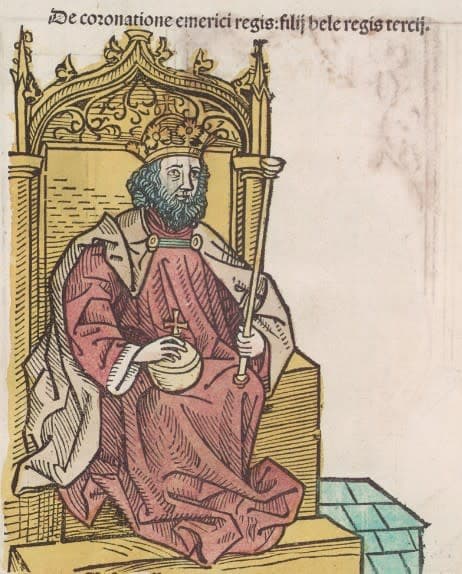

The reign of King Emeric, destined to become one of the most dramatic episodes in medieval Hungarian history, began long before his actual accession to the throne.
His father, the powerful monarch Béla III, was fully aware of the fragility of royal authority and was determined to secure a peaceful transfer of the crown to his son at any cost.
To establish his eldest son's unquestionable right to the Hungarian throne once and for all, Béla arranged for Emeric to be crowned during his own lifetime. The solemn ceremony took place on May 16, 1182.
Later, in 1194 or 1195, wishing to provide the crown prince with genuine administrative experience, his father granted him the prestigious title of Duke (Ban) of Dalmatia and Croatia.

However, when Béla III died on April 23, 1196, leaving Emeric the entire vast territory of his kingdom, a fatal miscalculation by the late monarch became apparent.
To his younger son Andrew, Béla had bequeathed only several castles and estates, along with an enormous sum of money.
These funds had a strictly designated purpose: Andrew was supposed to organize a Crusade to the Holy Land, thereby fulfilling his father's sacred vow, which Béla himself had been unable to carry out.
But the ambitious Andrew chose to use his inheritance differently.
Having acquired fabulous wealth, he did indeed begin assembling an army. However, the swords of these warriors were directed not against the Saracens, but against his own elder brother.
A fratricidal war erupted.
In December 1197, Andrew's army inflicted a crushing defeat upon the forces of the legitimate monarch near the Mecsek Mountains in southern Hungary.
Driven into a corner, Emeric was forced to make extremely painful concessions, surrendering the ducal crown of Dalmatia and Croatia to his rebellious brother.

Against the backdrop of these military setbacks, the king's personal life was also undergoing significant changes.
From early childhood, Emeric had been betrothed to Agnes, daughter of the formidable German emperor Frederick I Barbarossa.
However, the princess died in 1184, forcing the grown prince to seek another marriage alliance.
In 1198, he married Constance of Aragon.
This marriage proved fruitful: in 1199, the queen gave birth to a long-awaited son and heir, named Ladislaus.

The birth of a legitimate successor fundamentally changed the balance of power.
Realizing that he now had someone for whose sake he must fight to preserve the unity of the kingdom, Emeric began acting with extreme severity, increasing the pressure on Andrew and his supporters.
The king launched a campaign of repression against the rebellious duke's allies.
The influential Bishop Boleslaus of Vác was arrested, while the powerful Palatine Mog and several other Hungarian noblemen were disgracefully stripped of their titles and extensive landed estates.
Having gathered sufficient strength, Emeric launched a counterattack in the summer of 1199.
In the decisive Battle of Rád, fought in what is now Somogy County, the royal army completely defeated Andrew's forces.
The unsuccessful duke was forced to flee, finding refuge at the court of the Austrian duke Leopold VI.

It seemed that the conflict had reached a deadlock, but in 1200 the highest ecclesiastical authority intervened.
The papal legate Gregory, who had arrived in Hungary, succeeded in bringing the brothers to the negotiating table and reconciling them.
The terms of the agreement represented a compromise: Andrew was restored to his duchy, while the brothers solemnly declared each other their mutual heirs, depending on which of them survived the other.
Moved by this seemingly miraculous reconciliation, Emeric and Andrew swore that they would undertake a Crusade together, planning to entrust the administration of the kingdom during their absence to Leopold VI.
However, as soon as their emotions subsided, both brothers conveniently forgot their vows and abandoned the idea of an armed pilgrimage.
Instead of traveling eastward, Emeric used the temporary respite from internal conflicts to pursue an active and sometimes aggressive foreign policy.
He turned his attention toward the Balkans, skillfully intervening in the affairs of neighboring states.
In 1201, the king entered the civil war between the sons of Stefan Nemanja, the Grand Župan of Serbia.
Siding with the elder brother Vukan, Hungarian forces overthrew the second son, Stefan Nemanjić, from the Serbian throne.
Emeric appointed Vukan as Grand Župan and boldly proclaimed himself King of Serbia.
In that same year, 1201, the wealthy Dalmatian city of Zara, present-day Zadar, voluntarily accepted Hungarian sovereignty.

The ambitions of the Hungarian crown continued to grow.
In 1202, another military campaign followed, this time against Bulgaria.
Emeric forcibly seized the disputed and strategically important cities of Belgrade, Braničevo, and Niš from the Bulgarians, transferring their administration to his vassal Vukan.
Although the military success was not particularly spectacular, Emeric did not miss the opportunity to proclaim himself King of Bulgaria as well, at least nominally.
At the same time, he conducted a sophisticated diplomatic campaign in Germany, supporting the candidacy of Otto IV against Philip of Swabia.
However, the intoxication of success did not last long, and fortune soon turned against the king.
On November 24, 1202, a geopolitical catastrophe erupted.
The participants of the Fourth Crusade, yielding to the persuasion of the cunning Venetian doge Enrico Dandolo and directly violating the strict prohibition imposed by Pope Innocent III, captured and plundered Zara, placing the city under Venetian control.
The outraged pontiff excommunicated the crusaders and the doge, but the wealthy city was never returned to the Hungarian crown.

Further blows soon followed in the east.
In 1203, the Bulgarian tsar Ivan Kaloyan, relying on the formidable military power of the Cumans under his authority, defeated the Hungarian forces and recovered all the cities that had previously been lost.
Building upon this victory, Kaloyan restored Stefan Nemanjić to the Serbian throne in 1204, destroying the entire structure of Emeric's Balkan policy.
The only bright spot during this period was the subjugation of Bosnia.
The local Ban Kulin, who had attempted to side with Kaloyan, was swiftly defeated by the Hungarians.
On April 8, 1203, he hastened to declare himself an obedient vassal of King Emeric.
The relative calm within the royal family was shattered once again in 1204.
The cause was Emeric's decision to officially designate his young son Ladislaus as his successor.
Andrew, realizing that the crown was once again slipping from his grasp, launched another rebellion, unprecedented in its scale.
The brothers' armies confronted each other near Varaždin, in the territory of Croatia.
Here, an alarming trend for the Hungarian crown became unmistakably clear: Andrew's army vastly outnumbered the royal forces.
In the past, any claimant to the Hungarian throne had been forced to humble himself before foreign monarchs, begging them for mercenaries.
Now, however, Andrew had managed to assemble an enormous army entirely within the kingdom itself.
The explanation lay in the fact that Hungary was steadily moving toward feudal fragmentation.
The powerful Hungarian aristocracy — county governors, great landowners, and the military nobility — had grown increasingly resentful of the strong centralized authority once established by Béla III.
Duke Andrew had become the perfect rallying figure for these centrifugal forces.
Recognizing the absolute hopelessness of confronting such an enormous army in open battle, Emeric resolved to take an action that would forever enter the annals of European history.
Unarmed and without a single bodyguard, he left his camp and walked entirely alone toward the enemy's positions.
The royal crown shone upon his head, while he firmly gripped the royal scepter in his hands.
Passing through the ranks of astonished rebels, who stepped aside to let him through, he stood before Andrew.
In a commanding tone that tolerated no objections, he demanded that his brother immediately submit to the legitimate monarch, the anointed ruler chosen by God.
The psychological effect was extraordinary.
Overwhelmed by the majesty of the moment and unable to bring himself to raise a hand against an unarmed sovereign, Andrew's resolve collapsed, and he voluntarily surrendered.
The rebel was immediately thrown into prison.
Centuries later, this unparalleled act of courage would be immortalized in a famous painting by the Hungarian artist Mór Than.
Nevertheless, the triumph proved short-lived.
Andrew's loyal supporters soon rescued him from his dungeon.
Sensing the danger closing in around him and recognizing the fragility of his own position, Emeric hurried to arrange the coronation of his young son.
On August 26, 1204, the boy Ladislaus was solemnly anointed as king.
Because of the prince's young age, Emeric himself recited the words of the sacred royal oath on his son's behalf.
As though he had exhausted all his strength in this relentless struggle, the still-young and vigorous monarch suddenly fell ill with a mysterious, unknown disease.
The illness rapidly brought him toward the grave.
Sensing that death was inevitably approaching and understanding that his young son would be defenseless among greedy and ambitious barons, Emeric took a desperate step.
He summoned his lifelong enemy, his brother Andrew, to his deathbed and appointed him guardian of the young king.
He demanded from Andrew the most solemn and binding oath imaginable: to protect his nephew's life and health as though they were his own most precious possessions, and to voluntarily transfer full royal authority to him upon his coming of age.
King Emeric died sometime between August 26, the day of his son's coronation, when he was still physically capable of standing, and October 27, 1204, although established Hungarian tradition frequently identifies November 30 as the date of his death.
His body was laid to rest beneath the dark vaults of Eger Cathedral.
Before his death, Emeric disposed of his possessions with the same determination that had characterized his life.
He bequeathed exactly one-third of the state treasury to his young son, while generously donating the remaining two-thirds to the Church and the knights of the Order of Saint John, also known as the Knights Hospitaller.
It was as though, through these final gifts, he hoped to purchase their protection for his vulnerable heir, whose fate seemed already sealed.


