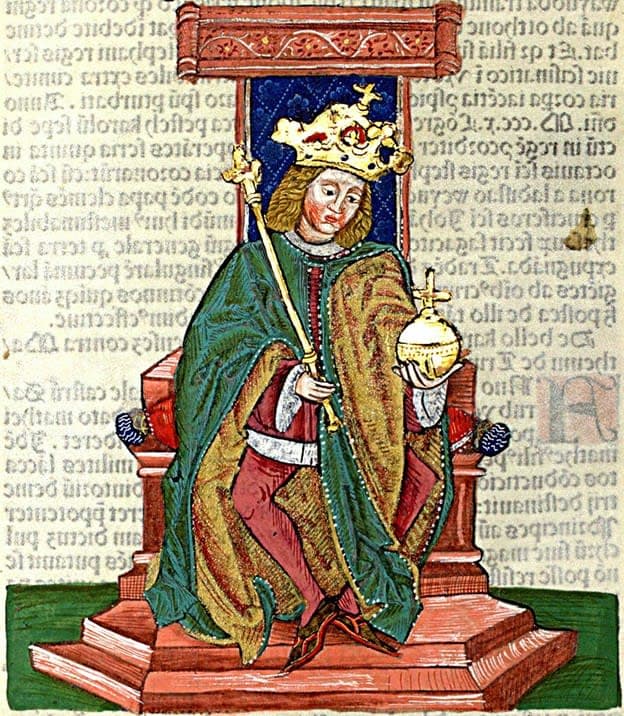

Charles Robert was born beneath the warm sun of Naples.
He was the only son of Charles Martel of Anjou, Prince of Salerno and titular King of Hungary, and his wife Clementia of Habsburg, daughter of King Rudolf I.
The blood of Europe's greatest dynasties flowed through his veins.
His paternal grandmother, Mary of Hungary, daughter of King Stephen V, had asserted her claim to the Hungarian throne back in 1290, following the death of her brother, Ladislaus IV the Cuman.
However, the people and nobility had supported her distant relative, Andrew III.
Refusing to accept defeat, Mary transferred her dynastic rights to her eldest son, Charles Martel.
But he never managed to enforce his claim, dying unexpectedly on August 19, 1295.

Thus, at the age of seven, Charles Robert became the principal heir to the Hungarian claims of the House of Anjou.
However, fate was preparing a cruel blow for him in his homeland.
On February 13, 1296, his grandfather, King Charles II of Naples, unexpectedly changed the order of succession.
Bypassing his young grandson, he designated his younger son — Charles Robert's uncle, Robert of Naples — as heir to the Kingdom of Naples.
This decree was officially confirmed on February 27, 1297, by the overlord of the Kingdom of Naples, Pope Boniface VIII.
In a single moment, Charles Robert permanently lost his rights to the wealthy and stable Neapolitan throne.
Only one hope of kingship remained: distant Hungary, torn apart by civil conflicts.

By the end of the thirteenth century, the Kingdom of Hungary was teetering on the brink of collapse.
The weakening of central authority under Stephen V had enabled the powerful Šubić noble family to restore its undisputed dominance over Dalmatia.
Attempting to secure their loyalty, the subsequently murdered Ladislaus IV the Cuman had recognized the Croatian magnate Paul I Šubić as Ban of Croatia and Dalmatia.
After the outbreak of civil war between King Andrew III and Charles Martel, our protagonist's grandfather, Charles II of Naples, went even further.
He declared all of Croatia, from Mount Gvozd to the Neretva River, the perpetual hereditary possession of Paul I Šubić.

This political concession achieved its purpose.
In early 1300, the powerful Paul I Šubić officially invited Charles Robert to Hungary, recognizing him as his legitimate king.
Charles II of Naples accepted the invitation, provided his grandson with a modest sum of money, and sent the twelve-year-old boy across the sea to reclaim the crown.
In August 1300, young Charles Robert landed in Split.
From there, he traveled to Zagreb, where he was received with honors by another influential magnate — Ugrin Csák.
When the last Árpád monarch, King Andrew III, suddenly died on January 14, 1301, the supporters of the Angevin prince acted with lightning speed.
They brought Charles Robert to Esztergom, the spiritual capital of the kingdom, where Archbishop Gregory Bicskei hastily crowned him.
However, the crown used was merely an ordinary diadem. The sacred Crown of Saint Stephen remained in the hands of his enemies.
For this reason, most Hungarian magnates refused to recognize the Neapolitan prince's authority and proclaimed the twelve-year-old Wenceslaus of Bohemia king instead.
Wenceslaus was immediately betrothed to Elizabeth of Töss, daughter of the deceased Andrew III, and crowned under the name Ladislaus by Archbishop John of Kalocsa in Székesfehérvár.
Crucially, his coronation was performed with the authentic Crown of Saint Stephen.
Having suffered a political defeat, Charles Robert prudently withdrew to Slavonia, where his supporters began gathering strength.
In September 1302, he attempted to capture Buda by assault, but the siege failed, forcing him to retreat once again.
The situation began to change on May 31, 1303, when Pope Boniface VIII officially confirmed Charles Robert's claim to the Hungarian throne.
Substantial military support was provided by his maternal uncle, King Albert I of Germany.
Sensing the shift in power, influential magnates Matthew Csák and Aba, who had previously supported the Bohemian claimant, defected to Charles Robert's side.
In the summer of 1304, King Wenceslaus II of Bohemia arrived with an army to rescue his son.
However, after realistically assessing the precarious situation, he took Wenceslaus and the Hungarian crown back to Prague.
Charles Robert, having concluded an alliance with Duke Rudolf I of Austria, pursued him into Bohemia, but the allies failed to capture the wealthy city of Kutná Hora.

In August 1305, Wenceslaus III, who had become King of Bohemia, formally transferred his rights to Hungary and the crown to Otto III, Duke of Bavaria and grandson of King Béla IV.
Disguised as an ordinary merchant, Otto secretly entered Pest.
On December 6, he was crowned under the name Béla V by the bishops of Veszprém and Csanád.
But the Bavarian's authority proved fleeting.
In 1306, Charles Robert launched a decisive offensive.
Esztergom, Spiš Castle, Zvolen, and the northern strongholds fell into his hands.
In 1307, he triumphantly entered Buda.
Otto III attempted to find allies and, in June 1307, traveled to meet the Voivode of Transylvania, Ladislaus Kán.
However, the treacherous magnate unexpectedly threw the king into prison.

Seizing the opportunity, the magnates proclaimed Charles Robert king at an assembly in Rákos on October 10, 1307.
Nevertheless, the wealthiest oligarchs — Matthew Csák and Ladislaus Kán — arrogantly ignored the gathering.
Toward the end of the year, Ladislaus Kán released Otto, who fled the country forever.
However, the Transylvanian voivode kept the Crown of Saint Stephen for himself.
At nineteen, Charles Robert remained the only claimant to the throne, but the kingdom had been torn apart by powerful magnates and divided into virtually independent principalities.
The turning point came in June 1308.
The newly arrived papal legate, Cardinal Gentile, met Matthew Csák at the monastery of Kékes and succeeded in persuading him to recognize the king.
On November 27, 1308, Csák himself attended an assembly in Pest, where Charles Robert was once again proclaimed monarch.
A synod of prelates in Buda ordered Ladislaus Kán to return the sacred relic, but he defiantly refused.

The papal legate then took an unprecedented step.
On June 15, 1309, Archbishop Thomas of Esztergom crowned Charles Robert with a specially commissioned new crown.
Only after being threatened with complete excommunication by the pope did Ladislaus Kán finally relent and surrender the authentic sacred crown.
On August 27, 1310, the Archbishop of Esztergom placed the Crown of Saint Stephen upon Charles Robert's head for the third time — and this time, the ceremony was entirely legitimate.
That day marked the true beginning of his great reign.
But possession of the crown did not guarantee authority over the rebellious barons.
In the summer of 1311, Matthew Csák, who had once again escaped royal control, besieged Buda, but the king repelled the assault.
Soon afterward, the inhabitants of Kassa (Košice) killed the powerful Amade Aba.
The king farsightedly sided with the townspeople, driving Aba's sons into an alliance with Matthew Csák.
In May 1312, Charles Robert laid siege to Csák's castle in Sáros, but the enemy's strength forced him to retreat.
Encouraged by their success, the combined forces of Csák and the sons of Aba advanced toward Kassa.
On June 15, 1312, the historic Battle of Rozgony took place, in which the royal army decisively defeated the rebellious coalition.
The king captured Aba's strongholds in Abaúj, Torna, and Sáros counties.
The war continued.
In 1314, Charles Robert took advantage of the turmoil within the Holy Roman Empire to recapture Devín Castle from the Austrians.
In early 1315, he wrested the strategically important fortress of Visegrád from Matthew Csák.
During this same period, he strengthened his political position through marriage to Mary of Bytom, daughter of Duke Casimir of Bytom.
In May 1316, the king unleashed his wrath upon the defiant Kőszegi family.
Meanwhile, the eastern magnates, led by Kopasz Borsa, attempted to launch a rebellion and even offered the crown to a descendant of Béla IV — Andrew of Galicia.
But Charles Robert was merciless.
He crushed the rebels, capturing their castles in Bihar, Szolnok, Borsod, and Kolozs counties.
In May 1317, he finally defeated the sons of Amade Aba and seized Komárom Castle from Matthew Csák.

To finance his army, the king boldly confiscated Church lands.
In 1318, outraged prelates demanded the convening of a national assembly representing all estates, but the people and nobility supported the monarch's policies.
That same year, the fortresses of the deceased sons of Ladislaus Kán fell in Transylvania.
Following the death of Mary of Bytom, the king married Beatrice of Luxembourg, daughter of Emperor Henry VII and Margaret of Brabant, in September 1318.
A year later, on October 11, 1319, tragedy struck: Beatrice died in childbirth, together with her newborn child.
At the age of thirty-one, Charles Robert had become a widower twice and still had no heir.
On July 6, 1320, he entered his third marriage, this time to Elizabeth of Poland, daughter of King Władysław the Elbow-high and Jadwiga of Greater Poland.

The death of Matthew Csák on March 21, 1321, marked the end of the era of feudal fragmentation.
His enormous domains disintegrated, and royal troops rapidly occupied all the key fortresses.
In January 1322, the cities of Dalmatia rebelled against Ban Mladen II Šubić, whose family had once helped bring Charles Robert to Hungary.
The king showed no sentimentality.
He arrived in Dalmatia, arrested the ban, and restored absolute royal authority in Croatia with an iron hand.
Having united the country through the sword, Charles Robert turned his attention to its economy.
In 1323, he moved the capital from Temesvár to Visegrád.
He completely dismantled the independence of the feudal lords by introducing the honor system.
Under this arrangement, loyal servants of the crown no longer received lands as permanent possessions. Instead, they were entrusted with the temporary administration of royal estates and castles.
The king could revoke these appointments at any moment.
In early 1323, Charles Robert abandoned the destructive practice of debasing or reducing the weight of coins, introducing the stable tax known as Lucrum camerae.
He ruthlessly abolished all private internal tolls established by the magnates and returned customs duties at the kingdom's borders to direct royal control as a royal prerogative.
A tax on goods imported by foreign merchants was introduced, known as the Trigesima or harmincadvám, amounting to one-thirtieth of their value.
Peasants were subject to the "gate tax," levied on every gate wide enough for a cart to pass through.
A large-scale population census was conducted, and a tax on the Church was introduced, amounting to one-third of papal revenues.
But Charles Robert's greatest economic achievement was gold.
Hungary possessed enormous mineral deposits, and the king introduced the tax known as Urbura (bányabér), amounting to one-tenth of the gold and one-eighth of the silver extracted from the mines.
His brilliant innovation was the decision to return one-third of this tax to the landowners.
This encouraged them to disclose their revenues rather than conceal them and to open new mines.
By 1325, a royal mint had been established in Kremnica, where full-weight gold florins began to be struck.
These coins became a standard of reliability throughout Europe.
The economy experienced an extraordinary transformation.
Gold production in Hungary reached 1,400 kilograms per year — one-third of the entire world's gold output at the time and five times more than the production of any other European country.
Between 30 and 40 percent of these enormous revenues flowed directly into the royal treasury.
This wealth enabled Charles Robert to maintain a powerful army, reform the country, and surround his court with unprecedented luxury.
Charles Robert's foreign policy was a masterpiece of dynastic diplomacy.
His greatest triumph was the historic Congress of Visegrád in 1335.
There, the monarchs of Hungary, Poland, and Bohemia, enjoying the splendor of the Hungarian court for two months, concluded a powerful defensive alliance, known as the Treaty of Trenčín, against the ambitions of the Habsburgs.
The alliance soon bore fruit.
In 1337, the Hungarians and Poles jointly attacked the possessions of Emperor Louis IV and his ally, Albert II of Austria.

The king dreamed of uniting the crowns of Hungary and Naples.
However, Venice and the papacy blocked this plan, fearing Hungarian hegemony over the Adriatic Sea.
Charles Robert found brilliant alternative solutions.
In 1339, his brother-in-law, King Casimir III of Poland, promised to transfer the Polish crown to Charles Robert's son Louis if he died without an heir.
Meanwhile, Charles Robert's younger son Andrew was betrothed to Joanna I, heiress to the Neapolitan throne.

The only dark chapter in Charles Robert's otherwise brilliant reign concerned the Balkans.
In the south, the Árpád dynasty had once established six military banates, encompassing territories in what are now Romania, Bulgaria, Serbia, and Bosnia.
During the years of anarchy, these Orthodox Christian territories had become virtually independent.
Attempts by Catholic missionaries to impose their authority provoked uprisings.
In the summer of 1319, Charles Robert successfully defeated the Serbian king Stefan Uroš II Milutin, capturing Belgrade and Macsó.
However, in 1336, Stefan Dušan delivered a powerful blow.
Charles Robert was wounded by an arrow in battle and permanently lost Belgrade.
The most terrible catastrophe, however, unfolded in Wallachia.
Until 1320, the western part of Wallachia, known as Oltenia, had been subordinate to the king's banates.
When the Wallachian ruler Basarab I launched a rebellion, Charles Robert personally led a punitive army against him.
But hunger forced the Hungarians to retreat.
In November 1330, in a narrow mountain gorge near Posada, the Hungarian army fell into a deadly ambush.
The Wallachians carried out a merciless slaughter.
The powerful King of Hungary barely escaped certain death, fleeing the battlefield in disgrace while disguised in the ordinary clothing of one of his knights.
Although the seemingly inexhaustible royal treasury allowed him to quickly rebuild his army, Hungarian domination over Wallachia was lost forever.

The great King Charles Robert of Anjou, who had inherited a country in ruins and transformed it into a powerful empire, died in his magnificent residence at Visegrád in 1342.
His loyal allies — King Casimir III of Poland and Charles IV of Luxembourg — traveled to Székesfehérvár to accompany the monarch on his final journey.
They were burying not merely a king, but a man who had permanently transformed the face of Central Europe.


