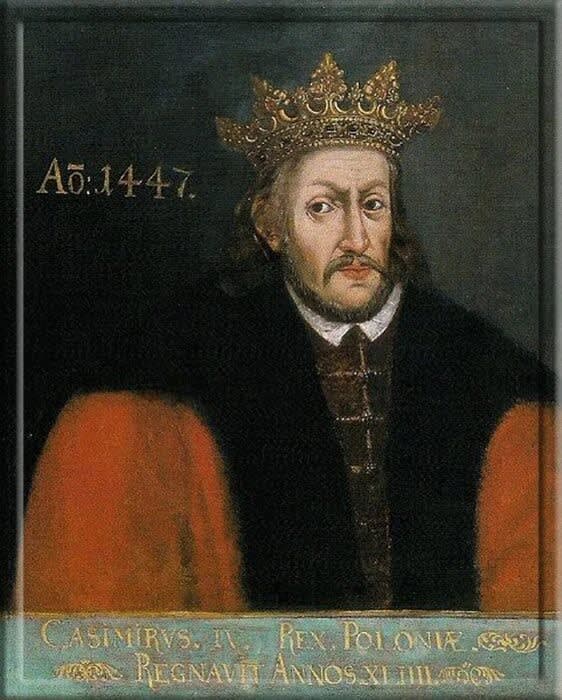

The reign of Casimir IV Jagiellon, son of the great Władysław II Jagiełło and Sophia of Halshany, marked the period when the Jagiellonian dynasty reached the height of its power and became one of the dominant forces in Central and Eastern Europe.
His path to power began in 1440, when he was proclaimed Grand Duke of Lithuania in Vilnius. The beginning of his rule in Lithuania was immediately subjected to a severe test: a major uprising broke out in Smolensk, where the townspeople attempted to restore their independence.
Despite his young age — the grand duke was only twelve years old — Casimir displayed considerable determination and personally participated in assembling a large army. His presence outside the walls of Smolensk proved decisive. Faced with the scale of the approaching threat, the city chose to surrender, preserving the territorial integrity of the Grand Duchy of Lithuania.
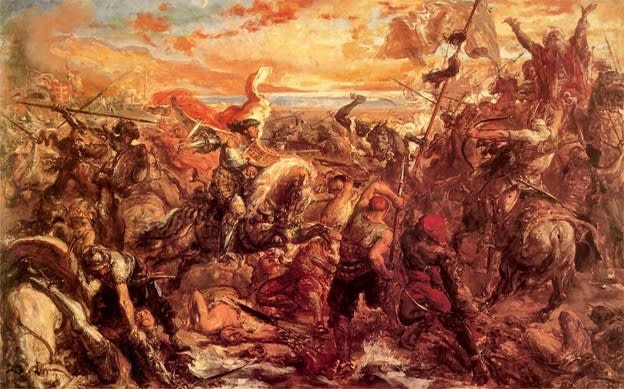
Casimir’s fate changed dramatically after the catastrophic defeat of the Polish and Hungarian armies at the Battle of Varna on November 10, 1444, where his elder brother, King Władysław III, was killed.
The three-year interregnum that followed in Poland ended with Casimir’s election to the Polish throne. His accession in Kraków, however, was far from straightforward. Determined to protect the interests of his Lithuanian subjects, Casimir initially refused to accept the Polish crown unless a special status for the Grand Duchy of Lithuania was guaranteed.
Only in 1447, fearing that the Poles might elect another monarch and thereby destroy the union between the two states, did he finally agree to be crowned.
At the same time, he secured recognition of the political equality of Lithuania and Poland, transforming the renewed union into a largely personal one based on their shared monarch.
Casimir’s domestic policy in the Grand Duchy of Lithuania was characterized by a desire for stability and the expansion of the rights of the political estates. He succeeded in peacefully retaining Samogitia within the state and resolving a number of territorial disputes.
The famous privilege of 1447 not only expanded the rights of the nobility but also laid important legal foundations for the later development of serfdom, with far-reaching social consequences.
Later, in 1468, Casimir issued the Sudebnik, the first major codification of criminal law in the Grand Duchy of Lithuania. It became an important step toward the centralization and standardization of the legal system.
At the same time, the great magnate families of Lithuania grew significantly in power, becoming both one of the principal foundations of the monarchy and an increasingly serious challenge to royal authority.
In the Kingdom of Poland, Casimir IV faced even stronger resistance from the magnates, who sought to restrict the monarch’s authority. To counterbalance their influence, the king increasingly relied on the middle nobility.
In 1454, he issued the Statutes of Nieszawa, which significantly expanded the political rights of the provincial nobility. This was not merely a political maneuver but also a military necessity: Casimir needed the support of the noble levies to wage the prolonged Thirteen Years’ War of 1454–1466 against the Teutonic Order.
The king also demonstrated firmness in ecclesiastical affairs, strengthening his influence over the appointment of bishops and thereby improving his position in disputes with both the papacy and the local Church hierarchy.
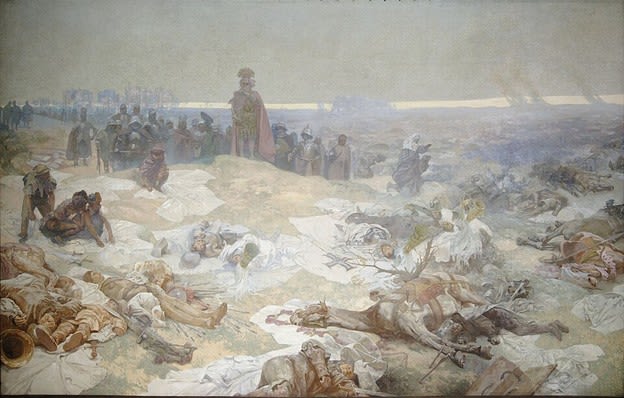

The struggle against the Teutonic Knights became one of the defining events of Casimir’s reign.
Taking advantage of the internal crisis within the Teutonic Order and the rebellion of the Prussian cities, Casimir entered into a long and exhausting war. Although the fighting brought mixed results, Poland ultimately achieved victory.
Under the terms of the Second Peace of Toruń in 1466, the Polish Crown regained Pomerelia, the Chełmno Land, Malbork, and Warmia. Western Prussia was incorporated into the Polish realm, while the remaining Teutonic state became politically subordinate to the Polish Crown.
This was a geopolitical victory of historic importance that decisively weakened Teutonic power and transformed the balance of power along Poland’s northern frontier.
In the east, Casimir was forced to conduct a delicate diplomatic struggle with Moscow and the Tatar khanates.
In 1449, he concluded a peace treaty with Grand Prince Vasily II of Moscow, defining spheres of influence and establishing mutual recognition of borders.
With the rise of Ivan III, however, relations became increasingly tense. Despite the existence of a strong pro-Lithuanian faction in Novgorod, Casimir chose not to intervene directly during Moscow’s campaigns of 1456, 1471, and 1478. As a result, Novgorod eventually lost its independence and was incorporated into the growing Muscovite state.
In ecclesiastical affairs, an important development came in 1458 with the establishment of a separate metropolitanate of Kyiv, deepening the religious division with Moscow, which had rejected the Union of Florence.
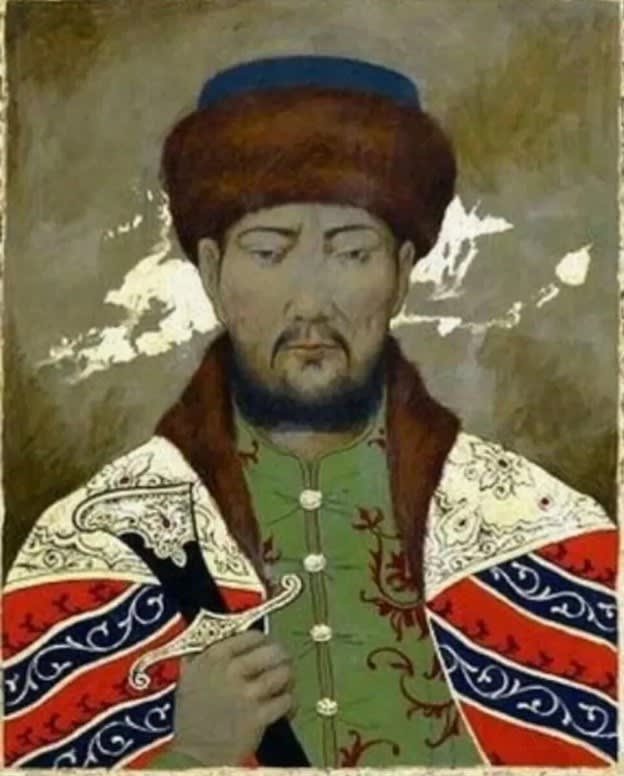
Casimir’s relations with the Great Horde and Crimea were equally complex.
His alliance with Khan Akhmat was directed against the growing power of Moscow, but the partnership proved insufficiently effective. During the famous Great Stand on the Ugra River in 1480, Casimir was unable to come to Akhmat’s assistance because Crimean Khan Mengli Giray, an ally of Ivan III, launched a sudden raid against Podolia.
In retaliation for Casimir’s failure to provide the promised support, the retreating forces of Akhmat devastated Lithuanian territories in the Oka basin.
Soon afterward, in 1481–1482, Casimir uncovered a dangerous conspiracy among several Lithuanian-Ruthenian princes who allegedly planned to assassinate him and transfer their allegiance to Moscow.
External pressure, however, continued to grow. In 1482, Mengli Giray carried out a devastating raid on Kyiv and sent captured church treasures to Ivan III as gifts.
The final years of Casimir’s reign were further overshadowed by the beginning of a border conflict with the Muscovite state in 1487, triggered by the defection of several Upper Oka princes to the service of the grand prince of Moscow.
Despite constant wars and diplomatic conflicts, Casimir IV pursued ambitious plans for the creation of a vast political sphere that would include not only Poland and Lithuania but also Prussia, Bohemia, Hungary, and Wallachia.
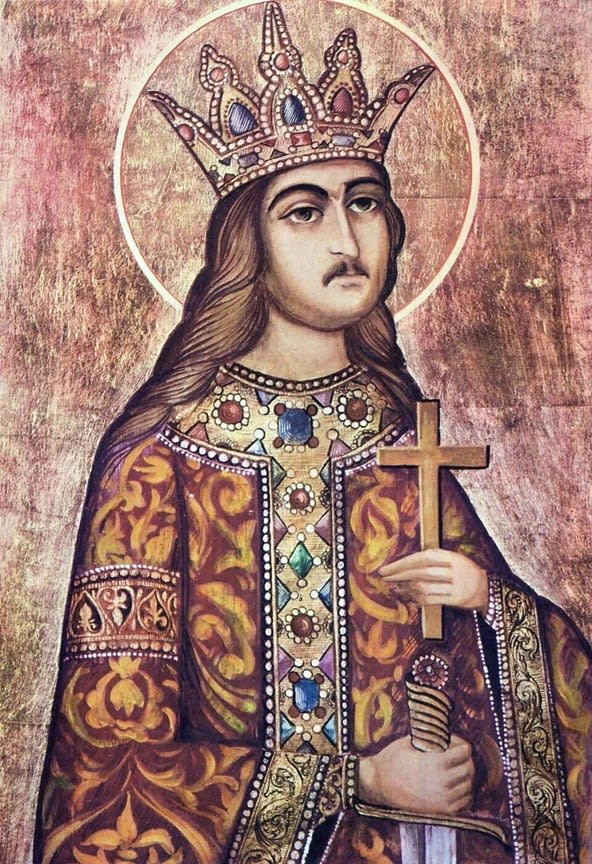
These ambitions were supported by genuine political successes. In 1485, Stephen the Great of Moldavia rendered homage to Casimir, recognizing his suzerainty under the circumstances of the time.
The king also sought to reform the Church and strengthen the development of towns, although he was often forced to make concessions to the increasingly influential nobility.
Casimir’s reign was also a period of significant cultural development. The University of Kraków became one of the major intellectual centers of Central Europe, Latin became firmly established as a language of administration, scholarship, and elite culture, and the works of Polish writers of the period helped lay important foundations for the country’s literary tradition.
Casimir IV left behind a powerful dynastic realm which, despite its internal contradictions, remained capable of exerting major influence over the politics of Central and Eastern Europe for decades to come.


