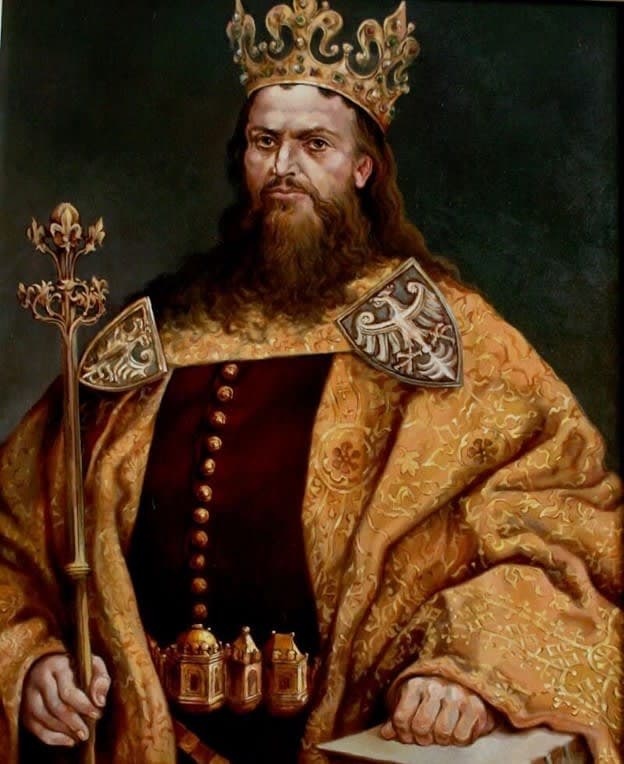

As the third son of King Władysław I the Elbow-high and Jadwiga of Kalisz, Casimir was not initially regarded as the future monarch. However, the premature deaths of his elder brothers, Stephen and Władysław, in 1306 and 1312 transformed the two-year-old child into the Piast dynasty’s only hope of preserving the throne.
Casimir spent his childhood and youth within the formidable walls of Wawel Castle, where he received an excellent education by the standards of his time, preparing him for the complex diplomatic struggles that defined fourteenth-century Europe.
As early as 1315, the five-year-old prince was betrothed to the Bohemian princess Jutta, an arrangement intended to bring an end to the Luxembourg dynasty’s claims to the Polish crown. The engagement, however, was broken off at the initiative of the Bohemian side.
A subsequent engagement to Anna of Habsburg in 1321 likewise failed to result in marriage after her father’s defeat at the Battle of Mühldorf.
Ultimately, Poland turned toward Lithuania. In 1325, the fifteen-year-old Casimir married Aldona, daughter of Grand Duke Gediminas of Lithuania, who adopted the Christian name Anna upon her baptism. This alliance not only strengthened Poland’s eastern frontier but also marked an important stage in the young heir’s introduction to affairs of state.
Casimir’s path to the throne was nevertheless overshadowed by a scandal that emerged during his visit to the Hungarian court in 1329. Sent there by his father to strengthen the anti-Bohemian coalition, Casimir became associated with a tragic affair involving a court lady named Klára Záh.
Historians disagree about the exact nature of their relationship, with interpretations ranging from a secret romance to an act of violence. The consequences, however, were bloody. On April 17, 1330, Klára’s father, Felician Záh, attempted to assassinate the Hungarian royal family. He was killed, and his relatives were subjected to brutal reprisals.
Although contemporary sources did not connect Casimir directly with the incident, later Teutonic propaganda made extensive use of this “Hungarian affair” in an effort to damage the reputation of the future Polish king.
Casimir received his first major military experience in 1331, when his father appointed him governor of Greater Poland, Sieradz, and Kuyavia. Poland was then facing a mortal threat from a Teutonic-Bohemian coalition.
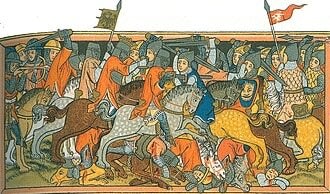
The young prince participated in the famous Battle of Płowce, whose outcome remained disputed. Although Teutonic chroniclers claimed that Casimir fled the battlefield, it is more likely that he withdrew on his father’s orders in order to preserve the life of the heir in case the Polish army was defeated.
After the death of Władysław the Elbow-high on March 2, 1333, Casimir succeeded to the throne at the age of twenty-three. On April 25, he was crowned in Kraków, assuming responsibility for a state in deep crisis: territorially fragmented, surrounded by enemies, and deprived of direct access to the Baltic Sea.


The first years of Casimir’s reign became a triumph of diplomacy. Understanding that Poland was too weak to fight a war on two fronts, he began a sophisticated political game between the Wittelsbach and Luxembourg dynasties.
His greatest early success came at the Congress of Visegrád in 1335, where King John of Luxembourg of Bohemia formally renounced his claim to the Polish throne in exchange for the enormous sum of 20,000 groschen.
The price was considerable: Casimir effectively accepted Bohemian supremacy over Silesia. Nevertheless, the agreement allowed him to establish himself as the internationally recognized and undisputed King of Poland.
Relations with the Teutonic Order required even greater caution. Casimir shifted the dispute from the battlefield to the legal arena, initiating a canonical trial against the Order in 1339.
Although the papal judgment ordering the Teutonic Knights to return the disputed territories was not immediately enforced, it created an important legal foundation for future negotiations.
The dispute culminated in the Peace of Kalisz, concluded on July 8, 1343. Under its terms, Poland recovered Kuyavia and the Dobrzyń Land, although Casimir temporarily renounced direct claims to Pomerelia. The settlement secured relative peace on Poland’s northern frontier for decades.
In the east, Casimir pursued a more expansionist policy. After the poisoning of Prince Yuri-Boleslav in 1340, a prolonged struggle began over the inheritance of the Principality of Halych-Volhynia.
Facing the Lithuanian prince Liubartas and resisting attacks associated with the Golden Horde, including fighting along the Vistula in 1341, Casimir gradually expanded Polish influence eastward. By 1366, he had firmly secured Galicia and part of Volhynia under Polish control.
This expansion dramatically changed the ethnic and religious composition of the kingdom, transforming Poland into an increasingly multiethnic state. The title “King of Poland and Rus’” became firmly established in Casimir’s royal titulature.

Casimir the Great’s domestic reforms were no less ambitious than his territorial expansion. He established a more unified system of royal administration based on officials known as starostas and on the royal council.
The codification of law through the Statutes of Wiślica in the 1340s laid foundations for a more standardized legal system and helped limit arbitrary actions by powerful magnates.
The king devoted enormous attention to economic development. He encouraged the settlement of foreign communities, including Germans, Jews, and Armenians, granted Magdeburg rights to numerous towns, and implemented monetary reforms.
His support for the lower social classes and attempts to protect peasants from abuses by the nobility earned him the popular nickname “King of the Peasants.”
The cultural and educational development of Poland became one of the crowning achievements of his reign. In 1364, Casimir founded the University of Kraków, which would become an important center of European learning, particularly in the field of law.
Perhaps the most visible monument to his era, however, was his enormous program of construction. Stone castles, fortifications, and defensive walls were erected throughout the kingdom.
A famous saying traditionally associated with the chronicler Jan Długosz declares that Casimir “found Poland built of wood and left it built of stone.” Around one hundred new towns were founded or developed during his reign, permanently transforming the economic and urban landscape of the country.
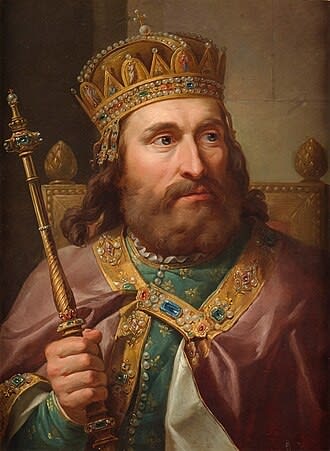
The final chapter of the great king’s life came unexpectedly.
In September 1370, while hunting near Przedbórz Castle, Casimir fell from his horse and fractured his left leg. Complications and a persistent fever, which the king initially tried to ignore, eventually proved fatal.
On November 3, he dictated his final will, and on November 5, 1370, he died at Wawel Castle without leaving a legitimate male heir.
With his death, the male line of the Piast dynasty on the Polish throne came to an end. In accordance with earlier dynastic agreements, the crown passed to his nephew, Louis of Hungary.
Casimir III left behind a powerful, extensively reformed, and internationally respected kingdom, securing his place in history as one of the greatest rulers of medieval Poland.


