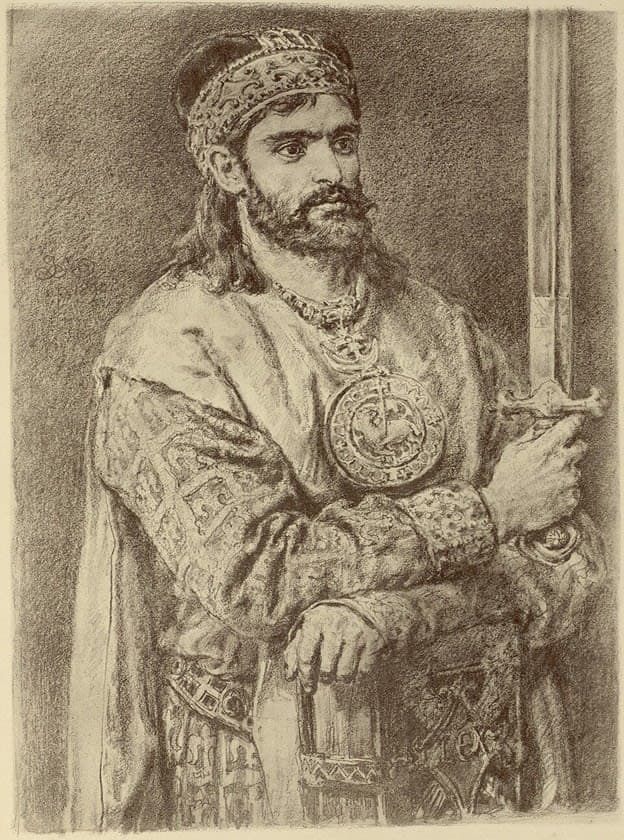

Casimir was born in 1138 — the year that proved fateful for the unity of the Polish state. According to the most widely accepted version, he was the posthumous son of Bolesław III Wrymouth, born around the time of the great duke’s death on October 28. However, the chronicler Wincenty Kadłubek, who lived relatively close to these events, cautiously suggested that Casimir may have been born somewhat earlier and was simply an infant when his father died.
Whatever the exact circumstances, this situation worked greatly to Casimir’s disadvantage: he was not mentioned in his father’s political testament, the famous Statute of Bolesław Wrymouth. While his elder brothers divided the country into separate principalities, Casimir remained a “prince without a principality,” living with his mother, Salomea of Berg, in her widow’s estate at Łęczyca.

After his mother’s death in 1144, the young Casimir came under the guardianship of his elder brother, Bolesław IV the Curly. Casimir’s youth was marked by constant waiting: even after reaching adulthood in 1151, he received not a single piece of territory from his brothers.
Fate continued to test the young prince. In 1157, following Emperor Frederick Barbarossa’s successful campaign against Poland, Bolesław IV was forced to hand Casimir over as a hostage to the German court. Little is known about the years Casimir spent within the Empire, but by 1161 he had returned to Poland, still remaining largely in the shadow of his elder brothers.

A turning point in Casimir’s fortunes came only in 1166, when his brother Henry of Sandomierz was killed during a crusading expedition against the Prussians. Henry, who had no children, had bequeathed his possessions to Casimir, hoping to correct the injustice created by their father’s testament.
High Duke Bolesław IV, however, once again ignored his younger brother’s rights and attempted to incorporate Sandomierz into the Seniorate Province. This became the final provocation. Supported by Mieszko III the Old and the powerful nobility of Lesser Poland, Casimir joined a rebellion against Bolesław.

The struggle produced results in 1168 at the assembly of Jędrzejów. Although Bolesław IV retained the throne, he was forced to compromise. Casimir finally received his first independent territory, although it was only a small principality centered on Wiślica.
Only after the death of Bolesław IV in 1173 did the new princeps, Mieszko III the Old, transfer the entire Duchy of Sandomierz to Casimir, restoring the inheritance that Henry had originally intended him to receive.
Mieszko III the Old’s rule soon acquired a reputation for severity and authoritarianism, provoking growing resentment among the magnates and clergy. In 1177, a major rebellion broke out. Its supporters included Gedko, Bishop of Kraków; Mieszko’s own son Odon; and the Silesian duke Bolesław the Tall.
Casimir, who became one of the principal leaders of the revolt, demonstrated that he was not only a capable warrior but also a skilled diplomat.

While Mieszko III struggled to retain control of Poznań, Casimir rapidly marched on Kraków and seized the city. Seeking to legitimize his authority and neutralize potential rivals, he concluded a series of political agreements.
He granted the towns of Bytom and Oświęcim to Mieszko I Tanglefoot in exchange for recognition of his title, while also helping Bolesław the Tall restore his position in Silesia.
After assuming the title of High Duke of Poland, Casimir II effectively gained control not only of Lesser Poland but also extended his influence over Masovia, Kuyavia, and the vassal territory of Eastern Pomerania, also known as Pomerelia.
One of Casimir’s most important political achievements was the assembly held at Łęczyca in 1180. Seeking to secure the throne for his descendants and obtain the support of the Church, he granted the clergy unprecedented privileges, abolishing several taxes and renouncing certain rights over the property of deceased bishops.
This settlement was sanctioned by Pope Alexander III, giving Casimir’s authority the highest level of ecclesiastical legitimacy.

Casimir’s foreign policy was primarily directed eastward. He actively intervened in the affairs of the Rus’ principalities, employing both military force and dynastic marriages. His daughter Maria, for example, was married to Vsevolod Sviatoslavich, the son of a Kievan prince.
In 1182, Casimir launched a successful expedition against Brest, installing his preferred candidate, Sviatoslav Mstislavich, as ruler.
He later became an important participant in the prolonged struggle for control of Halych, first supporting Roman Mstislavich and later helping Vladimir Yaroslavich regain power. Throughout these conflicts, Casimir skillfully maneuvered between the competing interests of King Béla III of Hungary and Emperor Frederick Barbarossa.
The final years of Casimir’s reign were dominated by an almost continuous struggle to preserve the unity of his territories. In 1186, following the death of his nephew Leszek of Masovia, Casimir inherited Masovia, although the restless Mieszko III the Old temporarily seized Kuyavia.
In 1191, while Casimir was occupied with affairs in Rus’, Mieszko III briefly captured Kraków. Casimir, however, returned with military assistance from Volhynia and recovered the capital with almost no resistance.
At the beginning of 1194, Casimir launched his final victorious campaign, this time against the Yotvingians. He returned to Kraków in triumph, but the celebrations proved short-lived.
On May 5, 1194, during a ceremonial banquet held in honor of the victory, Casimir II the Just suddenly died. The unexpected nature of his death immediately gave rise to rumors that he had been poisoned — a theory that continues to be discussed by historians to this day.


