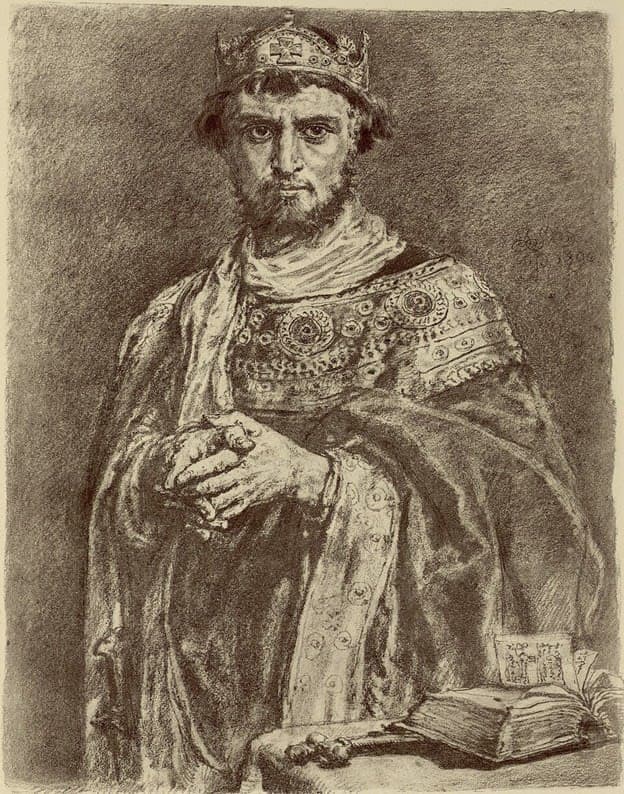

Casimir was the son of the deposed king Mieszko II and Richeza of Lotharingia, a granddaughter of Emperor Otto II. When his father died in 1034, the still-fragile Polish state collapsed under the weight of accumulated problems. Poland found itself at the center of a political storm: the aristocracy and higher clergy, sensing the weakness of central authority, rose in revolt. The young prince and his mother were expelled from the country, signaling the beginning of total chaos.
In the absence of a ruler, the country was overwhelmed by a wave of violence. Christianity, which had been imposed with a firm hand by the early Piast rulers, encountered fierce resistance. In 1037–1038, Poland was shaken by one of the largest popular uprisings of the period — a peasant revolt accompanied by a widespread return to paganism. State authority effectively ceased to exist outside fortified towns. The unity of the country was shattered: Masovia and Pomerania broke away under the rule of local dynasties and declared their independence.


The final devastating blow came with the invasion of the Bohemian duke Bretislav I in 1038. Taking advantage of the anarchy, the Bohemians plundered Gniezno, the spiritual heart of the country. Bretislav carried off to Prague Poland’s greatest sacred relic — the remains of Saint Adalbert, also known as Wojciech — and once again incorporated Silesia into the Bohemian realm. At that moment, Poland effectively ceased to exist as a unified political entity.
Casimir spent the years of his exile first in Hungary at the court of King Stephen I and later in Saxony with his mother. The fate of Poland was now being decided in the imperial chanceries. Emperor Henry III feared that the complete collapse of Poland would lead to an excessive strengthening of Bohemia and to a full-scale pagan restoration along the Empire’s eastern frontier. He therefore decided to support the legitimate Piast heir.
In 1039, relying on German troops and imperial diplomacy, Casimir I returned to his homeland. It was a return to a devastated wasteland, but the prince acted decisively. With the help of foreign soldiers and a small number of loyal supporters, he suppressed the peasant rebellion and forced the aristocracy into submission. The restoration of authority, however, came at a price: Poland was compelled to formally recognize the suzerainty of the Holy Roman Empire, transforming from an independent kingdom into a vassal duchy.


Realizing that imperial support alone would not be enough, Casimir began searching for allies in the east. In 1042, he concluded a crucial strategic alliance by marrying Dobroniega, also known as Maria, the sister of Grand Prince Yaroslav the Wise of Kyiv. This marriage not only brought Casimir a substantial dowry but also secured powerful military support from Kievan Rus’.
With the assistance of his brother-in-law Yaroslav, Casimir was able to begin recovering the lost provinces. In 1047, after a difficult struggle, rebellious Masovia was restored to Piast rule. The international situation, however, remained complicated. Seeking to preserve the balance of power, the emperor did not allow Casimir to fully restore his authority over Pomerania: only its eastern part recognized the prince’s rule, while Western Pomerania remained within the sphere of imperial interests.
Casimir’s final major territorial achievement was the recovery of Silesia in 1054. Although Poland had to agree to pay an annual tribute to Bohemia for the province, the restoration of the wealthy Silesian lands was nevertheless a major success.
Casimir’s domestic policy was focused on the “healing” of the country. He understood that without a strong Church organization, the state could not survive. The prince actively built new churches and monasteries, including the famous Benedictine Abbey of Tyniec, restored the devastated ecclesiastical hierarchy, and worked to rebuild the prestige of the Christian faith.
The outcome of Casimir I’s reign was truly remarkable. Having inherited ruins and a country torn apart by internal and external enemies, he left his successor a restored, stable, and viable state. He was unable to recover the royal crown once held by his father and grandfather, but he preserved Poland itself. For this achievement, he entered history under the honorary name Odnowiciel — “the Restorer.”


