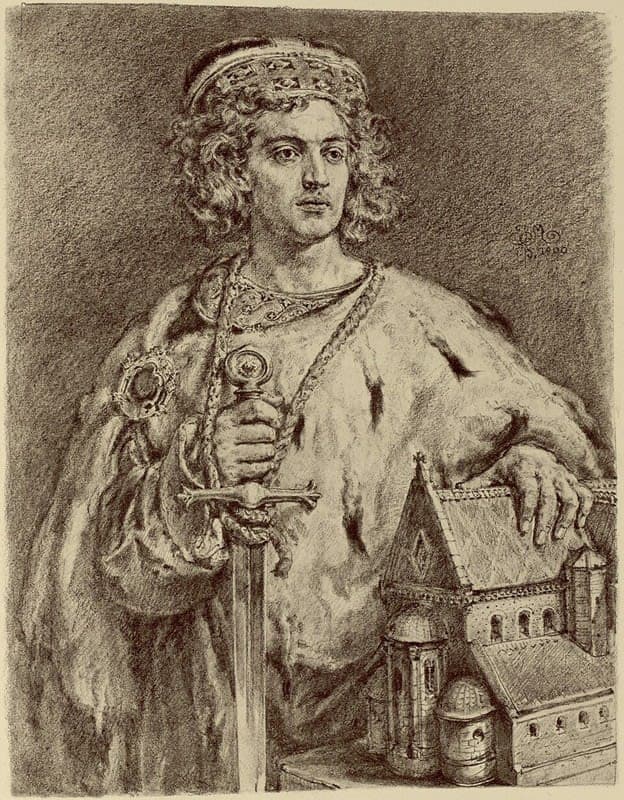

The story of Bolesław IV, remembered in chronicles and popular tradition by the epithet the Curly, is closely tied to the struggle for power that shaped Poland for centuries. As the second surviving son of the distinguished ruler Bolesław III Wrymouth and the eldest child of his second marriage to Salomea of Berg, Bolesław IV found himself at the very center of the dynastic conflicts that followed his father’s death.
Bolesław IV’s life changed dramatically in 1138, when the famous Statute of Bolesław Wrymouth came into force after his father’s death. Under the terms of the testament, the young prince received the Duchy of Masovia. At that time, however, he was hardly an independent political figure. His decisions were strongly influenced by his mother, Salomea, and by the experienced voivode Wszebor.
The latter, a perceptive strategist, had good reason to fear the ambitions of Bolesław’s elder half-brother, Władysław II, who had inherited the Seniorate Province and clearly resented having to share power with his younger relatives.

Tensions developed into open hostility in 1141. Acting without the knowledge of the senior prince Władysław, Salomea of Berg organized an assembly at Łęczyca attended by her younger sons. There, plans were made to strengthen the position of the younger Piasts. One proposal involved marrying Salomea’s daughter Agnes to the Rurikid prince Mstislav Iziaslavich.
The principal source of disagreement was Salomea’s “widow’s portion” — extensive lands that her sons intended to divide among themselves after her death, rather than allow them to return to the Seniorate Province, as Władysław demanded.
The elder brother responded decisively. He seized the diplomatic initiative by concluding an alliance with Grand Prince Vsevolod Olgovich of Kyiv. Bolesław the Curly’s defeat in this diplomatic struggle resulted in personal humiliation: in 1142–1143, he was forced by his brother to travel to Kyiv as an envoy, effectively acknowledging his subordinate position.

The situation became even more tense in 1144, when Salomea of Berg died. Bolesław the Curly and his brother Mieszko formed a united front, demanding that their mother’s lands be transferred to their younger brothers, Henry and Casimir. Władysław II, by contrast, immediately incorporated the Łęczyca lands into his own domain.
Armed conflict became inevitable, and in 1145 the forces of the brothers met in open battle. Although Bolesław the Curly initially suffered defeat at the hands of the princeps, he soon received unexpected support from the Polish nobility.
Władysław’s brutal punishment of the palatine Piotr Włostowic, who was blinded and had his tongue cut out, turned even many of his former supporters against him.

By the spring of 1146, Władysław initially succeeded in expelling Bolesław from Masovia and laying siege to Gniezno. However, a revolt that broke out in his rear, combined with the excommunication imposed on him by Archbishop Jakub of Żnin, forced Władysław to flee the country.
Bolesław IV the Curly triumphantly took control of the Seniorate Province and the throne of Kraków, assuming the title of High Duke of Poland. His brother Mieszko received Greater Poland, while Henry was granted the lands of Sandomierz.
The first attempt at intervention by the German king Conrad III in August 1146 ended in complete failure for the Germans, further strengthening Bolesław’s position.
The following decade was largely devoted to Bolesław IV’s efforts to legitimize his seizure of power internationally. In 1148, at Kruszwica, he concluded an alliance with Albert the Bear, sealing it through the marriage of his sister Judith to the margrave’s son.
Bolesław also demonstrated loyalty to German interests by supporting crusading campaigns against the Polabian Slavs. Nevertheless, he remained under constant pressure from Rome. In 1148, the papal legate Guido of Crema placed Poland under an interdict because of Bolesław’s refusal to restore Władysław to the throne. The Polish clergy, however, showed unusual solidarity with the prince, and the sanctions remained largely ineffective.

The real test came in 1157, when Emperor Frederick Barbarossa launched a campaign against Poland. This time, the scale of the German invasion was so great that Bolesław was forced to concede defeat.
He swore a vassal oath to the emperor, paid a massive indemnity, and handed over his younger brother Casimir as a hostage. Politically, however, Bolesław emerged victorious: the emperor allowed him to retain the title of High Duke, effectively abandoning the cause of the exiled Władysław.
After Władysław’s death in 1159, Bolesław’s position became more secure, although in 1163, under pressure from Barbarossa, he was forced to return Silesia to his nephews, the sons of Władysław the Exile.

The final years of Bolesław IV’s reign were overshadowed by internal conflicts and personal losses. Unsuccessful campaigns against the pagan Prussians drained both the treasury and the army.
In 1166, his brother Henry of Sandomierz was killed in one of these campaigns. Bolesław’s decision to take Sandomierz for himself, while ignoring the claims of Casimir, who until then had not possessed a hereditary domain of his own, provoked a major rebellion among the nobility and his brothers in 1168.
To preserve his position, Bolesław was forced to make concessions, granting Wiślica to Casimir and dividing Henry’s former lands.

Continued conflicts with his Silesian nephews, Bolesław the Tall and Mieszko Tanglefoot, also demanded considerable effort. Despite attempts to launch punitive expeditions against them, Bolesław the Curly ultimately recognized their independent control over Silesia.
In 1172, the situation once again deteriorated because of Frederick Barbarossa’s intervention in Silesian affairs. Bolesław was forced to pay the enormous sum of 8,000 silver coins in order to preserve peace with the Empire.
The final chapter of the High Duke’s life was tragic. In 1172, his eldest son and heir, who was also named Bolesław, died. The loss reportedly devastated the aging ruler.
Bolesław IV the Curly survived his son by only a few months and died on January 5, 1173. His remains were buried in the Cathedral of the Blessed Virgin Mary in Płock, alongside the graves of his father and grandfather.
After his death, the Seniorate throne passed to his brother Mieszko III the Old, but the political contradictions that had deepened during Bolesław’s reign continued to divide Poland for many years.


