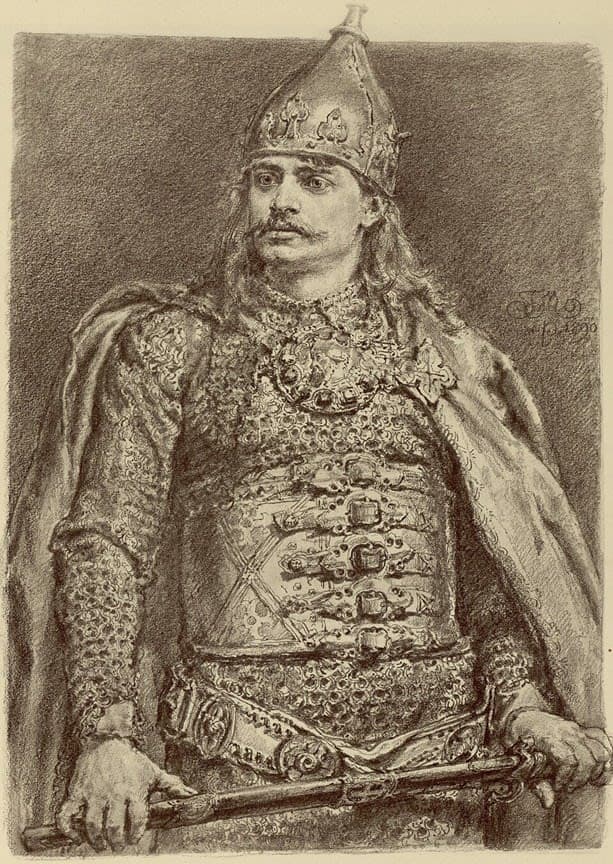

The reign of Bolesław III Wrymouth became the last great period of strength for a united Polish state before the long era of feudal fragmentation. The son of Władysław I Herman, Bolesław differed sharply from his indecisive father. He possessed extraordinary energy and considerable military talent, qualities that enabled him not only to reunify the country but also to restore Poland’s position as an important power on the European political stage.
After the death of his father, Władysław I Herman, in 1102, Poland was divided between two heirs: Bolesław and his elder brother Zbigniew. Their rivalry quickly developed into an open civil war. Supported by the lesser knights, the higher clergy, and alliances with Kievan Rus’ and Hungary, Bolesław gradually pushed his brother aside. In 1106, Zbigniew suffered a decisive defeat and was forced to flee to Pomerania, allowing Bolesław to become the effective ruler of all Polish lands by 1108.
Zbigniew, however, did not surrender and appealed for assistance to Holy Roman Emperor Henry V. In 1109, a German army numbering around ten thousand men — enormous by the standards of the period — invaded Poland. The culmination of the campaign came with the heroic defense of Głogów.
Bolesław III employed guerrilla-style warfare, ambushes, and constant attacks intended to exhaust the enemy. These tactics contributed to the failure of the imperial campaign, the lifting of the siege of Wrocław, and the withdrawal of the emperor’s forces. The Bohemian allies of the Empire were likewise driven from Polish territory.
Having strengthened his position, Bolesław took a ruthless but pragmatic step in 1112: he ordered the blinding of Zbigniew, who had returned to the country, thereby permanently eliminating the threat of divided rule.


Having secured the western frontier, Bolesław III concentrated his efforts on resolving the “Pomeranian question,” which had remained unsettled for more than a century. The conquest of these lands was carried out with exceptional brutality. In 1108, during the siege of the fortress of Wieleń, Bolesław promised to spare the lives of the Pomeranians who surrendered. Once they laid down their weapons, however, he ordered them all to be killed. In 1113, the strategically important fortress of Nakło fell, allowing Poland to restore control over the course of the Noteć River.
The next stage was the conquest of Gdańsk and Eastern Pomerania between 1115 and 1119. The most difficult challenge, however, was Western Pomerania, with its wealthy and largely autonomous cities of Szczecin and Wolin.
In 1121, Polish forces stormed and captured Szczecin, and in 1123 they occupied the island of Rügen. To consolidate these successes, Bolesław launched a large-scale Christianization campaign in the region. In 1124–1125, with the support of Bishop Otto of Bamberg, thousands of pagans were converted to Christianity, while a Pomeranian bishopric was established in Wolin.

Despite these achievements, pressure from the German marcher territories, particularly Brandenburg and Saxony, remained intense. In 1127, the Pomeranian duke Wartislaw attempted to place himself under imperial protection, but in 1129 Bolesław, acting in alliance with Denmark, once again brought the region under his authority.
The long struggle culminated at the Congress of Merseburg in 1135, where Bolesław III was formally recognized as suzerain of Western Pomerania, although he was required to render homage to the emperor for the territory as an imperial fief.
Bolesław’s foreign policy in the east and south was closely intertwined with dynastic interests. Through his marriage to Zbyslava, daughter of the Kievan prince Sviatopolk II Iziaslavich, he became deeply involved in the internal conflicts of the Rurikid dynasty.
Relations with Vladimir Monomakh ranged from open hostility to reluctant cooperation. In 1120, for example, Monomakh even sent troops to assist the Poles. One of the most remarkable episodes of Bolesław’s eastern policy was the capture of Volodar, Prince of Peremyshl, by the voivode Piotr Włostowic, for whom an enormous ransom was subsequently paid.

Bolesław’s policy in the south proved less successful. After supporting Boris Kalamanos, a claimant to the Hungarian throne, he entered into conflict with King Béla II the Blind.
In 1132, Polish forces suffered a crushing defeat in the Battle of the Sajó River, while Silesia was devastated by a Bohemian raid. As a result, in 1135 Bolesław was forced to recognize Béla II as the legitimate king of Hungary, marking the decline of his active expansionist policy in the south.

Anticipating his approaching death and hoping to prevent another fratricidal civil war, Bolesław III issued his famous Testament, or Statute, in 1138. The document introduced the principle of seniority and divided Poland into separate hereditary territories among his sons:
Władysław II the Exile: received Silesia, the Lubusz Land, and the title of princeps, or senior prince of the dynasty.
Bolesław IV the Curly: received Masovia and eastern Kuyavia.
Mieszko III the Old: received most of Greater Poland, including Poznań.
Henry: received the lands of Sandomierz and Lublin.
Salomea, the duke’s widow: received a “widow’s portion,” including Łęczyca and Sieradz, which was later intended to return to the central senioral domain.
According to the Statute, the eldest prince of the dynasty was to hold the title of High Duke of Kraków and control the central, or senioral, province. He was also responsible for the foreign policy and defense of the entire country.
Bolesław III’s death in 1138 became a major dividing line in Polish history. Instead of securing peace, his testament initiated more than two centuries of feudal fragmentation. Weakened by internal struggles, Poland began to lose territory rapidly: Silesia gradually fell under increasing German influence, while control over Pomerania was eventually lost.
Bolesław Wrymouth remained in historical memory as the last of the “great Piasts” whose iron will had preserved the unity of the country. Yet his political legacy unintentionally opened the door to centuries of decentralization and dynastic division.


