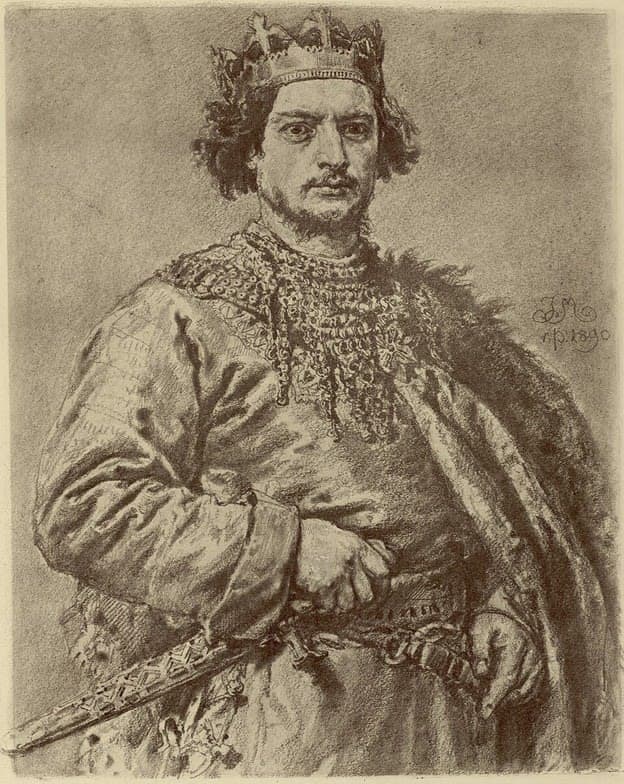

The reign of Bolesław II, who entered history under the epithets the Bold and the Generous, became a period of brilliant but short-lived revival of Polish power. The son of Casimir I the Restorer and the Kievan princess Dobroniega, Bolesław inherited a country that his father had only barely managed to rebuild from ruins. The young ruler, however, had no intention of limiting himself to the cautious role of a “restorer.” The blood of his great-grandfather, Bolesław the Brave, ran in his veins, and he aspired to restore Poland’s position as the dominant power of Central Europe.

From the very beginning of his reign, Bolesław II demonstrated that Poland was once again prepared to dictate terms to its neighbors. His foreign policy became a succession of bold military interventions. He effectively became a “kingmaker” in Hungary. In 1057, his military assistance supported Duke Béla in his struggle against King Andrew I, and seventeen years later, in 1074, Polish forces helped place Géza I on the Hungarian throne, overthrowing Solomon, who was supported by the Empire.

Bolesław was equally active in other directions. In 1061, relying on alliances with the Hungarians and the Rus’, he intervened in internal conflicts in Bohemia, although the campaign failed to bring him the desired success. The principal focus of his eastern policy, however, became Kievan Rus’.
In 1069, following secret agreements and seeking to expand his influence, Bolesław helped Iziaslav Yaroslavich regain the throne of Kyiv. The expedition, however, left a controversial legacy. Polish soldiers quartered in local villages engaged in plundering, provoking such fierce resistance from the population that Bolesław was forced to withdraw his army rapidly in order to avoid triggering a full-scale war with his recent allies.
Bolesław II’s greatest achievement was his skillful exploitation of the rivalries between the major powers of his era. When Europe was divided by the Investiture Controversy between Emperor Henry IV and Pope Gregory VII, the Polish ruler made a bold and strategically calculated choice. He firmly sided with Rome. In 1072, Bolesław committed an act of open political defiance by refusing to pay tribute to the emperor, effectively declaring Poland’s independence.
In 1074, he went even further by recognizing the Polish state as a fief of the Holy See. This strategic alliance with Rome soon produced the desired results. In 1075, papal legates confirmed the rights of the Archdiocese of Gniezno, and the culmination of this process came on Christmas Day, December 25, 1076, when Bolesław II was formally crowned King of Poland.
After decades of turmoil and humiliation, the Polish monarch once again possessed the highest royal title, while the country regained formal sovereignty.
At the height of his power, however, Bolesław encountered forces that could not be defeated by the sword. His attempts to recover Western Pomerania ended in failure, while domestic tensions steadily increased. In 1077, at the request of the pope, he launched a second expedition to Kyiv and once again restored Iziaslav to the throne. The triumph proved short-lived: Iziaslav’s death in 1078 at the Battle of Nezhatyna Nyva deprived Bolesław of his most important ally in the east.


Within Poland, dissatisfaction was growing among the magnates, whose independence was increasingly restricted by the king’s authoritarian style of government. The opposition received support from Bohemia and the Empire, both of which regarded a powerful Poland as a threat.
The decisive turning point came with Bolesław’s conflict with Bishop Stanislaus of Kraków. Accusing the bishop of treason, the king ordered his execution on April 11, 1079. The event, whose precise circumstances remain surrounded by mystery and legend, became the catalyst for a nationwide revolt.
Bolesław’s younger brother, Władysław Herman, rose against the king and became the symbolic leader of the rebellious aristocracy. In the same year, 1079, Bolesław II was overthrown and forced to flee to Hungary.
The man who only recently had imposed his will upon kings ended his life in exile two years later. His death in 1081 — according to some traditions, at Ossiach Abbey — marked the end of one of the most brilliant phases of the early Piast monarchy.
Władysław I Herman succeeded him to the throne, and under his rule Poland once again entered a period of political decentralization and growing dependence on its neighbors.


