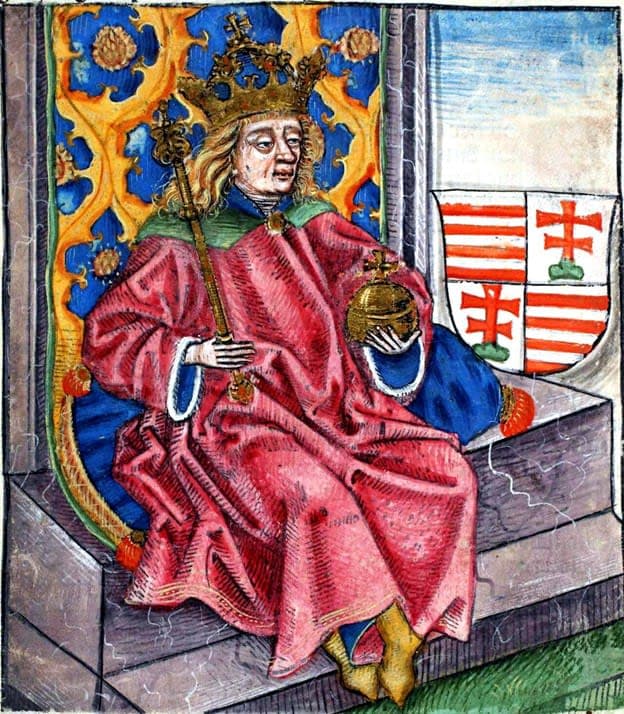

His destiny had been determined even before his birth.
The eldest son of King Andrew II the Crusader and his first wife, Gertrude of Merania, Béla was born under the shadow of enormous political expectations.
At the categorical insistence of Pope Innocent III, even before the boy came into the world, the highest ecclesiastical and secular dignitaries of Hungary had sworn an oath to recognize him as his father's legitimate successor.
However, the heir's childhood was shattered by a bloody tragedy.

On September 28, 1213, the seven-year-old Béla apparently became an unwilling witness to a horrifying event: a group of noble Hungarian conspirators brutally murdered his mother, Queen Gertrude.
What followed created an unbridgeable divide between father and son.
Instead of unleashing the full force of royal vengeance upon the murderers, King Andrew II ordered the execution of only the conspiracy's leader, granting forgiveness to the others.
A burning resentment toward his father and a thirst for revenge took root in the young prince's heart. For a time, these feelings could be restrained only by his gentle sister Elizabeth, who would enter history as the celebrated Saint Elizabeth of Hungary.

Meanwhile, the machinery of politics continued to turn.
In early 1214, the young Béla was betrothed to the daughter of the Bulgarian tsar Boril, and shortly afterward, the crown of "Junior King" was placed upon his head.
When Andrew II departed for the Fifth Crusade in August 1217, the heir's safety was entrusted to his maternal uncle, Berthold of Merania, Archbishop of Kalocsa.
Fearing for his nephew's life in the troubled kingdom, Berthold took him to Styria and confined him within the impregnable fortress of the town of Steyr.
Béla was able to return to his homeland only a year later, in 1218, at the same time as his father's return from the Holy Land.
In 1220, the fourteen-year-old Béla married the Byzantine princess Maria Laskarina, daughter of the Nicaean emperor Theodore I Laskaris.
That same year, his father entrusted him with the administration of Slavonia.
However, the Hungarian court was filled with intrigue.
Andrew II, who had negotiated this marriage during his return journey from the Crusade, soon became disillusioned with the alliance with the Empire of Nicaea.
In 1222, he forcibly separated his son from his wife.
Béla refused to accept this decision.
Having secured the support of Pope Honorius III, who declined to annul the marriage, the "Junior King" took Maria and fled to Austria, finding refuge with Duke Leopold of the House of Babenberg.

Only the intervention of the pontiff compelled father and son to reconcile.
Béla not only regained his wife but was also entrusted with the administration of Slavonia and Dalmatia.
As governor, he began acting with severity and uncompromising determination.
Having obtained papal authorization, he started reclaiming the royal estates that his father had generously distributed among his favorites during the first half of his reign.
Béla forcibly brought rebellious barons into submission. For example, he besieged and captured the Croatian fortress of Klis, compelling its owner to acknowledge his authority.
Dissatisfied with his son's independent actions, Andrew II transferred him to Transylvania in 1226, granting him the title of duke.
Here, Béla demonstrated his abilities as a farsighted statesman.
He actively supported the missionary activities of the Dominican Order among the Cuman tribes who roamed the territories west of the Dniester River.
This policy bore fruit around 1228, when the Cuman chieftains Bartz and Membrok converted to Christianity and acknowledged Béla's authority.
That same year, 1228, the restless duke, with his father's reluctant consent, resumed his investigation into "unnecessary and useless" land grants throughout the kingdom.
However, fortune turned against him in Galicia.
Béla suffered a military setback while attempting to assist his brother Andrew, sharply weakening his influence at court.
The king immediately prohibited any further review of land grants.
In the early 1230s, Béla was forced to submit to his father, participating in his military campaigns against Daniel of Galicia and the Duke of Austria.
Relations between father and son reached the point of no return on May 14, 1234, when the aging Andrew II married Beatrice d'Este, an Italian princess thirty years younger than himself.

On September 21, 1235, Andrew II died, and Béla IV became the kingdom's sovereign monarch.
On October 14, Archbishop Robert of Esztergom solemnly crowned him in Székesfehérvár.
The new king's very first actions were driven by an iron will and deeply rooted hatred.
He immediately accused his young stepmother and his late father's principal adviser of adultery and had them thrown into prison.

Béla's principal objective was to restore absolute royal authority.
To teach the increasingly arrogant barons a lesson, he staged a symbolic demonstration: he ordered the chairs of the royal councilors to be publicly burned, declaring that henceforth everyone would stand in the king's presence.
At the same time, he focused on urban development, confirming the charter of Székesfehérvár and granting new, extensive privileges to Pest, Trnava, Banská Štiavnica, Krupina, Zvolen, and Esztergom.
The king's gaze extended far beyond the kingdom's borders.
He dispatched the monk Julian eastward in search of the ancestral homeland of the Hungarians.
In 1238, Julian returned with terrifying news: an innumerable Mongol horde was advancing from the east.
Recognizing the magnitude of the threat, Béla IV took an unprecedented step.
He opened Hungary's borders to 40,000 Cumans fleeing the Mongols in exchange for their oath to serve in the royal army.
However, the nomadic customs of the Cumans encountered fierce hostility from the Hungarian population, and the kingdom became divided from within.
The barons, who hated the king for his reforms, refused to assemble their troops without political concessions and demanded the expulsion of the Cumans.
Béla stood firm.

Catastrophe struck in the spring of 1241.
On March 12, the tümens of Batu Khan broke through the defensive barriers in the Carpathian Mountains.
Panic spread throughout the country.
On March 14, the Hungarian barons committed a fatal mistake.
They stormed the residence of Köten, the Cuman khan, where he was staying with his family and noble chieftains.
Driven into a corner, Köten killed his wives and then took his own life, while his chieftains fell in the ensuing struggle.
Enraged by this betrayal, the Cumans rebelled.
They slaughtered the militia of the Bishop of Csanád, which had been marching to assist the king, and fought their way out of Hungary into Bulgaria.
Béla IV had lost his most battle-ready allies, but he nevertheless managed to assemble an army of approximately 40,000 warriors.
On April 11, 1241, at the Sajó River, in the Battle of Mohi, the Hungarian army was virtually annihilated.

Having fled the battlefield, the king retreated to Bratislava and then to Hainburg, seeking refuge with his longtime rival, Duke Frederick II the Quarrelsome of Austria.
The Austrian duke exploited Béla's desperate situation.
He seized the royal treasury and forced the Hungarian monarch to surrender three western counties.
Taking refuge in Zagreb, Béla desperately appealed for assistance to Emperor Frederick II of Hohenstaufen and Pope Gregory IX, even offering to acknowledge the suzerainty of the Holy Roman Empire.
But the West remained silent.

Meanwhile, the Mongols were reducing prosperous Hungary to ashes.
Pest was burned to the ground, and Buda lay in ruins.
In January 1242, when the Danube froze, the Asian cavalry crossed to its western bank.
Kadan, a Mongol commander, received a personal order from Batu Khan: capture the king at any cost.
A desperate pursuit began through the mountains of Croatia.
Mistakenly believing that Béla was hiding in the fortress of Klis, the Mongols lost valuable time.
The king had taken refuge on the island of Rab, then fled to Split, and from there, consumed by fear, to the island town of Trogir, keeping a ship ready for escape to Italy.
Death seemed to be breathing down his neck as Kadan, having plundered Zagreb and advanced along the Dalmatian coast, launched his final tümen against the coastal cities.
The Croats offered fierce resistance at Rijeka.
Exhausted by the mountainous terrain, the Mongols began to lose their strength.
Then came the news that changed the course of history: far away in Mongolia, the Great Khan Ögedei had died.
Batu turned his tümens eastward to participate in the kurultai, the great Mongol assembly, thereby saving Central Europe.

Returning to the smoking ruins of his kingdom, Béla IV radically transformed his policies.
Having learned a lesson written in blood, he once again began granting lands to the barons, but under one uncompromising condition: a stone castle had to be constructed on every newly granted estate.
The Hungary of wooden fortifications became a thing of the past. Cities were surrounded by powerful stone walls.
The king once again invited the Cumans into the country, settling them on the devastated lands between the Danube and Tisza rivers.
Within an astonishingly short period — just four years — Béla succeeded in erasing much of the devastation, earning himself the honorary title of the "Second Founder of Hungary" for generations to come.
The foreign policy of the restored kingdom became increasingly aggressive.
As early as 1242, Béla launched an attack against Austria, recaptured Sopron and Kőszeg, and forced Frederick II to relinquish the counties he had previously seized.
On June 30, 1244, he concluded a pragmatic peace agreement with Venice, surrendering Zadar but retaining one-third of Dalmatia's customs revenues.
For many years, the king continued intervening in the affairs of Galicia.
In 1245, he supported his son-in-law, Prince Rostislav Mikhailovich of Chernigov, but suffered defeat at the hands of Daniel of Galicia in the Battle of Yaroslav.
In 1249, the Hungarians suffered another devastating defeat on the San River.
Finally, in 1250, Béla and Daniel concluded a definitive peace treaty in Zvolen.
In 1249, the king also strengthened his southern frontiers by granting part of the Banat, the Banate of Severin, to the Knights Hospitaller amid rumors of another imminent Mongol invasion.

On August 21, 1245, Pope Gregory IX released Béla from the oath he had sworn to the emperor during the days of his desperation.
The Austrian duke Frederick II attempted to take revenge.
However, in 1246, although the Hungarian troops faltered during the Battle of the Leitha River, Frederick himself was killed in combat.
The Babenberg dynasty came to an end, and Béla IV entered into a prolonged struggle over the Austrian inheritance.
Beginning with political intrigues in 1247, he eventually sent his troops into Austria in 1252, advancing as far as Vienna.
His principal rival became King Ottokar II of Bohemia.
After lengthy negotiations, peace was concluded in Bratislava (Pressburg) in 1254.
Under the agreement, Béla received the Duchy of Styria and Wiener Neustadt.

However, holding the newly acquired territories proved more difficult than conquering them.
The Styrian population gravitated toward Bohemia.
After suppressing a rebellion in 1258, Béla appointed his son Stephen as Duke of Styria.
But in 1260, Styria rebelled once again, this time with the direct support of Ottokar II.
The decisive confrontation took place on July 12, 1260, at the Battle of Kressenbrunn.
The Hungarians suffered a crushing defeat, forcing Béla to permanently renounce his claims to Styria in favor of the Bohemian crown.

The conclusion of the foreign wars became the prelude to an internal tragedy.
As early as 1246, Béla had crowned his eldest son Stephen as "Junior King," but he had no intention of sharing real political authority with him.
By 1258, the ambitious Stephen had assembled his own army and wrested control of Transylvania from his father.
Although father and son fought together against the Second Bulgarian Empire in 1261, their relationship rapidly deteriorated.
The aging king openly favored his daughter Anna and his younger son, Béla, Duke of Slavonia, over Stephen.
The royal court split into two hostile factions.
In the summer of 1262, the prelates succeeded in securing the Agreement of Pressburg, under which Stephen received authority over the territories east of the Danube.
But peace was merely an illusion.

In 1264, Stephen directly challenged his father by confiscating the estates belonging to his mother and sister within the territories under his authority.
Enraged, Béla IV dispatched an army, captured the rebel's wife and son, and surrounded Stephen himself in the fortified castle of Codlea, known as the "Black Castle."
However, Stephen managed to break through the encirclement.
In March 1265, at the Battle of Isaszeg, the forces of the "Junior King" decisively defeated the royal army, commanded by Béla Rostislavich, Ban of Macsó.
Béla IV was forced to capitulate to his own son.
On March 23, 1266, on Rabbit Island (Margaret Island) in Buda, father and son reaffirmed the terms of their peace agreement.
These arrangements were subsequently ratified in 1267 at an assembly of the aristocracy in Esztergom.
The dynasty's final joint military triumph came in 1267–1268, when the Serbian king Stefan Uroš I invaded the province of Macsó.
The combined forces of Béla IV and Ban Béla Rostislavich defeated the Serbs.
Stefan Uroš was taken prisoner by the Hungarians and forced to pay an enormous ransom.
According to some accounts, he also acknowledged Hungarian suzerainty.
The peace was reinforced through a dynastic marriage: Béla IV's granddaughter, Catherine Árpád, married the Serbian prince Stefan Dragutin.

During the final years of his life, Béla IV sought support beyond the borders of his increasingly troubled kingdom.
He concluded a powerful strategic alliance with Charles I of Anjou, King of Sicily and brother of the French monarch.
This alliance was strengthened through a double marriage arrangement.
Béla's grandson, Prince Ladislaus the Cuman, was betrothed to Princess Isabella of Sicily, while his granddaughter Maria was promised in marriage to the heir, Charles II the Lame.
Decades later, this very agreement would pave the way for the Angevin dynasty to ascend the Hungarian throne.

Yet personal happiness continued to elude the aging king.
In the summer of 1269, his beloved son, Béla, Duke of Slavonia, died.
Overwhelmed by grief, the monarch fell completely under the influence of his daughter Anna.
In his final will, Béla IV, who had never forgiven his eldest son, entrusted the guardianship of the kingdom to his daughter Anna and her son-in-law, King Přemysl Ottokar II of Bohemia.
On May 3, 1270, the great king who had raised his country from the ashes died unexpectedly.
Princess Anna fled in fear to Prague, taking part of the royal treasury with her, while Stephen V claimed the Hungarian throne by right of force.
Despite years of anarchy and family warfare, the memory of Béla IV remained honored throughout the centuries.
For the generations who had survived the horrors of Mongol devastation and the turmoil that followed the king's death, he became a symbol of order and national rebirth.
The epitaph carved upon his tomb declared:
"As long as your power endured, O King Béla, deceit remained hidden, peace stood firm, and honesty prevailed."


