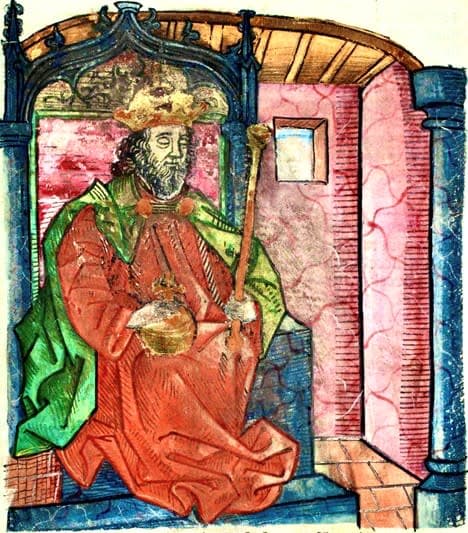

The life of King Béla II represents one of the darkest and most tragic chapters in the history of the Hungarian crown, beginning with a brutal act of mutilation.
Around 1115, when Béla was only seven years old, he became an innocent victim of the relentless political ambitions of his father, Prince Álmos.
For many years, Álmos had repeatedly launched rebellions in an attempt to overthrow his elder brother, the reigning King Coloman I the Learned.
Eventually, the patience of the enlightened but stern monarch ran out.
Enraged by the endless betrayals, Coloman issued a horrifying order: Álmos and his completely innocent young son Béla were to be blinded, permanently eliminating this branch of the dynasty from the struggle for power.

The mutilated father and son were thrown into the gloomy confines of a monastery in Dömös, near Esztergom.
The little boy was condemned to a life of eternal darkness.
However, even the loss of his sight could not break Álmos's rebellious spirit.
The blinded prince refused to surrender and, in 1126, made yet another truly desperate attempt to launch a rebellion.
After suffering another predictable failure, Álmos was forced to leave his homeland forever and flee to Byzantium, where he died in 1127.
By that time, the Hungarian throne was already occupied by Stephen II, the son of Coloman the Learned, who had succeeded his father in 1116.
Following his father's escape, the young blind Béla was secretly sheltered and protected by compassionate monks, who saved him from the possible wrath of the ruling branch of the dynasty.

However, fate was preparing an extraordinary twist.
King Stephen II, who suffered from extremely poor health and had no children of his own, was facing a profound succession crisis.
According to ancient chronicles, toward the end of his life, which had been filled with wars and disappointments, Stephen was genuinely delighted to learn that his blinded cousin was still alive and secretly living somewhere in Hungary.
Perhaps driven by remorse for his father's sins, or by a pragmatic desire to keep the crown within the Árpád dynasty, Stephen II searched for Béla and eventually found him.
He showered the blind young man with royal favors, granting him extensive estates in Tolna, officially declaring him his legitimate heir, and personally arranging his marriage.
Béla's bride was Princess Helena (Ilona) of Serbia — the strong-willed and commanding daughter of Uroš I Vukanović, the powerful župan of the Serbian Principality of Raška.
This marriage was destined to change the course of Hungarian history.

Immediately after Béla II ascended the throne in 1131, it became clear that much of the real political power would rest in the hands of his wife.
Queen Helena, who became the eyes and principal support of her blind husband, proved to be a woman of extraordinary political determination and chilling ruthlessness.
On the occasion of Béla's coronation, a great national assembly (országgyűlés) was convened near the city of Arad, bringing together the most distinguished members of the Hungarian aristocracy.
What should have been a solemn ceremony in which the nobles swore allegiance to their new sovereign was transformed, by the queen's will, into an enormous and merciless massacre.
The Assembly of Arad became the setting for a terrible act of revenge against everyone who was directly or indirectly suspected of having participated in the blinding of Béla and his father sixteen years earlier.
At Helena's signal, warriors loyal to the crown descended upon the unarmed barons.
On that day, as the chronicles record with chilling detachment, 68 of the kingdom's most distinguished noblemen were brutally murdered or executed.
The historical chronicles leave little doubt that Queen Helena herself was the principal driving force and ruthless architect of this massacre, clearing the way for her husband's secure reign.
However, internal terror did not protect Hungary from external threats.
At the very beginning of Béla II's reign, Boris Kolomanović decided to exploit the king's blindness and the political instability within the country.
Boris was the son of the Rus' princess Euphemia, daughter of Vladimir Monomakh, and, allegedly, King Coloman the Learned himself.
Yet the circumstances of his birth were surrounded by scandal.
Years earlier, Coloman had accused his young wife of adultery, categorically refused to recognize her child as his own, and disgracefully sent the pregnant Euphemia back to Kiev.

Years later, the ambitious Boris regarded the transfer of the crown to a blind monarch as the perfect opportunity to assert his own claim to the inheritance of the Árpád dynasty.
Having secured substantial military support from the Polish king Bolesław III, the pretender invaded Hungary.
In response, Béla II relied on his Austrian allies.
This diplomatic connection had been established in advance when Béla arranged the marriage of his sister Hedwig (Jadwiga) to the eldest son of the powerful Austrian margrave Leopold III.
On the eve of the decisive confrontation, Queen Helena once again demonstrated her iron will.
She summoned the Hungarian nobility and issued an ultimatum, demanding that every nobleman swear an oath declaring Boris an illegitimate bastard with absolutely no right to the throne.
Those few who dared to remain silent or refused to take the oath were immediately put to death in the military camp.
Having secured the loyalty of his forces, the combined Austro-Hungarian army marched to confront the enemy.
On July 22, 1132, a great battle erupted on the banks of the Sajó River.
The army of Boris and his Polish allies suffered a crushing defeat.
The pretender himself managed to escape, but his forces had been broken, and he no longer represented a serious threat to Béla's crown.
Because of his physical disability, King Béla II was effectively unable to command armies independently or personally oversee every detail of state administration.
Power was therefore divided among the members of his closest circle.
The principal figures on Hungary's political stage became the uncompromising Queen Helena and her brother Beloš, whom she had prudently appointed to the kingdom's highest military position — commander-in-chief of the royal army.
It was under Beloš's talented leadership that Hungary launched a large-scale counteroffensive along its external frontiers.
In 1136, Hungarian forces triumphantly restored royal control over a significant portion of the previously lost territories of Dalmatia.
Then, in 1137, the army invaded Bosnia and conquered it completely.
To consolidate this victory, the king's young son, Prince Ladislaus, was solemnly proclaimed Duke of the conquered Bosnia.

The ambitions of the Hungarian court extended far beyond the Balkans.
In 1139, a Hungarian army numbering an enormous 30,000 men by the standards of the time crossed the Carpathian Mountains to intervene openly in the complicated civil wars among the princes of Rus'.
Acting in a strong alliance with Prince Yaropolk of Kiev, the son of Vladimir Monomakh, the Hungarian forces laid a tight siege around Chernigov.
The combined army was so powerful that Prince Vsevolod Olgovich of Chernigov was forced to capitulate and sue for peace on terms dictated by his enemies.
Portrait of Prince Yaropolk from the Titulyarnik of Hilarion the Humble, produced for the Trinity Cathedral.

But while the royal banners were winning glory in Dalmatia, Bosnia, and Rus', the king himself was slowly fading away in the darkness of his chambers.
Excluded from actual government affairs by his domineering wife and brother-in-law, tormented by the ghosts of his past and the burden of his blindness, Béla II sought the only consolation and entertainment available to him at the bottom of a wine cup.
His destructive addiction to wine rapidly undermined his already fragile health.
On February 13, 1141, King Béla II the Blind died an inglorious death from the severe consequences of chronic alcoholism.
The country over which he had nominally presided stood at the height of its power, yet this greatness had brought the monarch himself no happiness.
Immediately after his death, his eldest son, Géza II, was proclaimed the new sovereign of Hungary, destined to open a new chapter in the kingdom's history.
King Géza II. Illuminated initial from the Hungarian Illuminated Chronicle.


