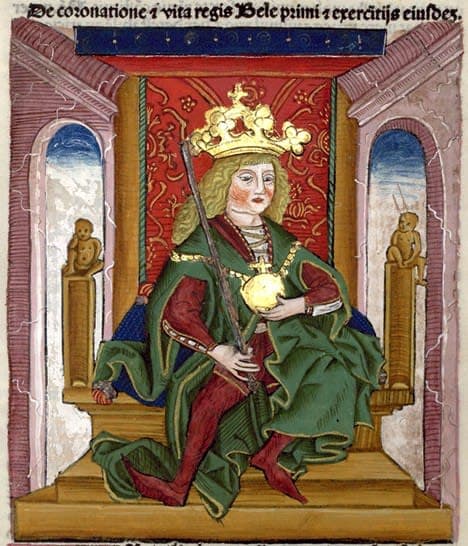

Béla was born around 1016, although some researchers place his birth somewhere between 1015 and 1020.
Most ancient chronicles, such as Simon of Kéza's Gesta Hunnorum et Hungarorum (The Deeds of the Huns and Hungarians) and the Illustrated Chronicle Compilation, initially identified his father as Ladislaus the Bald, a cousin of Hungary's first king, Stephen I.
However, the chroniclers themselves, often confused by the complicated genealogy, frequently added that Béla and his two brothers, Andrew and Levente, were actually the sons of Vazul, Ladislaus's own brother.
Today, historians have reached a consensus: the father of the three princes was indeed Vazul, while their mother was his concubine, a mysterious "girl from the Tátony clan."
The origin of Béla's name also remains a mystery. Polish and Hungarian scholars, including Swoboda, Kristó, and Makk, believe that it derives from the Turkic title bujla, meaning "noble," although they do not rule out a connection to the Slavic word for "white" or even a biblical origin.

The carefree youth of the young princes came to an abrupt end on September 2, 1031.
On that day, Emeric, the only son and legitimate heir of King Stephen I, died tragically.
Vazul automatically became the principal claimant to the throne. However, the aging king, suspecting his relative of secretly sympathizing with paganism, decided to pass the crown to his nephew, Peter Orseolo.
To clear Peter's path to the throne and permanently deprive Vazul of his claim, Stephen resorted to a horrifying measure: he ordered the claimant to be blinded.
Realizing that they themselves would be the next victims, Béla and his brothers hastily fled Hungary.
Their exile began in Bohemia, where the princes, deprived of their homeland and titles, found themselves, in the words of the chroniclers, "in want and poverty."
Unable to find suitable refuge, they traveled farther north to Poland.
There, the exiles encountered an entirely different reception: they were welcomed warmly and generously at the court of King Mieszko II.
It was in Poland that Béla's military glory began to rise.

Hungarian chronicles have preserved a fascinating story of how Pomerania refused to pay its traditional tribute to the Polish crown.
When the opposing armies confronted one another, it was decided that, rather than shed blood in a full-scale battle, the dispute would be settled through single combat between their champions.
Seeing that King Mieszko and his sons hesitated to confront the mighty pagan chieftain of the Pomeranians, young Béla stepped forward.
Through an interpreter, he proudly declared that, as a man of noble blood, he was prepared to cross swords in defense of his Polish overlord's honor.
The duel was fierce.
Armed with a spear, Béla charged his opponent with such devastating force that he knocked him out of the saddle, then struck him down with his sword.
The astonished Pomeranians acknowledged their defeat and paid the tribute without protest.
Impressed by Béla's courage and strength, Mieszko II granted him the right to keep all the tribute collected from Pomerania, awarded him extensive fertile lands, and gave him his daughter Rixa in marriage (in some sources, she is referred to as Adelaide).
Before the wedding, Béla converted to Christianity, receiving the baptismal name Adalbert.
In 1034, Mieszko II died, and his son Casimir was driven into exile.
Poland descended into a period of bloody anarchy that lasted until 1039.
During this dark period, Béla, possessing both military talent and extensive estates, not only survived but, according to some historians, effectively governed the devastated country on behalf of his absent brother-in-law.
There is, however, another theory suggesting that Béla returned to Poland together with Casimir after 1039.
Whatever the truth, around 1038 his brothers, Andrew and Levente, decided to leave the Polish court.
The Illustrated Chronicle Compilation records their motives without sentiment: the proud princes had no desire to languish as dependents who were regarded at court merely as "the brothers of that mighty Béla."
They departed for Kiev.

A whole decade passed.
In 1046, the pagan uprising led by Vata erupted in Hungary. King Peter Orseolo was overthrown, and Andrew, who had returned from Kiev, became the new ruler.
Levente died shortly afterward, and the childless Andrew, desperately needing a reliable ally, turned to Béla.
"We shared poverty and hardship together," he wrote to his brother. "For me, there is neither heir nor brother other than you."
Deeply moved by these words, Béla triumphantly returned to his homeland in 1048, accompanied by his entire family.
The king rewarded his brother generously, granting him the title of duke and bestowing upon him the ducatus — one-third of the entire territory of the kingdom.
Béla's possessions included extensive territories in the east and north, including the autonomous Principality of Nitra and the historic County of Bihar.
Béla acquired enormous authority. He constructed powerful wooden palisades and earthen ramparts in Nitra, collected taxes, and even minted his own coins bearing the proud inscription "BELA DUX" ("Duke Béla").
During the early 1050s, the brothers acted as a single, unbreakable force, jointly developing brilliant military strategies against the invading German armies of the Holy Roman Empire.
It was in the crucible of these battles that Béla, distinguished by his extraordinary physical strength and fearlessness, earned the respectful nickname "the Bison" among his warriors.
The chroniclers emphasized that the brothers lived "in great tranquility and peace," even after the birth of the king's son Solomon in 1053.
Béla humbly accepted this development, and in 1055 he joined the king in the solemn ceremony marking the laying of the foundation stone of the magnificent Tihany Abbey.


But the poison of power was slowly corrupting their alliance.
Their relationship suffered a fatal rupture in 1057 or 1058, when Andrew, disregarding his earlier promises, proclaimed the young Solomon heir to the throne.
This decision was dictated by the demands of international politics. The Holy Roman Empire categorically refused to allow the young German princess Judith to marry Solomon unless he had already been crowned.
The climax of the brothers' conflict came during a famous meeting at a royal estate.

Béla had already been warned by his secret supporters that if he touched the crown, assassins concealed in the shadows would immediately take his life.
Maintaining his composure, the duke chose the sword.
Yet he was under no illusions.
Immediately after this chilling audience, he fled to Poland, seeking refuge with his nephew, Bolesław II the Bold, described in the account as Rixa's son.
The paralyzed Andrew I forces his brother Béla to choose between the crown and the sword.
In the autumn of 1060, Béla "the Bison" returned to Hungary not as an obedient vassal, but as an avenger at the head of Polish forces.
German regiments came to Andrew's aid.
The terrible fratricidal war ended swiftly. In two major battles — on the Tisza River and near Wieselburg — Béla's army completely defeated the royal forces.
The severely wounded Andrew died soon afterward, while his supporters fled in panic to Germany, taking the young Solomon with them.
On December 6, 1060, Béla I was solemnly crowned in Székesfehérvár.
From the very first days of his reign, he showed himself to be not a vengeful tyrant, but a wise statesman.
He strictly forbade anyone from harming the wives, children, or property of the noblemen who had fled to Germany with Solomon.
This generosity made it possible to reconcile the divided aristocracy quickly. Many supporters of the exiled prince returned and swore allegiance to the new king.

Béla energetically set about implementing reforms.
He completely reorganized the financial system, introducing large coins minted from pure, unalloyed silver.
To rescue the economy, the king imposed fixed prices with a firm hand and ruthlessly suppressed the black market.
One of his most controversial decisions was to move the weekly markets from Sunday to Saturday.
As historian Nora Berend notes, this was done not only to observe the Christian day of rest but also to support local merchants by pushing Jewish traders out of the marketplace, since their religion strictly prohibited them from working on Saturdays.
It was Béla I who laid the foundations of Hungarian parliamentarism.
Seeking popular support for his reforms, he dispatched heralds throughout the country, ordering every village to send two elders with voting rights to the royal council.
However, this democratic initiative nearly cost him his crown.
Emboldened commoners, suffering under heavy taxation and dissatisfied with forced Christianization, arrived in Székesfehérvár and demanded what seemed impossible: the expulsion of all Catholic priests and the restoration of paganism throughout the country.
Béla requested three days to consider their demands.
He did not repeat the mistake of his brother Andrew, who had once made a bargain with the pagans.
Three days later, the warrior king simply summoned garrisons from neighboring castles and harshly, but without bloodshed, dispersed the crowd, permanently suppressing pagan resistance in Hungary.
Despite his domestic successes, the shadow of an external threat loomed over Béla.
He made every effort to establish peace with the Holy Roman Empire, even generously releasing all the German commanders who had been captured during the civil war.
But the advisers of the young Emperor Henry IV were determined to seek revenge.
In the summer of 1063, a powerful alliance of German princes marched against Hungary, intending to restore Solomon to the throne.
The aging king, hoping to spare his country the devastation of war, planned to make concessions and even abdicate in favor of his nephew, provided that Solomon agreed to return his former extensive ducatus.
But fate intervened, striking not with a sword, but through a seemingly absurd accident.
While staying at the royal estate of Dömös, Béla was sitting on his massive wooden throne when it suddenly collapsed beneath him.
The injuries he sustained proved fatal.
The severely injured, "half-dead" king, still attempting to direct the kingdom's defense, was carried toward the western frontier to confront the approaching enemy.
Béla I died during the journey, near the Kinizsa stream, on September 11, 1063.
His body was buried in the Benedictine Abbey of Szekszárd, which he himself had founded just two years earlier.
With his death, the king's sons — Géza, Ladislaus, and Lampert — were forced to seek refuge in Poland, surrendering the Hungarian throne to Solomon.
Thus ended the life of Béla the Bison, a man who had secured the Pomeranian tribute for Poland, shattered the empire's ambitions, and united Hungary — yet could not outwit his own destiny.


