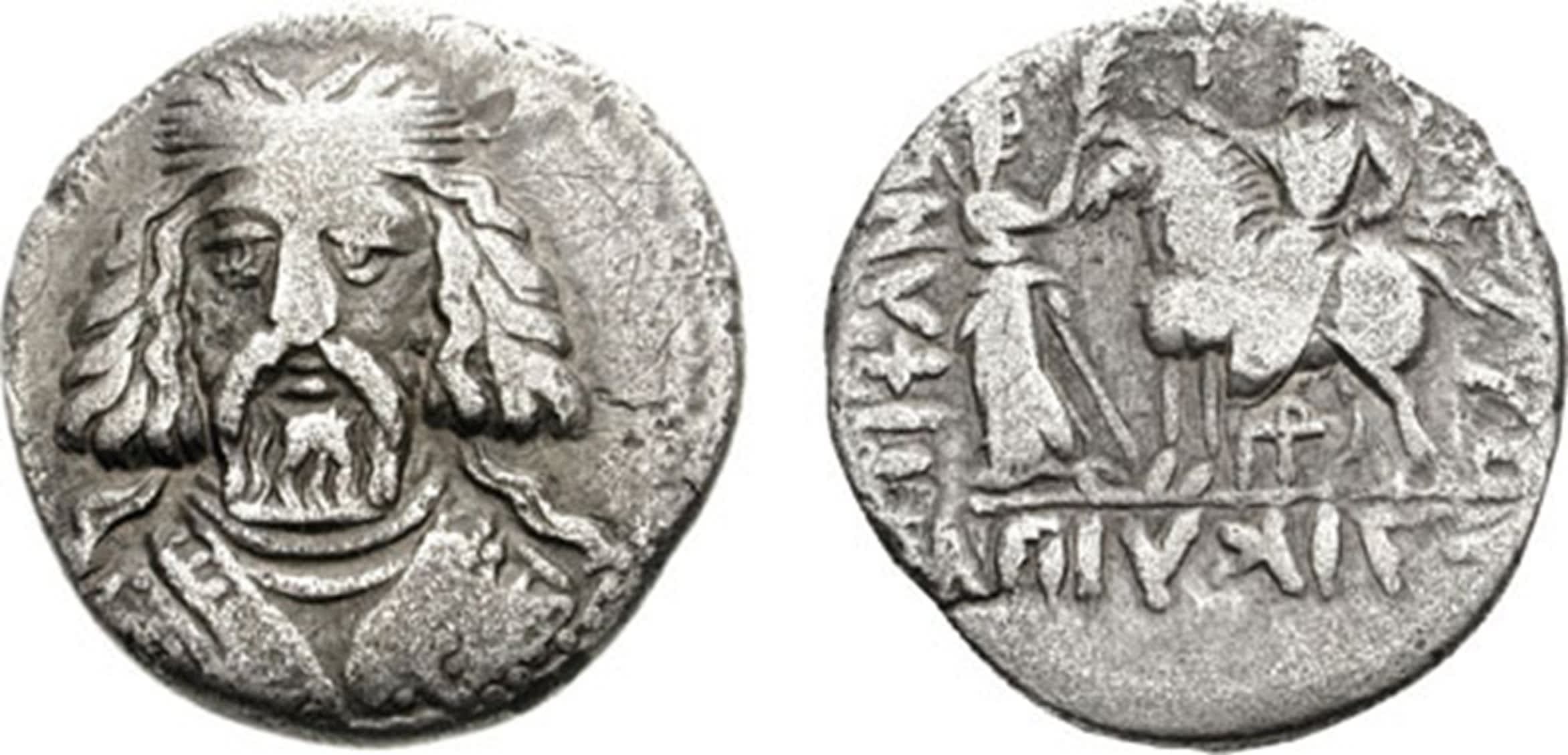

The story of the accession of Artabanus III is a story of cultural conflict. At the beginning of the 1st century CE, Parthia faced a choice: accept a king raised in Rome or return to its nomadic roots. The Parthian nobility, which had initially invited Vonones I (son of Phraates IV) to the throne, quickly became disillusioned. Vonones, who had spent his youth in the Eternal City, was alien to his people: he disliked hunting, traveled in a litter, and surrounded himself with Greeks. For the proud Parthian feudal lords, this was not merely eccentricity but an insult. “The Arsacid throne,” they said, “must not become a Roman province.”

The dissatisfied nobles turned their gaze eastward, to Media Atropatene. There ruled Artabanus — a stern and warlike man. Through his mother he belonged to the sacred Arsacid line, while through his father he descended from the Dahae tribe — the very nomads who had once founded the Parthian kingdom.
The first battle between the “Roman” and the “nomad” ended in Artabanus’s defeat, forcing him to retreat into the mountains of Media. But Artabanus was persistent. Having assembled a new and more powerful army, he again challenged his rival. This time fortune favored him. Vonones was defeated and fled to Seleucia, while Artabanus, after staging a demonstrative massacre of the enemy’s supporters, triumphantly entered Ctesiphon. Around 12 CE he was officially proclaimed King of Kings.
The defeated Vonones fled to Armenia, where he managed to seize the throne. Understanding the danger of such a neighbor, Artabanus exerted strong pressure, forcing Vonones to abdicate in 15–16 CE and flee under Roman protection to Syria.
The situation escalated in 18 CE, when Artabanus attempted to place his son Orodes on the vacant Armenian throne. Emperor Tiberius, unwilling to allow Parthia to grow stronger, sent his adopted son — the famous general Germanicus — to the East. The Romans acted cleverly. Instead of direct war, Germanicus arrived in Artaxata and crowned Zeno, son of the Pontic king, who was popular among Armenians for his knowledge of their customs (he took the name Artaxias III).

Artabanus acted wisely and did not start a war. Envoys of the two empires met on the banks of the Euphrates, and the alliance was renewed. Artabanus merely requested that the hated Vonones be moved farther from the frontier, which was done (Vonones was later killed in Cilicia). An era of peace began.
The period from 19 to 32 CE became a time of prosperity and internal consolidation. Artabanus III proved himself a pragmatic ruler. A striking example of his flexibility was the story of the two Jewish brothers, Anilai and Asinai. They created a veritable bandit state in northern Babylonia, even defeating the local satrap. Instead of wasting resources on punitive campaigns, Artabanus invited the brothers to his court and legalized their authority, entrusting them with the defense of the region. This bold move ensured peace in a troubled province for fifteen years.
The only royal document from that era to survive — Artabanus’s letter to the city of Susa (December 21 CE) — shows that the king actively intervened in urban affairs, confirming election results and strengthening central authority. It is also believed that he resettled the Mandaean people into Mesopotamia, altering the empire’s ethnographic landscape.

Long rule and success went to Artabanus’s head. After the death of the Armenian king Artaxias III, he abandoned caution and placed his eldest son Arsaces on the Armenian throne.
Moreover, feeling invulnerable, Artabanus sent an extraordinarily insolent letter to the aged Emperor Tiberius. He demanded the return of the treasures left by Vonones, threatened to seize all lands of the former Achaemenid and Seleucid empires, and finally insulted Tiberius personally. The Parthian king reproached the emperor for debauchery and the murder of his relatives, cynically advising him to “satisfy the hatred of his citizens by voluntary death.”

This was a fatal mistake. Tiberius was old, but his grip remained iron.
In 35 CE Rome began a covert war. Tiberius sent another Arsacid pretender, Tiridates III, to the East and appointed the cunning Lucius Vitellius as governor of Syria. Vitellius skillfully played the card of the Caucasian peoples. He bribed the Iberian king Pharasmanes. The Iberians invaded Armenia; their agents killed Artabanus’s son Arsaces, and the capital Artaxata was captured.
Artabanus immediately dispatched another son, Orodes, with an army of mercenaries. But Roman diplomacy prevailed again: mountain passes were blocked, leaving Orodes without reinforcements. In the decisive battle against the Iberians and Alans, the Parthian cavalry, deprived of maneuverability, suffered defeat. Orodes fell in single combat (or was mortally wounded), and rumors of his death caused the Parthians to flee.
By 36 CE the situation became catastrophic. The Alans invaded deep into Parthia. Vitellius approached the Euphrates with legions, threatening invasion. Within the country Roman gold did its work: the nobility betrayed Artabanus. Abandoned by all, the king fled to the eastern frontier, to Hyrcania, accompanied only by a detachment of loyal mercenaries.
In Ctesiphon, Tiridates III was crowned with Roman support. But history repeated itself: the new king proved a Roman puppet. The Parthians, quickly weary of the foreign-backed ruler, again remembered Artabanus.
A delegation of nobles found the deposed king in Hyrcania. The Great King, dressed in filthy rags, lived by hunting, sustaining himself with his bow. Convinced that he was not being lured into a trap, Artabanus transformed himself. He gathered an army from the Dahae and Saka, yet remained in his rags to evoke pity and fury among the people.
His march on Seleucia was swift. Tiridates III fled to Syria without battle. Artabanus’s power was restored almost bloodlessly.
At the end of 36 CE, the famous meeting between Artabanus and Lucius Vitellius took place on a bridge of boats in the middle of the Euphrates. Peace was restored. Artabanus sent his son Darius to Rome as a hostage. The Jewish tetrarch Herod Antipas hosted a lavish banquet in a pavilion on the bridge, where, according to tradition, the Parthians presented the Romans with a giant Jew over three meters tall.
Yet the calm was illusory. The country was exhausted by half a century of turmoil. The great city of Seleucia-on-the-Tigris revolted. Its mercantile oligarchy, weary of dynastic strife, declared independence. This uprising lasted seven years, and Artabanus never managed to suppress it fully before his death.
Fate subjected him to another trial. Soon after peace with Rome, the nobility rebelled again. The king was forced to flee to his vassal Izates II, king of Adiabene. In Parthia, a certain Cinnamus was proclaimed king. But Izates acted as mediator. He wrote a letter to the Parthians, who, fearing renewed civil war, agreed to restore Artabanus.
Cinnamus, meeting Artabanus, voluntarily removed the diadem from his own head and placed it upon the exile. Artabanus III regained the throne for the third time. In gratitude he granted Izates the city of Nisibis.
Artabanus III died around 38 CE. His life was a series of rises and falls, yet he managed to preserve the empire despite Roman pressure, aristocratic betrayal, and nomadic invasions, remaining in history as one of Parthia’s most vivid and resilient rulers.


