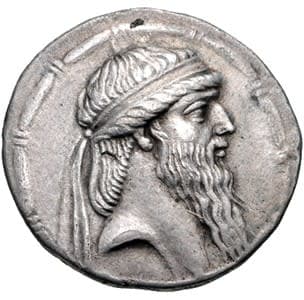

The accession of Artabanus I (in some chronologies called Artabanus II) is shrouded in the same dense veil of uncertainty that surrounds the entire genealogy of the early Arsacids. Who was he in reality? Most modern scholars are inclined to see in him a son of King Phriapatius and the brother of the great Mithridates I.
However, the principal source for this period — the Roman historian Justin — left us a contradictory legacy. On the one hand, in his epitome of the Philippic Histories he states that the fallen Phraates II was succeeded by his “paternal uncle.” On the other hand, the same Justin earlier wrote that King Phriapatius had only two sons — Mithridates and Phraates. How can this paradox be resolved?

Version of N. Overtoom: The historian believes that when Justin spoke of “two sons,” he meant only the adult or particularly prominent heirs, overlooking younger children among whom were Artabanus and Bagasis.
Version of A. S. Balakhvantsev: The Russian researcher questions Phriapatius’s paternity. He suggests either a copyist’s error or a mistake by Justin himself in defining the kinship “paternal uncle,” and considers Artabanus to have been a nephew of Phriapatius. For ancient texts transmitted through centuries of copying, such distortions are not uncommon.
In any case, in 127–126 BCE Artabanus accepted the crown, which at that moment seemed more like a crown of thorns than a symbol of power.
Before Artabanus secured the throne, Parthia experienced a brief but dark interregnum. Numismatic data and deciphered ostraca from Nisa (the ancient capital) suggest that between the death of Phraates II and the accession of Artabanus there was an interval of about eight months.
During this time the mysterious Bagasis may have ruled the country. Historians still debate this figure. Was he a full-fledged king, as the Iranian historian G. R. Assar believed in his early works? Or merely an influential regent who died during the lifetime of Phraates II? There is even a hypothesis of a “first Artabanus” — a king whose short reign Justin simply merged with that of his successor, creating a composite image. Nevertheless, by 127 BCE our protagonist, Artabanus I, had taken the reins of the collapsing empire into his own hands.
Artabanus inherited a terrifying situation. His predecessor, Phraates II, had been killed in battle with nomads — the Saka and Yuezhi — who had poured in from the Great Steppe. The eastern frontiers were cracking under the pressure of hordes that had destroyed the Greco-Bactrian Kingdom.
At first Artabanus attempted resistance, personally leading the defense of the eastern provinces. But the forces were unequal. To save the Iranian plateau from total devastation, the king made a painful yet pragmatic decision. According to John of Antioch, he paid the nomads an enormous tribute.
This stabilized the frontier and forced most of the horde to withdraw with rich plunder. However, as classical scholar Jona Lendering notes, this was a humiliation for the dynasty. The Arsacids, themselves of nomadic origin, prided themselves on their independence. Recognizing other nomads as equals and paying them tribute struck at the king’s legitimacy in the eyes of the Parthian nobility. Yet Artabanus had no choice, for a new fire was flaring in the west.
While the king was saving the east, the western part of the empire began to disintegrate. News of the death of Phraates II became a signal for separatists. The richest satrapies — Characene (at the mouth of the Tigris and Euphrates) and Elymais — proclaimed independence.
A particularly dangerous figure was Hyspaosines, ruler of Characene. In 128–127 BCE, taking advantage of the chaos, he invaded Babylonia, sacred to the Parthians, devastating the region and threatening to cut Parthia off from the trade routes of Mesopotamia.
Having bought peace in the east, Artabanus I transferred his depleted forces westward. He achieved the impossible: he defeated Hyspaosines’ army and restored control over Babylonia. This victory was critically important, proving that Parthia was still alive and capable of holding its key possessions.


After the triumph in the west, Artabanus’s traces fade from the sources. His end, like the beginning of his reign, has two versions:
Heroic (according to Justin): The king again went to war with nomads, this time with the Tocharian tribes. In a fierce battle he received a fatal wound to the arm (possibly from a poisoned arrow) and died as a warrior. This version is supported by Lendering, Balakhvantsev, and M. Kia.
Pragmatic (according to N. Overtoom): At the time he disappeared from the chronicles, Artabanus was already an elderly man. Most likely he died of natural causes, and the story of a battle is merely a later romanticization.
The dating of his death also varies from 125 to 122 BCE (the most common date being 124–123 BCE).
Despite the brevity of his reign and the endless wars, Artabanus I left a mark on state ideology. On his coins he minted the titles “Shahanshah” (King of Kings) and “Philhellene” (Friend of the Greeks).

Debates continue over whether Artabanus controlled the mints (Assar’s hypothesis versus Overtoom’s opinion), but one fact remains: Artabanus I received a country in free fall and managed — albeit at the cost of humiliating tribute — to slow this collapse. He passed the throne to his son, the great Mithridates II (sometimes called Artabanus II), the man who would finally transform Parthia into a global superpower.


