
The history of early Parthia resembles a mosaic whose many fragments have been lost or distorted by time. The reign of the first Arsacids is concealed behind a veil of contradictory testimony from ancient authors, whose Greek and Roman works were often openly hostile toward the Parthians. In this historical haze, the figure of Arsaces II, the son of the dynasty’s founder, emerges as a link between bold conquest and the struggle for the survival of the state.
For centuries, the origin of his father, Arsaces I, was the subject of debate. Ancient historians variously described him as a brigand, a Bactrian fugitive from Diodotus, or the leader of the nomadic Parni from the Dahae confederation. The Arsacids themselves, seeking to legitimize their authority in the Iranian world, traced their lineage to the legendary Achaemenid Artaxerxes II, although modern scholarship finds no confirmation of this claim. Today, research supports the view that the Arsacids were leaders of the Iranian Parni tribe who invaded Parthiene and Hyrcania, adopted Zoroastrianism and elements of the conquered peoples’ culture, yet retained their nomadic ethos.

The accession of Arsaces II to the throne has also been debated. Traditional historiography long inserted between him and his father the figures of a brother, Tiridates, and a nephew, Artabanus. However, thanks to the work of the historian Józef Wolski and numismatic evidence, this tradition has been revised. Modern scholars generally conclude that Tiridates and Artabanus were either legendary or never ruled, and that Arsaces I transferred power directly to his son. Moreover, the name “Arsaces” was his birth name rather than a regnal pseudonym, refuting the earlier theory that Artabanus ruled under that name.
Upon assuming power (variously dated to 217, 214, or 211 BCE), the new king faced a colossal threat that could have erased the young state from existence.
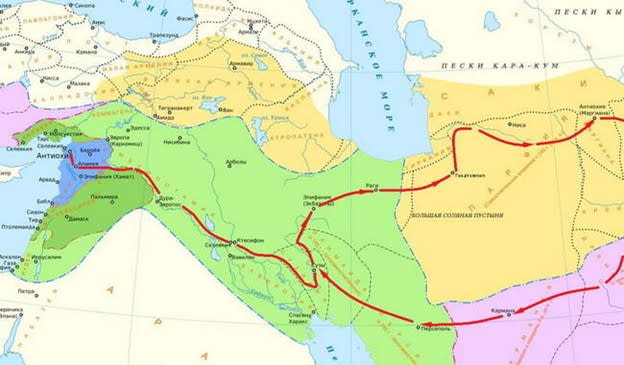
By the late third century BCE, dark clouds gathered over Parthia. The Seleucid king Antiochus III—later called “the Great”—after suppressing the rebellion of Achaeus in Asia Minor and concluding a temporary peace with the Egyptian pharaoh Ptolemy IV, turned his gaze eastward. His objective was the restoration of Alexander’s empire within its former boundaries and the recovery of lost satrapies.
According to the historian N. Overtoom, Arsaces II made a fatal miscalculation: he underestimated the resolve and resources of his opponent, assuming that the desert would become an insurmountable obstacle for the Greek phalanxes. Yet Antiochus prepared meticulously. After storming the Armenian capital and receiving the capitulation of its king, he spent several years in Babylon and Seleucia assembling a vast army. Justin reports a force of 120,000 men—likely exaggerated—while modern estimates (J. Grainger) suggest a more realistic but still formidable army of up to 35,000 elite troops, including the “Silver Shields” (argyraspides), Cretan archers, and heavy cavalry suited for the plains of Iran.
When the iron march of Antiochus’ legions shook the borders of Parthia, Arsaces II adopted a strategy characteristic not of a sedentary monarch but of a nomadic chieftain. Lacking the strength for a pitched battle in open terrain, he chose a scorched-earth policy. The king ordered the destruction of qanats—underground irrigation channels—and the filling of wells along the enemy’s path.
According to A. S. Balakhvantsev, this decision vividly illustrates the nature of early Arsacid authority: for them, Parthia was less a homeland than a territory of subsistence. The destruction of irrigation doomed the local agricultural population to hunger and thirst. The effect proved opposite to what was intended—residents of Parthiene, suffering from their own ruler’s actions, greeted Antiochus III not as a conqueror but as a liberator.
The Greeks occupied Hecatompylos, the capital of Parthia, and advanced into Hyrcania. Arsaces II, retreating into the mountains, offered desperate resistance. Sources state that he fought “with great bravery,” but the forces were unequal. The Parthian army, deprived of local support and inferior in numbers, was compelled to retreat further and further, losing control over key regions.
The war, which threatened the complete destruction of the dynasty, ended in compromise. Antiochus III, recognizing the difficulty of conducting a prolonged guerrilla war in mountainous terrain, and Arsaces II, cornered, entered negotiations. The Parthian king retained his life and crown, but the price was high. Parthia effectively lost its independence, becoming a vassal of the Seleucids. Arsaces forfeited the rich lands of Hyrcania and Parthiene, retaining authority only over his mountainous domains.

N. Overtoom emphasizes that this peace set Parthian development back by a generation. Arsaces II was obliged to supply Antiochus with troops, including the famous heavily armored cataphracts, for his western wars. Strategically, however, the dynasty survived. Antiochus failed to eradicate the root of Parthian statehood, an omission that decades later would contribute to the collapse of Seleucid dominance in the East.
The exact date of Arsaces II’s death, like that of his accession, remains debated. Traditional chronology indicates 191 BCE, while more recent studies shift the event to around 185 BCE. After defeat by Antiochus, Parthian influence was minimized, and it is likely that the minting of independent coinage was temporarily suspended by order of the suzerain.
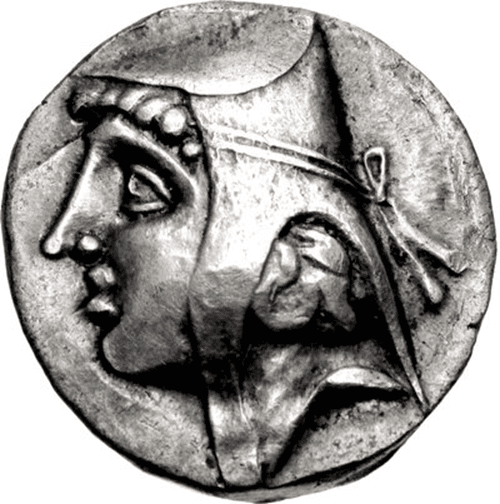
Nevertheless, surviving coins of Arsaces II (and his successor) demonstrate stylistic continuity. The obverse depicts the king’s profile wearing a soft pointed cap (bashlyk); the reverse shows an archer in Iranian dress. The appearance of Greek titles such as “Basileus” (King) and “Great” is associated by scholars with a later period, when Parthia began restoring its strength after Antiochus’ departure.
The successor of Arsaces II was Phriapatius (who assumed the name Arsaces III). The question of their kinship is another puzzle of Parthian genealogy. Was he a son, nephew, or grand-nephew (a grandson of Tiridates)? Most modern historians, including Balakhvantsev, favor direct succession, considering Phriapatius the son of Arsaces II.
In any case, Arsaces II, despite heavy defeat and territorial losses, fulfilled the primary task of any monarch: he preserved the dynasty, enabling it to survive the storm and prepare for future greatness under Mithridates I.


