
The history of the emergence of one of the greatest states of the Ancient East is inseparably connected with the figure of Arsaces I—a ruler whose biography is woven from contradictory testimonies and legends. The period of his rise to power, hidden in the shadow of centuries, is poorly illuminated by ancient authors, whose works were often hostile toward “barbarians.” Greek and Roman historians such as Strabo, Justin, and Ammianus Marcellinus disagreed about who this man was. Some described him as a bold brigand who seized power by force; others saw in him a Bactrian who, unable to tolerate the rise of Diodotus I, fled to Parthia to raise a revolt. There was also a version tracing his lineage to Andragoras or even to the ancient Achaemenids—Artaxerxes II (or I)—which was meant to legitimize his authority in the eyes of the Iranians.
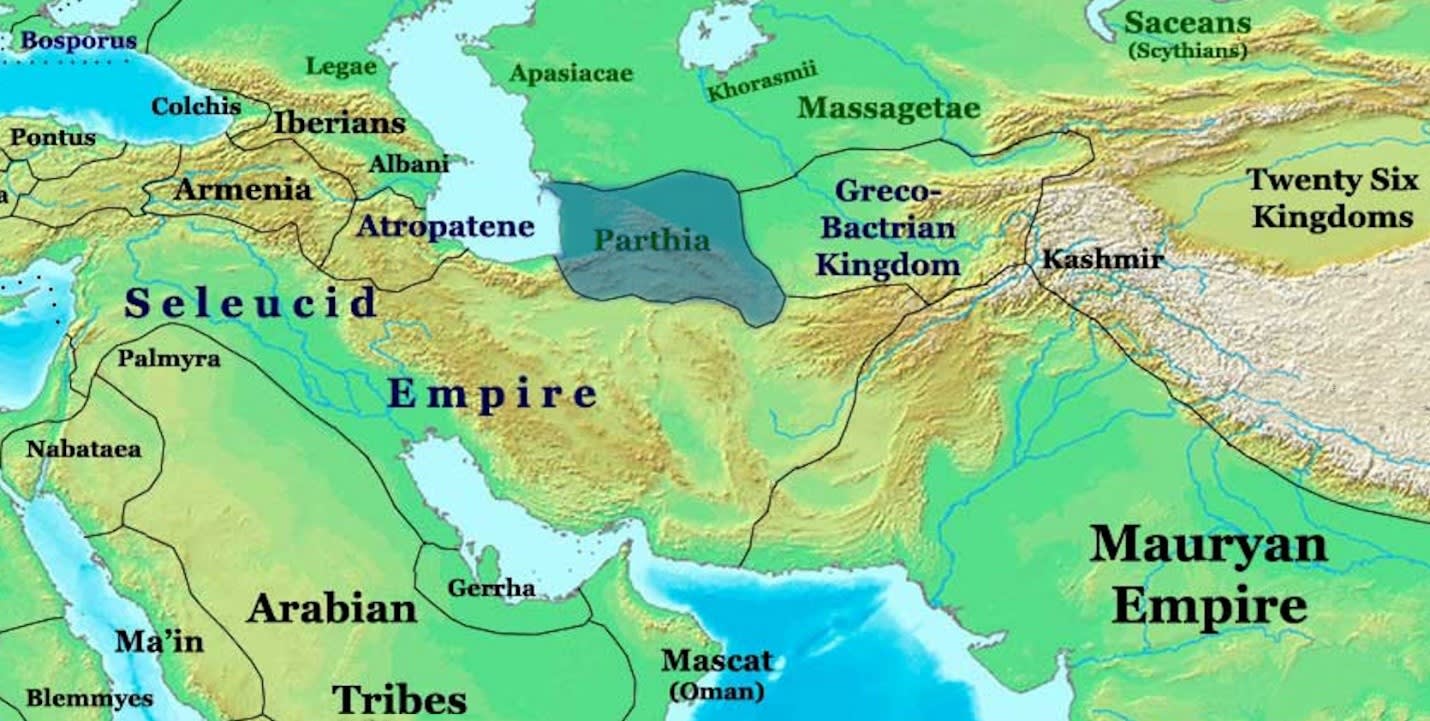
However, modern scholars tend toward a different reconstruction. Arsaces most likely belonged to the Parni tribe, part of the powerful nomadic confederation of the Dahae. It is believed that the Parni were either a local Iranian people or migrants from the north who adopted Zoroastrianism and the culture of their sedentary neighbors. Arsaces, the son of Phriapites, was probably born in Parthia and spoke the Parthian language. His youth may have been spent in Seleucid territories; the hypothesis that the future king served as a mercenary among the Greeks (possibly in Asia Minor or Bactria) explains his brilliant military skills and knowledge of enemy tactics. In any case, by the mid-third century BCE, he had become a recognized leader who succeeded in uniting the warring Parni clans and ending internal strife.


The very name “Arsaces” carried deep sacred meaning. Derived from an Avestan root meaning “hero” (in diminutive form), it connected the dynasty with the mythic archer Arash and the Kayanian kings. Later, much like the Roman title “Augustus” or the name Caesar, it became a dynastic name: every Parthian king, upon ascending the throne, adopted the name Arsaces, emphasizing continuity and divine patronage.
The mid-third century BCE was a time of geopolitical upheaval, ideal for the rise of a new power. The Seleucid Empire was fragmenting: the Second and Third Syrian Wars with Egypt, the loss of Susa and Babylon, and dynastic struggles between Seleucus II and Antiochus Hierax weakened central control over the eastern satrapies.

Amid this chaos, around 250 BCE, the Parni launched their second incursion into Parthia. The situation was further complicated by the separatism of local governors. Diodotus I in Bactria and possibly Andragoras in Parthiene sought independence. The precise date of Andragoras’ revolt remains debated (often cited as 245 BCE), but one fact is clear: Greek authority had become fragile.

A key event occurred in 247 BCE. On the day of the spring equinox (April 14/15), a sacred festival for the Iranians, Arsaces was crowned in the city of Asaak (presumably near modern Kuchan). This date became the starting point of the Parthian era and statehood. It was not merely the proclamation of a chieftain, but the birth of a dynasty.
Around 239 BCE, taking advantage of the defeat of Seleucus II at Ancyra, Arsaces led his clan to conquer Parthiene and Hyrcania. These lands, rich and strategically important, promised great spoils but also entailed danger. The decisive clash took place at Hecatompylos, where Andragoras’ army was defeated and the satrap himself fell in battle.
However, victory was not easy. Parthia was a complex conglomerate of ethnic groups and social classes. The local sedentary population and Greek colonists greeted the nomadic Parni with distrust and fear, concerned that their fields would be turned into pastureland. According to Strabo, Arsaces had to wage a prolonged struggle to pacify the conquered territories. Only over time was a compromise reached between newcomers and indigenous inhabitants, allowing the Arsacids to consolidate their rule. The capture of Hyrcania further strengthened their position, enabling the creation of a powerful army and securing defenses from both west and east.
The triumph of Arsaces disrupted the balance of power in the Middle East. Having made peace with his brother around 236 BCE, Seleucus II prepared for revenge. His eastern campaign (variously dated between 238 and 227 BCE) became a serious test for the young state.

At first, fortune favored the Greeks. Seleucus II managed to push back the Parthians, forcing Arsaces into a strategic retreat into the steppes, among the Apasiacae tribes. Some historians interpret this as flight; others see it as a brilliant application of the nomadic tactic of the “feigned retreat.” The situation shifted due to Arsaces’ diplomatic success: he formed an alliance with Diodotus II, the new king of Greco-Bactria, thereby securing his rear.
At the decisive moment, the Parthians struck back. The Seleucid army suffered a defeat that became for the Arsacids the official day of independence celebration. There exists a bold hypothesis, based on Athenaeus, that Seleucus II himself was captured and released only in exchange for recognizing Parthian sovereignty, although many scholars dispute this claim. In any case, the Greeks were compelled to accept the loss of their eastern possessions.
Having secured independence, Arsaces I devoted his final years to strengthening the state. He extended his domains to the Caspian Gates, founded the city of Dara, and transformed Nisa into a magnificent royal residence, later serving as the dynastic necropolis. Arsaces adopted the title “Father of the Nation,” underscoring his role as unifier.

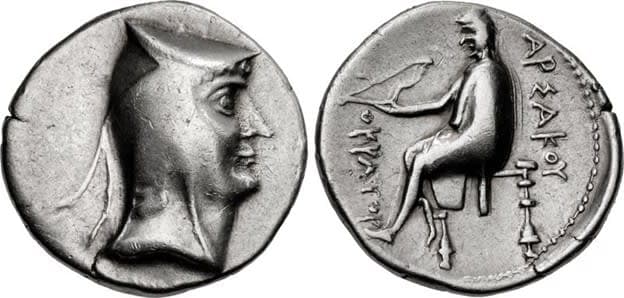
One of the most important instruments of his policy was coinage. The drachms of Arsaces, struck in Nisa from silver and bronze, were true ideological manifestos. On them, the king is depicted wearing an Iranian bashlyk, seated on an omphalos with a bow in hand—an image combining Hellenistic traditions with national Iranian features. The use of the title “Karni” (autokrator) and Greek legends demonstrated his claim to a status equal, if not superior, to that of Seleucid governors.
Arsaces I died at the height of his glory (the dates vary: 217, 214, or 211 BCE), leaving behind a powerful state. His throne was inherited by his son, Arsaces II.


