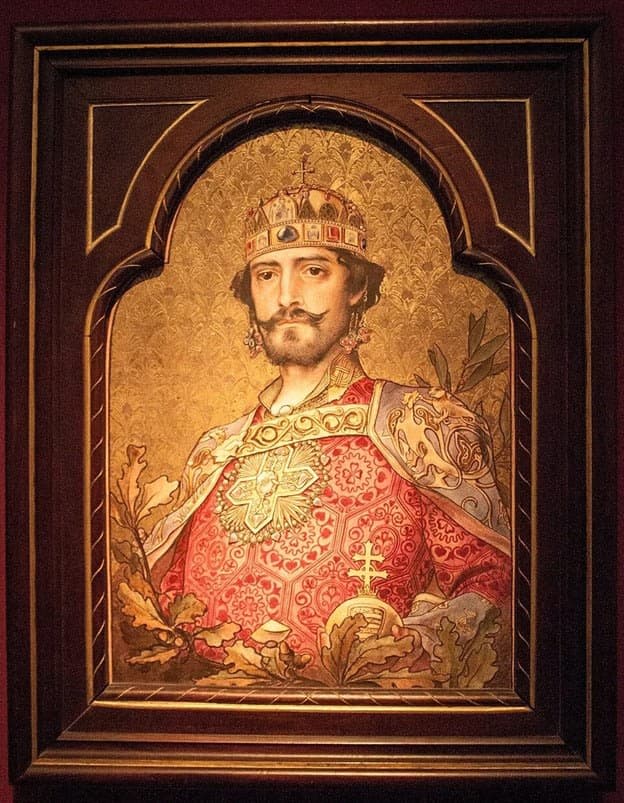

July 10, 1290, became a fateful day for the Kingdom of Hungary.
King Ladislaus IV the Cuman was murdered in his tent by Cuman conspirators.
Since the monarch had left no heirs, the principal branch of the legendary Árpád dynasty, which had ruled for centuries, suddenly came to an end.
The country, already exhausted by years of feudal anarchy, found itself on the brink of catastrophe.
The kingdom's only remaining hope was a man living far beyond its borders — the "Venetian" Prince Andrew.

Andrew, a grandson of King Andrew II, possessed the strongest claim to the vacant throne.
His father was Stephen the Posthumous, Duke of Slavonia, who had been born after his own father's death, while his mother was Tomasina, a member of the powerful and distinguished Venetian Morosini family.
The future king was born in Venice around 1265.
In 1271, his father died, and the upbringing of the young Andrew fell entirely upon the shoulders of his influential Venetian relatives.
Far from the Hungarian steppes, he absorbed the culture and diplomatic sophistication of the Most Serene Republic.
His first encounter with his ancestral homeland proved unsuccessful.
In 1278, the Hungarian aristocrat Ivan Kőszegi, who had seized several fortresses in the west of the country amid widespread feudal lawlessness, decided to pursue his own political ambitions by inviting the young Andrew to Hungary.
Upon arriving in the kingdom, the prince boldly asserted his legitimate claim to the Duchy of Slavonia.
However, the reigning monarch, Ladislaus IV the Cuman, responded with a firm refusal.
Having suffered a political failure, Andrew was forced to return to Venice empty-handed.

Fate offered him a second chance in early 1290.
The same Ivan Kőszegi, having joined forces with Archbishop Lodomer of Esztergom, who had already excommunicated King Ladislaus IV, once again dispatched messengers to Andrew.
This time, the stakes were far higher: the prince was offered the Hungarian crown.
Andrew accepted and immediately set out for Hungary.
But his path to the throne was filled with betrayal.
During the journey, he was treacherously captured by the Hungarian nobleman Arnold Hahót.
The captive heir was handed over to Duke Albert I of Austria, who imprisoned him in Vienna, intending to use him as a bargaining chip in his geopolitical ambitions.

The situation changed dramatically on July 10, 1290, when news of the murder of the childless Ladislaus IV reached Vienna.
Realizing that any delay could prove fatal, Andrew staged a daring escape from Austrian captivity.
He swiftly arrived in Esztergom, where, on July 23, 1290, Archbishop Lodomer solemnly placed the sacred Crown of Saint Stephen upon his head.
The new monarch's first actions were decisive.
Immediately after his coronation, he convened an assembly of "prelates, barons, and nobles" in Óbuda, which authorized Andrew III to review and annul the ruinous land grants made by his predecessor.
To strengthen his political position internationally, the king hastily married the Polish princess Fenenna of Kuyavia.
From its first day to its last, the reign of Andrew III became an unending and exhausting struggle for survival.
The problem lay in his ancestry: Stephen the Posthumous's brothers had once declared him a bastard, an illegitimate child.
This stigma provided numerous ambitious rulers with a pretext to challenge the legitimacy of Andrew's coronation.
His enemies immediately closed in.
As early as August 31, 1290, Holy Roman Emperor Rudolf I cynically declared Hungary to be a vacant imperial fief and nominated his own son — Duke Albert I of Austria — for the Hungarian throne.
At the same time, an impostor appeared on the political stage: a Polish adventurer who proclaimed himself "Andrew of Slavonia," the supposedly miraculously surviving younger brother of the murdered Ladislaus IV.
Fortunately, the royal forces quickly defeated the false prince's army.

But in April 1291, a new and far more serious threat emerged from the south.
The sister of the murdered King Ladislaus, Queen Mary of Naples, formally asserted her claim to the Crown of Saint Stephen.
She soon transferred these rights to her son, Charles Martel of Anjou.
After his death in 1295, the claim passed to her formidable grandson — Charles Robert.
Andrew III understood that only military strength could protect his throne.
In early 1291, he undertook a strategic journey through the eastern regions of the kingdom.
There, in Oradea and Gyulafehérvár, the local nobility swore allegiance to him, securing a dependable base of support in the east.
Having assembled an army, Andrew launched a preemptive strike against Austria.
The military campaign proved remarkably successful.
His forces achieved a decisive victory, and the humiliated Duke Albert I was forced to sue for peace.
On August 26, 1291, the Treaty of Hainburg was signed, under which the Austrian duke completely renounced his claims to the Hungarian crown.
However, this diplomatic victory came at a fatal price.
As compensation for peace, Andrew III imprudently agreed to demolish several small frontier fortresses belonging to the Kőszegi clan.
The magnates' reaction was immediate and furious.
Nicholas Kőszegi promptly launched a rebellion, forming an alliance with the powerful Croatian Babonić and Frankopan families, who openly supported the Queen of Naples.
The king personally led his troops to suppress the uprising, but military fortune turned against him.
In the heat of battle, Andrew III was captured by Nicholas Kőszegi.
To regain his freedom and preserve his crown, the monarch was forced to pay an enormous and humiliating ransom.

Recognizing that brute force alone could not break the magnates, Andrew III invited his mother, Tomasina Morosini, to Hungary in 1293.
The Venetian noblewoman proved herself an outstanding politician.
Through skillful diplomacy, intrigue, and promises, she successfully negotiated with several rebellious barons, including the formidable Henry Kőszegi.
They agreed to recognize her son's authority.
In 1294–1295, the combined forces of Andrew and his mother carried out a series of successful military campaigns against the supporters of Charles Martel of Anjou in the south.

On February 6, 1296, the royal court was plunged into mourning: Queen Fenenna died.
However, the widowed Andrew soon executed a brilliant geopolitical maneuver.
He married Agnes of Austria, daughter of his former enemy Albert I.
Having secured powerful military support from his father-in-law, the king launched a decisive offensive.
He ruthlessly suppressed the rebellions of Nicholas Kőszegi and Matthew III Csák, capturing their key strongholds — Kőszeg Castle and Pozsony — after fierce fighting.
The alliance proved mutually beneficial.
In 1298, Andrew supported Albert's uprising against the German king Adolf.

Despite these tactical victories, Andrew III never succeeded in becoming the absolute ruler of Hungary.
The country remained torn apart by powerful regional lords.
Defiant barons sheltered behind the impregnable walls of the castles belonging to the kingdom's greatest magnates — Nicholas Kőszegi, Matthew Csák, and Ladislaus Kán — who governed their territories as though they were independent monarchs.
The situation deteriorated catastrophically in 1298, when Pope Benedict VIII appointed George Bicskei as the new Archbishop of Esztergom.
This prelate turned out to be an outspoken supporter of the Neapolitan claimants.

In August 1298, Andrew convened a major assembly in Pest, attended by "prelates and nobles, Saxons and Cumans," which once again reaffirmed the legitimacy of his reign.
But Archbishop Bicskei refused to surrender.
He began secretly organizing a faction of supporters of the House of Anjou within the highest ranks of the clergy.
When Bicskei launched an open rebellion in 1299 and demonstratively refused to attend another national assembly, the king's patience finally ran out.
Andrew confiscated all the archbishop's extensive estates.
Hungary once again found itself on the brink of civil war.
The decisive turning point came in August 1300.
Taking advantage of the turmoil, the Croatian magnate Paul I Šubić formally invited Charles Robert to claim the Hungarian throne.
The young Angevin pretender landed in Split and, with military support from his Croatian allies, triumphantly occupied Zagreb.
Andrew III began hastily gathering an army for a decisive strike against the invaders.
But cruel fate intervened.
The royal court was shaken by the sudden death of the queen mother, Tomasina Morosini — the principal diplomat and pillar of the throne.
Having lost his mother, the king was overwhelmed by grief.
Soon afterward, on January 14, 1301, the thirty-five-year-old Andrew III himself died just as suddenly, under mysterious circumstances.
He was buried in Buda, taking an entire historical era with him to the grave.
With his death, the reign of the Árpád dynasty, which had ruled Hungary for more than four centuries, came to a permanent end.
One contemporary chronicler, with bitter poetic elegance, described Andrew III as:
"The last golden branch of the tree of the Árpáds."
Power over Hungary passed into the hands of Charles Robert, marking the beginning of a new era — the reign of the Angevin-Sicilian dynasty.


