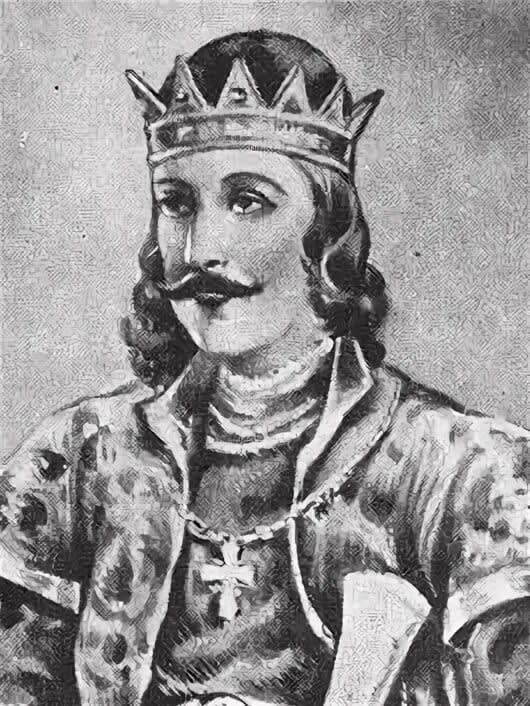

The life of Andrew II, whose heraldic emblem featured linden leaves held between the paws of seven lions, initially offered little indication that he would ever wear the royal crown.
As the second son of King Béla III and his first wife, Agnes of Antioch, the younger prince had virtually no chance of inheriting the throne.
To ensure a peaceful transfer of power, Béla III had insisted on the coronation of his eldest son, Emeric, during his own lifetime in 1182.
Andrew, it seemed, was destined to remain forever in his brother's shadow.

However, the first signs of his political importance emerged as early as 1188.
At that time, Prince Vladimir Yaroslavich, who had been expelled from the Principality of Galicia, fled to Hungary and begged Béla III for assistance.
The Hungarian monarch, however, had other plans.
Taking advantage of the turmoil, he treacherously imprisoned Vladimir and installed the young Andrew on the princely throne of Halych.
Naturally, the minor prince's authority was purely nominal — he never even set foot in his new principality.
Although Hungarian troops acting in Andrew's name managed to suppress a rebellion by the local boyars in 1189, the triumph proved short-lived.
Soon afterward, Vladimir Yaroslavich escaped captivity, returned to Galicia, and expelled the Hungarians from Halych, bringing Andrew's first period of rule to an end.
The decisive turning point came on April 23, 1196, when King Béla III died.
As expected, the throne passed to Emeric.
Andrew inherited an enormous sum of money, but under one strict condition: he had sworn to his father that he would use these funds to organize a Crusade.
However, the younger brother's ambitions proved stronger than his filial obligations.
Instead of assembling troops for an expedition to the Holy Land, Andrew used his father's gold to bribe influential Hungarian barons and secured military support from the Austrian duke Leopold VI.
In December 1197, Andrew's rebellious forces inflicted a crushing defeat upon King Emeric's army in a battle near the Mecsek Mountains.
The defeated monarch was forced to make concessions, granting Andrew full control over Croatia and Dalmatia with the title of duke.

Yet even this was insufficient to satisfy the ambitious duke.
In early 1198, Pope Innocent III himself intervened in the conflict, demanding that Andrew fulfill his father's final wishes and lead a Crusade.
Ignoring the pontiff's appeal, Andrew instead turned his weapons against neighboring territories, capturing the provinces of Zachlumia and Rama.
At the same time, he continued weaving new conspiracies against Emeric, entering into secret agreements with several prelates, including his principal supporter, Bishop Boleslaus of Vác.
King Emeric, having discovered the treachery in time, acted decisively.
He personally arrested the bishop and stripped the rebels of all their privileges.
In the summer of 1199, the fratricidal conflict reached its climax at the Battle of Rád, where Emeric defeated Andrew and forced him to flee to Austria.

A fragile peace was established only in 1200, thanks to the diplomatic efforts of the papal legate Gregory.
The brothers reconciled and mutually designated each other as heirs to the throne.
Overcome by the emotions of the moment, they even made a joint vow to undertake a Crusade, planning to leave the kingdom under the supervision of Leopold of Austria.
However, as time passed and their emotions subsided, both brothers conveniently forgot their promise.
Around that same year, 1200, Andrew married Gertrude, daughter of Duke Berthold of Merania.
Researchers believe that this strong-willed woman encouraged her husband to launch another rebellion.
Having assembled an impressive army of barons dissatisfied with the king's firm rule, Andrew marched toward Varaždin.
Realizing that the rebels considerably outnumbered the royal forces, Emeric resorted to an unprecedented and desperate measure.
Without weapons or armor, wearing only his crown and carrying his royal scepter, the legitimate monarch entered the enemy camp entirely alone.
Overwhelmed by his brother's majesty, Andrew surrendered without a fight.
He was arrested but soon managed to escape with the assistance of his loyal supporters.

King Emeric's health was rapidly deteriorating.
Seeking to protect his dynasty, he arranged the coronation of his young son Ladislaus III on August 26, 1204.
Then, facing death, he made a final reconciliation with Andrew, appointing him regent.
On September 30, 1204, Emeric died.
Andrew immediately assumed control of the government as guardian of his nephew, simultaneously appropriating the royal treasury.
The widowed Queen Constance of Aragon, reasonably fearing for the young king's life, secretly fled with Ladislaus to Austria, seeking the protection of Leopold VI.
Andrew was already gathering troops for a campaign to bring his nephew back when startling news arrived: on May 7, 1205, the boy had died unexpectedly.
The path to the throne was finally clear.

On May 29, 1205, in Székesfehérvár, Archbishop John of Kalocsa placed the royal crown upon Andrew II's head after first requiring him to swear an oath.
Upon coming to power, the new monarch introduced a radical transformation in domestic policy that would enter history as the novæ institutiones ("new institutions").
Unlike his predecessors, Andrew began distributing crown lands on an unprecedented scale.
Declaring that "Nothing can set limits to the generosity of His Royal Majesty, and the best measure of a monarch's gifts is their immeasurability," the king began granting his supporters not merely money, but villages, enormous estates, and even entire counties (comitatus).
This reckless policy quickly drove the royal treasury toward complete impoverishment.
The situation was made worse by the fact that royal generosity was directed primarily toward foreign favorites — the German relatives and associates of Queen Gertrude.
This provoked deep, rapidly growing resentment among the Hungarian nobility.
A group of outraged aristocrats even attempted to organize a conspiracy to transfer the throne to the king's cousins, who were living in exile at the court of the Nicaean emperor Theodore I Laskaris.
However, the plan failed. Their messenger was intercepted, and the conspiracy was suppressed.

Seeking to protect the southeastern frontiers from Cuman raids, the king made another controversial decision in 1211: he granted the region of Burzenland to the Teutonic Knights.
However, instead of serving as a defensive shield for the Hungarian crown, the order soon began constructing its own independent state on the lands it had received.
Andrew II's foreign policy during the early years of his reign was closely connected with the exhausting struggle for the Principality of Galicia.
In 1205, Hungarian forces entered Halych to support the young Daniel, son of Prince Roman Mstislavich.
Encouraged by this intervention, Andrew assumed the prestigious title of "King of Galicia and Lodomeria."
However, the political situation changed rapidly.
In early 1206, Daniel was expelled.
Andrew, having been bribed by the boy's opponent, Prince Vladimir Igorevich, refused to help Daniel. Yet in that same year, he invaded the principality himself, this time assisting Roman Igorevich in seizing power.

In 1208, taking advantage of another conflict between Prince Roman and the local boyars, the Hungarian king once again occupied Halych and installed his own regent there.
But just one year later, in 1209, Vladimir Igorevich drove the Hungarians out of the city.
The political struggle continued in 1211, when Andrew once again supported Daniel with military force.
In 1212, he personally led an army to repel an attack by Prince Mstislav the Mute.
When Daniel was expelled yet again, Andrew began gathering troops for a major campaign.
However, his preparations were interrupted by horrifying news from home.
The Hungarian barons' hatred of growing foreign influence had erupted into a bloody act of revenge: conspirators had brutally murdered Queen Gertrude.
Overwhelmed by rage and grief, the king unleashed a savage campaign of vengeance against the peasantry, carrying out mass killings.
Yet among the actual conspirators, he executed only the ringleader, granting amnesty to the others.
This inexplicable leniency toward his mother's killers permanently alienated Andrew's son Béla from his father, although the king was nevertheless compelled to have him crowned as heir in 1214.

Meanwhile, the intrigues surrounding Galicia continued.
In the summer of 1214, Andrew II met with the Polish duke Leszek the White.
The two rulers agreed to divide the Principality of Galicia, placing it under the authority of Andrew's younger son, Coloman.
The allies captured the city, but Andrew violated their agreement by refusing to surrender the territories he had promised the Poles.
Offended, Leszek allied himself with Mstislav the Bold and expelled the Hungarians from the principality.
Realizing his mistake, Andrew soon renewed his alliance with Poland, allowing Coloman to regain his position in Halych.
On the southern front, however, the Hungarians enjoyed success in 1214, managing to seize the strategically important cities of Belgrade and Braničevo from the Bulgarian Empire.
In February 1215, the widowed king entered into a second marriage, taking Yolanda, niece of Henry I, Emperor of the Latin Empire, as his wife.
When Henry died on July 11, 1216, Andrew became fascinated by the possibility of obtaining the imperial crown.
However, the barons preferred his own father-in-law, Peter of Courtenay, over him.

Stung by this political setback, Andrew finally decided to fulfill his long-standing crusading vow and seek military glory in the East.
He negotiated with Venice to provide a fleet, in exchange for abandoning his territorial claims to the city of Zadar.
On August 23, 1217, he set sail from Split.
Before departing, the king entrusted the strategically important fortress of Klis to the Knights Templar and appointed Pons de Cruz, a master of the order, as regent of Croatia and Dalmatia.
As the nominal leader of the Fifth Crusade, Andrew II arrived in Cyprus on October 9 at the head of a Venetian fleet, before proceeding to Acre.
There, his forces joined those of John of Jerusalem, Hugh I of Cyprus, and Prince Bohemond IV of Antioch in a campaign against the Ayyubid dynasty.
At a military council in Acre in October, the crusader leaders decided to launch an offensive.
Fearing a repetition of the massacre of 1099, the Muslims abandoned Jerusalem, first demolishing its walls to prevent the Christians from establishing a fortified position there.

Despite careful preparations, on November 10, 1217, Andrew's army suffered a defeat at the hands of Sultan Al-Adil near Bethsaida on the Jordan River.
The Muslims withdrew behind the walls of their fortresses, while the Hungarian troops, lacking siege equipment, became trapped in fruitless attempts to capture strongholds in Lebanon.
In early 1218, the seriously ill Andrew decided to abandon the campaign and return to his homeland.
His journey home took him through Armenia, Nicaea, and Bulgaria.
Along the way, the king actively engaged in diplomacy.
He arranged for his son Andrew to marry Isabella, daughter of the Armenian king Leo I, and narrowly survived an assassination attempt organized by his exiled relatives in Nicaea.

The king's return to Hungary in February 1218 brought him face to face with a harsh reality: the country had descended into complete anarchy.
The regent, Archbishop John of Esztergom, had fled, while the royal treasury had been thoroughly plundered.
Andrew's attempts to remedy the situation through new taxes, the debasement of coinage, and loans from Muslim and Jewish moneylenders only intensified the widespread hatred directed toward him.
His foreign policy also suffered another setback.
In August 1219, Prince Mstislav the Bold of Novgorod definitively expelled Coloman, the crowned king of Galicia.
Andrew was forced to accept a humiliating peace agreement and even attempted to strengthen it through the marriage of his younger son Andrew to Mstislav's daughter.
In 1220, the king attempted to stabilize the kingdom's internal administration by entrusting Slavonia, Dalmatia, and Croatia to his son Béla.
At the same time, however, he forcibly separated Béla from his wife, further intensifying the conflict within the royal family.

The simmering dissatisfaction of the nobility reached its breaking point in early 1222, forcing the monarch to sign the famous Golden Bull.
This fundamental document, historically comparable to England's Magna Carta, represented a compromise between the crown and the great landowners.
The Golden Bull not only guaranteed the privileges of the nobility but also established their legal right to resist the king by force of arms if he violated its provisions.

Internal intrigues continued.
In 1223, Prince Béla, exhausted by his father's authoritarian rule, took his wife and fled to Austria.
The conflict was resolved only through the intervention of Pope Honorius III.
Béla returned to the administration of his provinces, and on June 6, 1224, peace was concluded with the Austrian duke Leopold VI.
That same year, 1224, was also marked by two other important decisions.
The king issued the Diploma Andreanum, also known as the "Law of Andrew," a unique charter granting extensive self-government to the Transylvanian Saxons, described as the oldest document of its kind in the world.
In addition, the monarch finally recognized the threat posed by the Teutonic Knights and decisively expelled them from Transylvania.

The family drama continued to intensify.
Prince Béla, having obtained the approval of Pope Honorius III, began resolutely reclaiming the royal estates that his father had distributed, seeking to restore the kingdom's economy.
Enraged, Andrew removed his eldest son from his position, assigning him to govern Transylvania instead.
The provinces that Béla had previously administered were transferred to Andrew's middle son, Coloman.
Meanwhile, the Galician question erupted once again.
In the second half of 1226, Andrew II led an army into Halych at the request of his younger son.
Although Mstislav the Bold's forces defeated the Hungarians, the principality was ultimately ceded to Andrew the Younger.
However, in 1228, the elder brothers, Béla and Coloman, joined forces.
They not only resumed the confiscation of lands but also compelled their father to seize the estates of the barons who had once participated in the murder of their mother, Gertrude.
External pressure was also increasing.
In 1229, Daniel of Galicia once again expelled Andrew the Younger from Halych, while in 1230 Emperor Frederick II attacked the kingdom's western frontiers.

An acute shortage of funds compelled Andrew II to disregard the decrees of the Fourth Lateran Council and employ Jews and Muslims in the administration of the royal treasury.
This provoked the fury of Pope Gregory IX.
Under threat of excommunication, the king reaffirmed the Golden Bull, adding a prohibition against employing non-Christians, and agreed to grant the Archbishop of Esztergom the authority to impose ecclesiastical sanctions upon the monarch.
But old habits proved difficult to abandon.
In the second half of 1231, while Andrew was fighting in Galicia to establish his son's authority, a major scandal erupted in Hungary.
Archbishop Robert of Esztergom placed the entire country under an interdict and excommunicated senior royal officials because the king had still failed to dismiss his non-Christian administrators.

The king was forced to employ all his diplomatic skills.
The pope eventually softened his position, lifted the penalties, and prohibited the excommunication of royal officials without his personal authorization.
On August 20, 1233, in Bereg County, Andrew signed an agreement with the papal legate, formally securing the privileges of the clergy.
In the autumn of that same year, he also managed to conclude a fragile peace with the Austrian duke Frederick II.
Toward the end of his life, Andrew II took a step that finally destroyed his relations with his sons.
Having been widowed for the second time, the aging king married Beatrice d'Este on May 14, 1234.
His new wife was thirty years younger than he was.

The circle of problems surrounding the king continued to tighten.
In the summer of 1234, Bishop John of Bosnia excommunicated the monarch for violating the Agreement of Bereg, forcing Andrew to appeal to Rome once again.
In the autumn of 1234, his long-standing Galician ambitions finally collapsed.
Prince Daniel permanently restored Halych to his own authority, while Prince Andrew the Younger was killed during the siege of the city.
The era of Hungarian claims to these territories had come to an end.
Despite his advanced age and the severe blows dealt to him by fate, the king still found the strength to continue fighting.
In early 1235, he personally led a punitive expedition against Austria, forcing Frederick II to sue for peace.
Andrew II experienced his final spiritual joy shortly before his death.
On May 28, 1235, his deceased daughter Elizabeth was officially canonized by the Church.
Shortly before the old monarch's death, the pope lifted all remaining excommunications imposed upon him, guaranteeing that henceforth the kings of Hungary and their families would be protected from such penalties unless they were specifically authorized by the Holy See.
Thus ended the era of Andrew II — a ruler whose ambitious, controversial, and turbulent reign permanently transformed the character of the Hungarian state.


