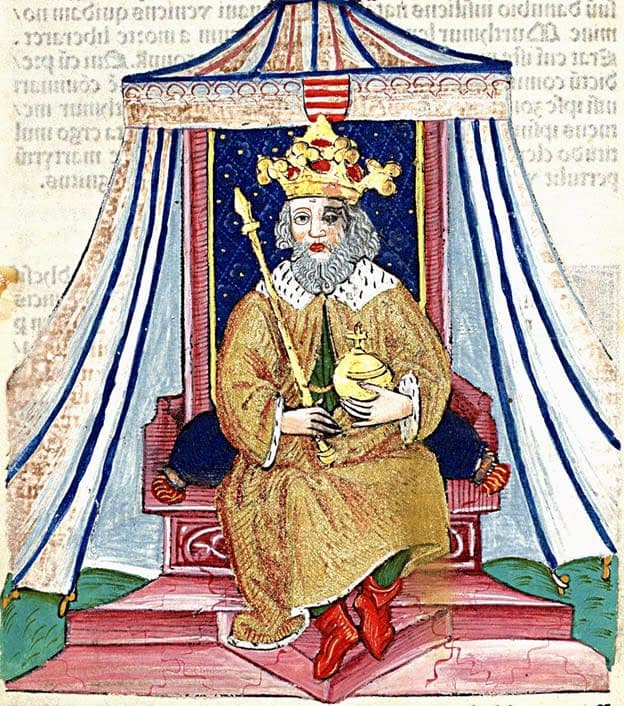

The era into which Andrew I was born was a time of violent upheaval and the emergence of new states. He was born around 1015, becoming the second of three sons in a family whose origins remain shrouded in the mysteries of medieval chronicles.
Some medieval texts, seemingly confused by the tangled branches of the family tree, attempted to identify Ladislaus the Bald as the father of the young princes. However, most sources, including the Chronicle of Zagreb and the Life of Saint Gerard, followed by modern historians, confidently maintain that Andrew, like his brothers Levente and Béla, was the son of Vazul (Basil) — a powerful grandson of Grand Prince Taksony of Hungary.
Their mother, according to the Hungarian Illuminated Chronicle, was "a certain maiden" from the noble Tátony family. Their marriage was never formally recognized, yet it was this union that would give Hungary its future rulers.

Andrew's childhood came to an abrupt end in 1031, when a tragedy shook the country: Emeric, the only son of Stephen I, Hungary's first Christian king, died unexpectedly.
Left without a direct heir, Stephen I brought his nephew Peter Orseolo closer to the royal court and designated him as his successor. This decision divided the court.
Vazul, a legitimate claimant to the throne, refused to accept what he regarded as a grave injustice. The king's response was horrifying in its medieval brutality. According to the Annales Altahenses (Annals of Niederaltaich), Stephen ordered Vazul to be seized and blinded, permanently depriving him of the possibility of claiming the crown.
The same source states that immediately after punishing their father, the king expelled the three young princes — Andrew, Levente, and Béla — from the country.
According to another, more sympathetic version, Stephen I, anticipating that his political enemies would not leave the sons of the mutilated Vazul in peace, personally arranged their urgent departure to save their lives.

Thus began long years of exile.
Initially, the brothers, deprived of their homeland and living in poverty, found refuge at the court of Duke Oldřich of Bohemia.
There, their paths crossed with King Mieszko II, who was also hiding in Bohemia after being expelled from his native Poland.
When Mieszko regained the Polish crown in 1032 with the assistance of Czech troops, the three Hungarian brothers followed him.
In Poland, the exiles were received with great warmth and honor. Soon, the youngest brother, Béla, secured an advantageous marriage to Mieszko II's daughter, Rixa.
Realizing that their future in Poland would now be overshadowed by the rising fortunes of their brother, Andrew and Levente decided to continue their wanderings.

Hungarian chronicles have preserved fantastic, sometimes anachronistic legends about their subsequent adventures.
According to one legend, the brothers were refused shelter by the king of Lodomeria and, having nowhere to turn, ventured into the wild steppes.
There, they were supposedly captured by the Cumans — although historians point out that this nomadic people would not appear in Europe until the 1050s.
The steppe warriors mistook the strangers for spies and would certainly have executed them had a Hungarian prisoner not miraculously recognized them as the sons of a prince.
Having escaped captivity, Andrew and Levente eventually reached the lands of Rus' in the late 1030s, finding a secure refuge in Kiev at the magnificent court of Grand Prince Yaroslav the Wise.
It was here that Andrew's destiny took a dramatic turn. Until then a pagan, he received the sacrament of Christian baptism.
Soon afterward, the Grand Prince of Kiev gave Andrew his daughter Anastasia in marriage, sealing their alliance through a dynastic union.

Meanwhile, storm clouds were gathering over the homeland the brothers had left behind.
King Peter Orseolo, who had ascended the throne in 1038, was rapidly losing support.
The patience of the Hungarian nobility and clergy finally ran out when, in 1045, Peter solemnly acknowledged the suzerainty of Holy Roman Emperor Henry III the Black.
Witnessing the suffering of the people and the humiliation of the crown, dissatisfied nobles secretly gathered in Csanád.
They made a fateful decision: to dispatch messengers to distant Kiev, begging Andrew and Levente to return and save Hungary.
Having learned from their bitter experience of exile, the brothers suspected a trap. They agreed to undertake the journey only when their own scout confirmed that the country was indeed engulfed in rebellion against King Peter.

When Andrew and Levente crossed the border, Hungary was already engulfed in a massive pagan rebellion that would enter history as the Vata Uprising.
The rebels welcomed the returning princes in Abaújvár with a radical ultimatum. They demanded that the people be allowed to live according to the customs of their pagan ancestors, that bishops be exterminated, churches destroyed, and the "shackles" of Christianity cast aside.
Realizing that they could not defeat the king's army without the support of these furious crowds, the brothers compromised their principles and agreed to the rebels' demands.
The consequences were bloody.
As the Annales Altahenses recounts, at the beginning of the uprising Andrew "raged cruelly against the flock of the Holy Church."
Bishop Gerard of Hungary and four other prelates sincerely wished to join the princes, but they fell into the hands of the frenzied pagans. Three of them, including Gerard himself, suffered martyrdom in Buda.
Terrified by the scale of the rebellion, King Peter Orseolo attempted to flee to Austria, but it was already too late.
Andrew's envoys cunningly lured him back before he could cross the border. He was captured and blinded, suffering the same terrible fate that had once befallen Vazul.

Having achieved victory, Andrew faced a difficult choice.
Despite the rebellion, the majority of the Hungarian nobility had no desire to return to paganism.
The aristocracy chose Andrew, a devout Christian, rather than his elder brother Levente, who had remained faithful to the old gods.
Levente, whose health was already deteriorating, did not resist the course of events. He soon died quietly, leaving Andrew's path to the throne unobstructed.
In the autumn of 1046, or according to other sources, in 1047, a solemn coronation ceremony took place in Székesfehérvár.
Three bishops who had miraculously survived the massacre placed the Hungarian crown upon Andrew's head.
Having barely become king, Andrew I demonstrated his iron will. He immediately broke his alliance with the rebels, outlawed pagan rituals under penalty of death, and restored Christianity by fire and sword in accordance with the legacy of Stephen I.
It was precisely for this determination and devotion to the faith that he became known in history by the epithets Andrew the White and Andrew the Catholic.

As a ruler, Andrew proved himself to be a skilled diplomat.
At the beginning of his reign, he sent ambassadors bearing modest gifts to Emperor Henry III, offering to pay annual tribute in exchange for recognition.
At the same time, in 1048, he persuaded his brother Béla to return from Poland, granting him control over vast territories amounting to one-third of the kingdom, with administrative centers in Nitra and Bihar.
However, peace with the Holy Roman Empire proved fragile.
As early as 1050, the first border clashes erupted, and in August 1051 Emperor Henry III himself invaded Hungary.
The combined forces of Andrew and Béla employed a ruthless but effective scorched-earth strategy, forcing the exhausted imperial troops to retreat.
The following year, Henry III returned and laid siege to the fortress of Pressburg, present-day Bratislava.
Here, too, the Hungarians demonstrated extraordinary courage. The legendary warrior Zotmund, described as "the most skilled swimmer," secretly drilled holes into the hulls of the imperial siege ships under cover of darkness, sending them to the bottom of the river.
The conflict became so serious that Pope Leo IX himself was forced to intervene.
The emperor lifted the siege. However, as soon as the threat had passed, Andrew cast aside his mask of submission, renounced all the promises he had made under pressure, and even concluded a daring alliance with Conrad of Bavaria, the emperor's bitterest enemy.

Yet the greatest tragedy of Andrew I's life was developing not on the battlefield, but within his own family.
In 1053, Queen Anastasia gave birth to a son, Solomon.
As a devoted father, Andrew desperately wanted to pass the crown to his firstborn son. However, this directly violated the ancient principle of succession by seniority, according to which the throne should have passed to his brother Béla.
Initially, the brothers maintained the appearance of peace.
In 1055, Béla even attended the laying of the foundation stone of the magnificent Benedictine abbey on the Tihany Peninsula.
In addition, Andrew founded an Eastern Orthodox monastery at Tihany and another Orthodox monastery near Visegrád, paying tribute to the religious traditions of his wife Anastasia.

But soon fate dealt the king a devastating blow.
A severe stroke left Andrew bedridden and paralyzed.
Sensing that the end was approaching and determined to secure his son's future at any cost, the paralyzed monarch arranged Solomon's coronation in the autumn of 1057.
A year later, in September 1058, he arranged a brilliant political engagement between the young prince and Judith, daughter of the late Henry III and sister of the new German ruler, Henry IV.
The climax of this family conflict came in a famous historical drama.
Realizing that Béla would not abandon his ambitions, the paralyzed king summoned his brother to a meeting.
Two symbols were placed before Béla: the royal crown and the ducal sword.
He was instructed to choose.
Béla did not know that assassins loyal to the king were hiding behind the curtains, having received orders to cut him to pieces if he reached for the crown.
However, someone managed to whisper a warning to Béla about the trap.
To save his life, he deliberately chose the sword.
Yet this gesture merely postponed the inevitable.
Béla immediately fled to Poland, seeking the protection of Duke Bolesław II, and soon returned to Hungary at the head of a powerful Polish army.
In response, the dowager empress Agnes promptly dispatched Bavarian, Bohemian, and Saxon troops to assist the paralyzed Andrew.
The decisive battle erupted on the plains east of the mighty Tisza River.
Andrew's forces were defeated.
The king himself, severely wounded and incapable of fighting, attempted to escape toward the Holy Roman Empire.
However, near Wieselburg, Béla's warriors caught up with the retreating forces.
In the chaos that followed, as the Annals of Niederaltaich tersely recount, panicking horses trampled the tent in which the helpless monarch was lying.
Mortally wounded, Andrew was transported to the royal estate of Zirc, where, according to contemporary accounts, the fallen king was treated with icy contempt.
Andrew I the White breathed his last in Zirc shortly before December 6, 1060 — the very day on which his brother Béla ascended the throne.
The body of the monarch, whose life had been filled with extraordinary triumphs, years of wandering, and personal tragedies, found its final resting place in the stone crypt of Tihany Abbey, which he himself had founded.
Centuries later, in 1891, archaeologists would discover this tomb — the only surviving undisturbed royal burial from Hungary's pre-Ottoman era.



