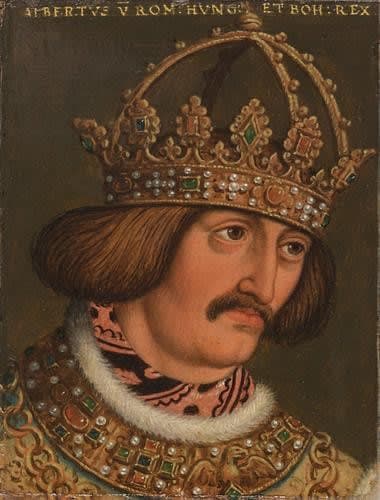

The path of Albert V, who would enter world history as Albert II, to the heights of European power began with severe trials and the early loss of his father.
The son of Duke Albert IV of Austria and Joanna Sophia of Bavaria, he inherited the Duchy of Austria in 1404, when he was only seven years old.
Naturally, the ruler's extremely young age immediately provoked a fierce struggle for power.
Guardianship over the young duke was bitterly contested by his ambitious uncles, representatives of the Leopoldian branch of the powerful House of Habsburg.
Only after two years of intense political intrigue, in 1406, did the opposing factions manage to reach a fragile agreement, appointing the eldest member of the family, Leopold IV, as the official guardian.

However, peace proved short-lived.
As early as 1407, another wave of internal conflict erupted, triggered by the Vienna City Council's unexpected decision to support Duke Ernest the Iron of Styria.
A full-scale war broke out between Leopold IV and Ernest, plunging the Austrian territories into chaos.
This conflict was accompanied by brutal repression and public executions of supporters of both factions in the streets of Vienna.
Ultimately, the balance tipped in favor of Leopold IV, who emerged victorious from the confrontation.
But his triumph did not last long.
In 1411, Leopold died, and the now-mature Albert V was finally able to take the reins of the Duchy of Austria into his own hands, bringing the era of regency to an end.

The beginning of the young duke's independent rule proved surprisingly successful and beneficial for a country exhausted by conflict.
Demonstrating the qualities of a farsighted statesman, Albert V actively encouraged the development of trade and, with a firm hand, secured the complete submission of the unruly aristocracy to central authority.
Long-awaited peace and order returned to Austria.
Having consolidated his position within his territories, the duke turned his attention to foreign policy in the early 1420s, developing close ties with Holy Roman Emperor Sigismund.
The culmination of this political alliance came in 1422, when Albert V married the emperor's daughter and heiress, Elizabeth of Luxembourg.
This marriage represented a genuine dynastic triumph for the Habsburgs.
Through her maternal lineage, Elizabeth descended from the kings of Hungary, Bohemia, and Poland.
Thus, almost overnight, the Austrian duke found himself at the very center of Central Europe's intricate network of dynastic relationships.

However, this powerful alliance also had another, far bloodier side.
Closer ties with Sigismund meant Albert's inevitable involvement in the exhausting and unsuccessful war that the emperor was waging against the Bohemian Hussites.
Recognizing his son-in-law's achievements, Sigismund granted him the Margraviate of Moravia as an appanage in 1423.
In practice, this territory formed the first and most dangerous defensive frontier in the struggle against the rebels.
Albert's military confrontation with the Hussites had actually begun even earlier.
In 1420, he personally participated in a Crusade against the Hussites in Bohemia, which ended in the inglorious and unsuccessful siege of the fortified Hussite stronghold at Tábor.
Later, the duke committed an enormous army of twelve thousand men, recruited from the Austrian territories, to this conflict.
But the religious fervor and military innovations of the Bohemian rebels proved stronger.
Taking the offensive, Hussite forces invaded Austria itself in 1425.
Two years later, in 1427, Albert V once again personally led a Crusade, hoping to crush the heretics, but suffered a devastating defeat.
Austrian territories were ruthlessly ravaged by Hussite detachments, while Vienna and other major cities of the duchy endured severe sieges.
Only after years of continuous fighting did the Austrian forces manage to reverse the situation, defeating the Bohemian militias at Kirchberg, in present-day Austria, in 1431 and at Znojmo in 1432.

Alongside the foreign wars, tragic events were unfolding within the country, driven by the religious intolerance of the age.
In 1420, on Albert's strict orders, mass arrests of Jews began throughout Austria.
The official justification for this extensive campaign was an accusation of desecrating the consecrated Host in the town of Enns.
The subsequent persecution was monstrous.
Two hundred and seventy Jews were burned alive at the stake.
The remaining prisoners were presented with an ultimatum: convert to Christianity or lose everything.
Jews who categorically refused baptism were permanently expelled from the country, and all their property was confiscated.
Young children were forcibly taken from their parents and placed under the care of Catholic monasteries.
This campaign of terror culminated in 1421 with the complete destruction of Vienna's historic Jewish quarter and the demolition of all its synagogues.
The culmination of Albert's political career came in 1437, when Emperor Sigismund died.
A long-standing agreement concluded in 1402 by the duke's father, Albert IV of Habsburg, now came into effect.
The document stipulated that, should Sigismund die without direct male heirs, all his vast possessions would pass to the Habsburgs.
This historic claim was put into practice.
An assembly of influential estates in Hungary, followed by the Diet of the Kingdom of Bohemia, officially recognized Albert V as their legitimate monarch.
However, the process was far from smooth.
In Hungary, Albert was forced to make concessions and accept the extremely demanding conditions imposed by the local elite.
The monarch was required to consult the barons and prelates of the kingdom on every matter of domestic and foreign policy, without exception.
He was also obliged to appoint only ethnic Hungarians to the highest government offices.
Having accepted these conditions, Albert was solemnly crowned King of Hungary under the name Albert on January 1, 1438, in the sacred Hungarian city of Székesfehérvár.
In Bohemia, the situation proved even more explosive.
There, Albert encountered fierce opposition from a significant portion of the Hussite nobility, who categorically refused to accept an Austrian ruler on the throne.
The rebels looked toward neighboring Poland, hoping to transfer the Bohemian crown to a representative of the ruling Jagiellonian dynasty.
The Hussites hastily fortified their positions in Tábor, while their Polish allies invaded Bohemian territory.
Demonstrating considerable military and diplomatic talent, Albert succeeded in driving the Polish army out of the country, reaching a compromise with part of the opposition, and finally consolidating his authority over the Bohemian throne.
The crowning achievement of his political career came on March 18, 1438, when an assembly of German prince-electors gathered in Frankfurt and unanimously elected him King of Germany.
From that moment onward, he became known as Albert II.
This was an unprecedented moment: for the first time in European history, the thrones of Austria, Bohemia, Hungary, and Germany were firmly united under the authority of a single representative of the House of Habsburg.
This triumph laid the foundations for the dynasty's dominance.
From 1438 until the final dissolution of the Holy Roman Empire in 1806, with the exception of the brief period between 1742 and 1745, the imperial throne was continuously occupied by the Habsburgs.
Albert II himself never managed to undergo the formal ceremony of imperial coronation in Rome.
The greatest and most terrifying challenge facing his enormous but fragmented realm was the rapidly growing threat from the East.
The Ottoman Empire, under the leadership of Sultan Murad II, launched a major offensive against the territories of the Serbian despot Đurađ Branković, the Hungarian kings' principal ally and buffer against Ottoman expansion in the Balkans.
Serbia was mercilessly and completely devastated, while the victorious Turkish armies advanced directly to Hungary's borders.
Realizing that any delay could prove fatal, Albert called the Hungarian nobility to arms to defend their kingdom and personally assumed command of an anti-Ottoman campaign.
But fortune turned against the king.
The military expedition failed to achieve its objectives, and the army was forced to begin a difficult retreat.

The final chapter of the monarch's life was sudden and tragic.
In late October 1439, while staying in a military camp near the city of Komárom, the king unexpectedly contracted dysentery.
The illness progressed rapidly, and on October 27, Albert II died, leaving his vast realm on the brink of tremendous upheaval.
The body of the first Habsburg ruler to unite Central Europe was buried with full honors in the traditional resting place of the Hungarian kings at Székesfehérvár.
The bitter irony of his fate was that he fulfilled his most important dynastic duty only after his death.
Albert's only son and heir, who would enter history under the fitting name Ladislaus the Posthumous, was born four long months after his great father's heart had stopped beating.


