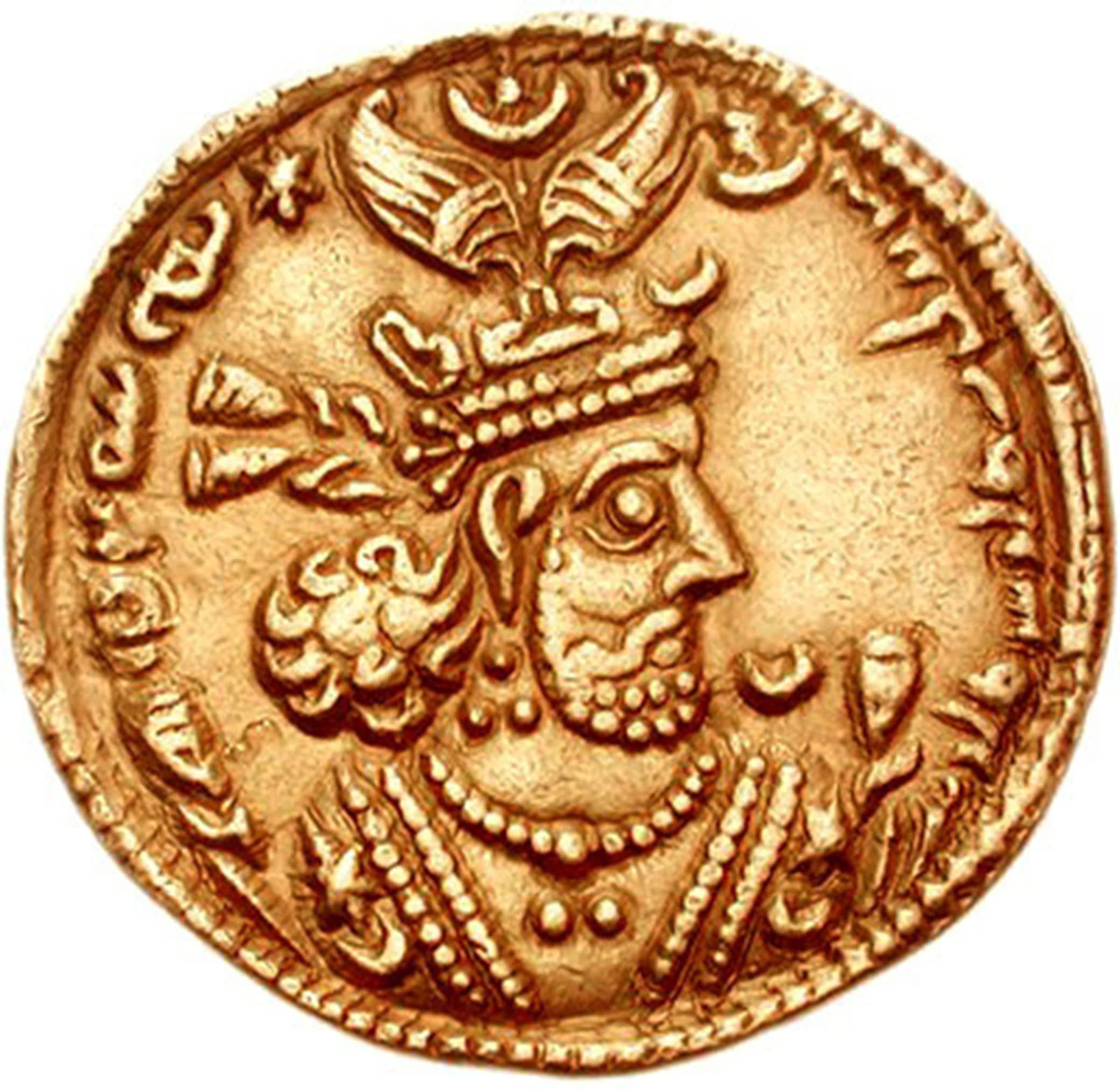

Khosrow II, nicknamed Parviz (“the Victorious”), was born in the 570s. His father, Hormizd IV, was unpopular with the nobility, which ultimately led to his overthrow. The main reason for Hormizd’s fall was his conflict with the general Bahram Chobin, who defeated the Turks and saved the empire but was humiliated by the shah. Bahram rose in revolt, and in 590 Khosrow’s maternal uncles, Bindoy and Bistam, deposed Hormizd IV, who was soon killed in prison.

Khosrow himself at that time was in Adurbadagan. Bahram Chobin minted coins with Khosrow’s name to set him at odds with his father. Believing that his son was preparing a plot, Hormizd IV planned to kill him, but Khosrow fled. Having taken the throne, he found himself in a precarious position: he was considered guilty of his father’s death, and the powerful Bahram Chobin had no intention of submitting.
After an exchange of barbed letters, the forces of Khosrow and Bahram met in a decisive battle on the Great Zab River; Khosrow’s army wavered, and he was forced to flee. Accompanied by a few loyal men, including his uncles Bindoy and Bistam, he took refuge in Byzantine territory.
In the Byzantine fortress of Edessa Khosrow appealed to Emperor Maurice, his former enemy. He offered Maurice significant territorial concessions in exchange for 40 centenaria of gold and an army led by the Armenian Narses. Maurice, contrary to the advice of courtiers, agreed. Soon Khosrow, with the support of Byzantine troops, defeated Bahram Chobin at the Battle of Ganzak. Bahram fled to the Turks but was treacherously killed.

After the victory Khosrow returned to Maurice all the Byzantine cities captured by his predecessors and stopped the payment of tribute. In gratitude for the help, he showed remarkable favor toward Christians: he wore clothing with crosses, and his table was blessed by a Nestorian bishop. Many considered him a secret Christian. He surrounded himself with Christians, and his favorite wives were the Byzantine princess Maria and the Syrian Shirin, who became the heroine of many Eastern poems.

The period of peace was short. In 602 the Byzantine emperor Maurice was overthrown and killed by the usurper Phocas. For Khosrow this became a pretext for revenge for “his benefactor.” He declared mourning for Maurice and marched his army against Byzantium, minting coins with the image of an impostor who posed as Maurice’s son.

The war became grand. For several years the Persians inflicted crushing defeats on the Byzantine forces. By 613 the largest cities of the East Antioch, Edessa, Damascus were in their hands, and in 614 Jerusalem. The Persians plundered the city, killed thousands of inhabitants, and carried off to Ctesiphon one of the greatest Christian relics the Wood of the True Cross. Drunk with victories, Khosrow sent the Byzantine emperor Heraclius a haughty letter in which he mocked his God and demanded complete submission.
By 619 the Persians had seized all of Egypt and, according to Michael the Syrian, “plundered and carried off an innumerable multitude of people.” Khosrow, who had received the epithet Parviz (“the Victorious”), was at the peak of his power.

However, the Byzantine emperor Heraclius undertook titanic efforts to save the empire. He gathered money, created a new army, and in 622 began a counteroffensive. He invaded the heart of Persia, burning fire temples and plundering royal palaces. In 626 the Persians’ allies, the Avars, together with the Slavs, besieged Constantinople but were defeated. In 627 Heraclius, in alliance with the Khazars, dealt a crushing defeat to the Persian army at the Battle of Nineveh.
Iran’s economy, exhausted by endless wars, began to collapse. The people suffered from taxes and hardships, and the nobility murmured. Khosrow, enraged by defeats, began to repress his commanders. At this time Heraclius intercepted a letter from Khosrow in which he ordered his general Shahrbaraz to be killed. Heraclius sent the letter to Shahrbaraz himself, which led to a conspiracy.
Discontented courtiers, wishing to save their lives and families, organized a plot against Khosrow. It was led by the king’s eldest son, Kavadh Shiruye. In February 628 the conspirators burst into Khosrow’s residence. He was seized and placed under guard, and a few days later killed.

Khosrow II Parviz ruled for 38 years and was one of the most contradictory rulers in the history of the Sasanians. His era was a time of flourishing and incredible conquests, but at the same time a period of internal upheavals and a tragic end. He became a legendary figure in Eastern literature and art, symbolizing the splendor and tragedy of his power.


