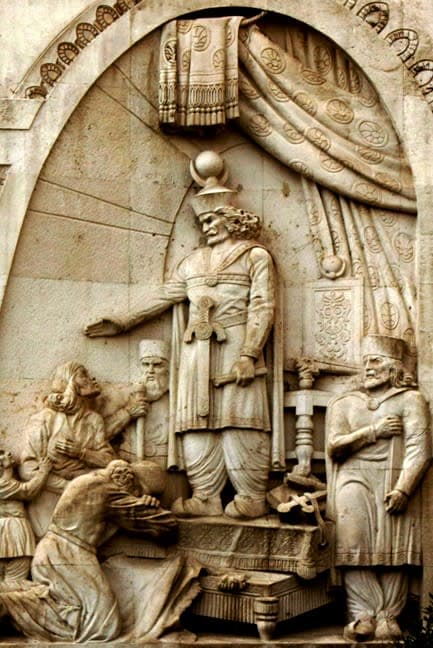

Khosrow I, whose name Anushirvan means “Immortal Soul,” was the third son of Shah Kavad I. Even before his accession to the throne he showed himself to be a far-sighted politician and a tough pragmatist. In the mid-520s, when his father was conducting peace negotiations with Byzantium, Kavad proposed making Khosrow the adopted son of Emperor Justin I. However, these negotiations failed, since the Byzantines feared that the adoption would turn Khosrow into the lawful heir of the Roman Empire, which would “hand over to the Persians the state of the Romans.”

The war with Byzantium that followed lasted until 532. At this time a crisis broke out within Iran, caused by the Mazdakite movement. Although this movement helped Kavad deal with the nobility, the terror of the Mazdakites and the subsequent redistribution of property led to social and economic chaos, as well as to the weakening of the Iranian army, whose core was the heavy cavalry of the nobility, the savaran.
The main force in the struggle against the Mazdakites was precisely Khosrow. In 528 he initiated a mass crackdown on Mazdak and his supporters. Together with them Khosrow’s elder brother, Prince Kavus, who was a supporter of the Mazdakites, was executed. These decisive actions, aimed at suppressing the radicals, allowed Khosrow to strengthen his position at court and prepared the ground for his coming to power.


Ascending the throne, Khosrow faced a huge burden of problems such as an exterminated nobility, a ruined economy, and threats from both the west and the east. He went down in history as a great reformer whose transformations marked the beginning of the era of feudalism in the Middle East.
Administrative reform: Khosrow abolished the patrimonial domains of the nobility and divided Iran into four large provinces kusts. At the head of each stood a governor appointed by the shah, a marzban. All administrative positions, previously passed down by inheritance, were now appointed personally by the shah, which made it possible to centralize power and weaken the separatist tendencies of the aristocracy.
Economic reform: Khosrow streamlined the tax system, replacing payments in kind with monetary ones, which significantly increased the revenues of the treasury and reduced corruption. He also carried out land and poll censuses with a progressive tax scale.

Military reform: Before Khosrow the army was irregular and consisted only of the nobility. Khosrow abolished this structure, creating a regular army. Not only the high nobility were admitted to service, but also small landowners the dehqans and azats. The regiments were maintained at the expense of the treasury and were subordinate only to the shah. The position of commander-in-chief was abolished, and the shah himself became the supreme commander.
In foreign policy Khosrow proved himself a subtle strategist. In 532 he concluded with Byzantium the “Eternal Peace,” which allowed him for a time to secure the western borders. However, the successes of Byzantium under Justinian I in North Africa and Italy prompted Khosrow to break the treaty. In 540 the Lazic War began.
In 542 the Sasanian army captured Antioch, and Khosrow resettled its inhabitants in the vicinity of Ctesiphon, founding “Khosrow’s Antioch.” The war continued with mixed success, and in 562 a fifty-year peace was concluded, under which Byzantium paid tribute to Persia and Persia undertook not to persecute Christians. Byzantium also agreed to finance the strengthening of the Caucasian passes, in particular the construction of the fortress of Derbent.


In the east Khosrow successfully fought the Hephthalites. In 560, in alliance with the Turkic Khaganate, he crushed their state and established the border between Persia and the Turkic Khaganate along the Amu Darya.
Khosrow also significantly expanded Persia’s influence in the south. Around 570 he took advantage of the conflict in Yemen and sent his troops there, who defeated the Ethiopian army. As a result Yemen became a vassal of the Sasanian Empire.
Domestic policy toward vassals was harsh. Khosrow finally abolished royal power in Armenia and Caucasian Albania, turning them into provinces of the empire, which, however, led to another uprising in 572, supported by Byzantium. The war continued until 576, when the Iranians suffered a heavy defeat near Melitene. Khosrow I died in 579, leaving behind a strong and prosperous state.
Khosrow I Anushirvan entered history as the greatest of the Sasanians. His wise reforms, patronage of the sciences, and toleration (which, however, was not absolute) made his image legendary. He was a pragmatist who understood that the interests of the state should stand above personal ambitions.
In Eastern literature and folklore, the image of Khosrow Anushirvan became a symbol of the ideal ruler. Wisdom, justice, military valor, and enlightenment were attributed to him. His reign, which began in a period of decline, revived the Sasanian Empire and allowed it to exist for almost another century at the zenith of its glory. His name became a throne name for many eastern monarchs, which underlines his enormous influence on the history and culture of the region.



