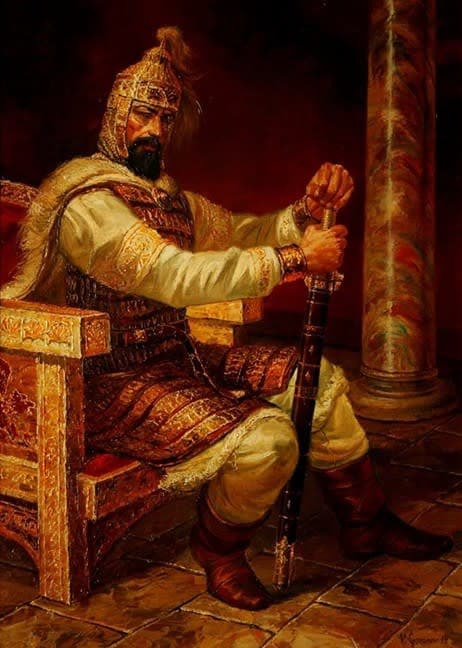

Ascending the throne after the death of his father, Asparuh, Tervel faced a challenge that would forever change the history of Byzantine-Bulgarian relations. In 704, the former Byzantine emperor Justinian II, nicknamed "the Slit-Nosed," who had been living in exile in Phanagoria under Khazar protection, escaped by boat to the Danube. Finding himself in a desperate situation, Justinian sent his envoy Stephen to Tervel, requesting assistance in reclaiming his throne. In exchange for military support, the emperor promised magnificent gifts and the hand of his daughter Anastasia in marriage. Demonstrating political wisdom, Tervel accepted the offer. He assembled a vast army of Bulgars and Slavs under his authority and marched toward Constantinople itself.

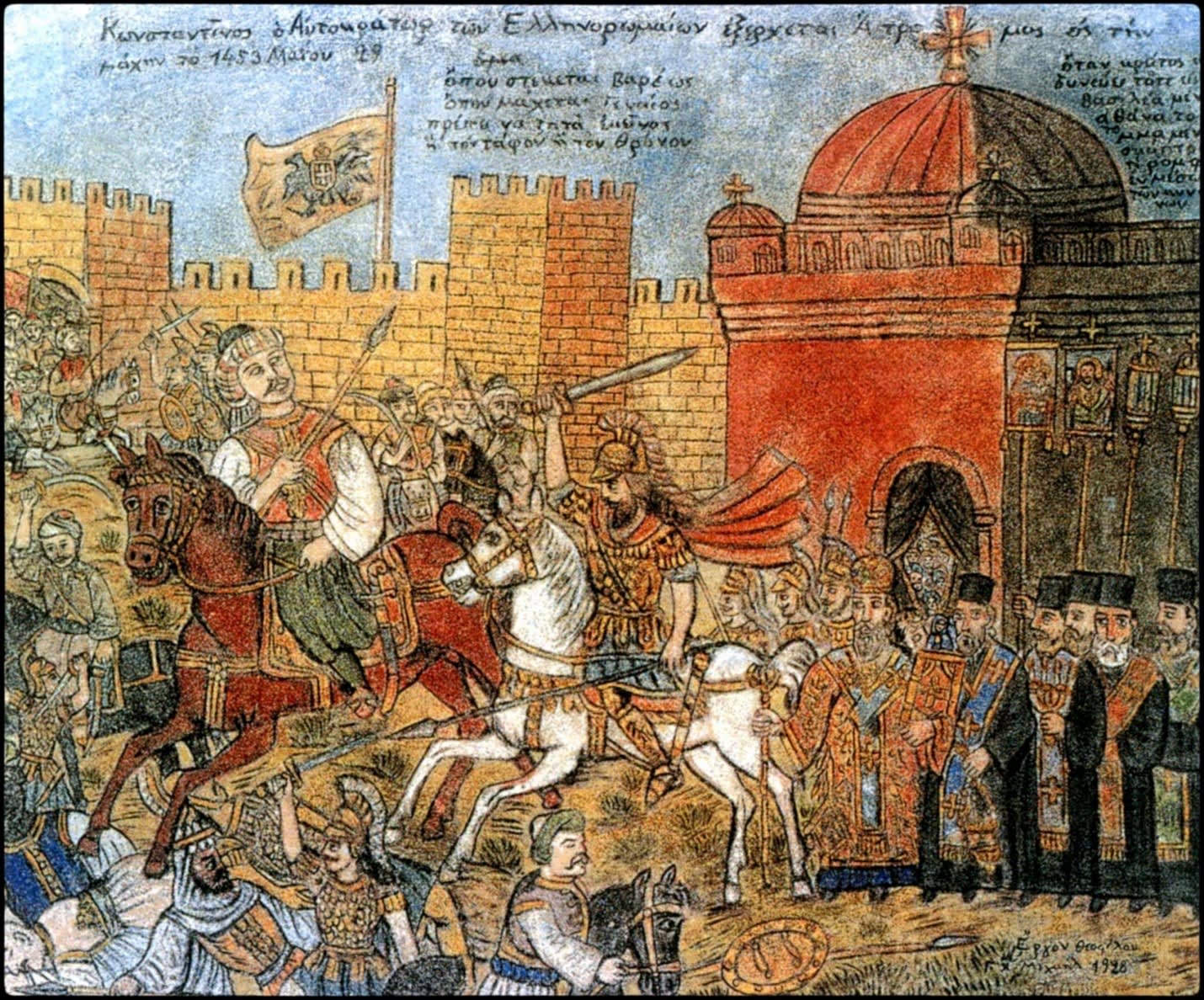
Interestingly, Justinian also attempted to secure the support of another Bulgar leader — Khan Kuber, the fourth son of Kubrat, who ruled in Macedonia. However, according to Tervel himself, his uncles "did not trust the slit-nosed emperor" and preferred to remain in their settlements. Nevertheless, in 705, the combined forces of Tervel and Justinian reached the walls of the Byzantine capital. After three days of fruitless negotiations and mutual insults, Justinian secretly entered the city and regained power. The emperor's gratitude was unprecedented: Tervel became the first foreign ruler to receive the title of Caesar, the second-highest rank in the Byzantine imperial hierarchy. Bulgaria received the region of Zagore in northeastern Thrace, while Byzantium agreed to pay an annual tribute. Legends describe the khan's grandeur during those days: when receiving gold, he would throw his shield and whip onto the ground, and they would be completely covered with coins, while his spear would be buried beneath precious silk garments.
However, peace between the two rulers proved short-lived. In 708, Justinian II, forgetting the khan's generosity, treacherously invaded Bulgarian lands. The decisive confrontation took place at the Battle of Anchialus. The Byzantine fleet approached the fortress, while the cavalry carelessly scattered across the fields to gather fodder. Bulgar scouts, concealed in the mountains, immediately took advantage of the disorder. Like wild beasts, they descended upon the "Roman herd," capturing numerous prisoners, horses, and weapons. Justinian spent three humiliating days hiding behind the fortress walls before secretly escaping by ship to Constantinople, having personally cut the tendons of his horse.

Despite this betrayal, Tervel did not refuse assistance when Justinian's own army rebelled against him in 711. The khan dispatched a force of 3,000 soldiers, but it was already too late: the emperor was killed, and Philippicus Bardanes seized power. The following years were marked by renewed Bulgar raids along the Bosporus and the outskirts of the capital in 712. These events eventually led to the conclusion of the landmark peace treaty of 716 under Emperor Theodosius III. This agreement clearly defined the borders, confirmed the transfer of the Zagore region, and established trade regulations: goods without official seals or stamps were subject to confiscation. Particularly remarkable was the tribute clause: Byzantium was obligated to provide gold and garments made of red leather — a symbol of imperial grandeur. In effect, this meant transferring elements of the Byzantine emperor's own wardrobe to the Bulgarian khan.
Tervel's most remarkable achievement was his role in repelling Arab expansion. In 717, an Arab army of 100,000 soldiers under the command of Maslama, supported by a fleet of 1,000 ships, laid siege to Constantinople. The new emperor, Leo III the Isaurian, appealed to Tervel for assistance. Recognizing the common threat, the Bulgarian khan launched a devastating attack against the Arab rear. The winter of 718 was exceptionally harsh: snow covered the ground for more than a hundred days, severely weakening the besieging forces. The Arabs were forced to dig defensive trenches not only against the Byzantines but also against the Bulgars, who relentlessly attacked and destroyed their troops. The Arab defeat at Constantinople, together with Charles Martel's victory at the Battle of Poitiers in 732, halted the Islamic conquest of Europe. Following this triumph, Tervel continued to act as a "kingmaker," notably providing substantial financial assistance — 360,000 gold coins — to the former emperor Anastasius II in his attempt to reclaim the throne.
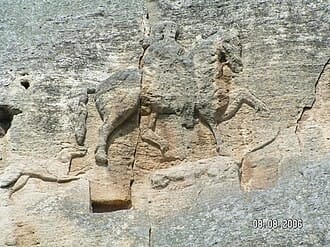
A symbol of the khan's power became the famous Madara Rider, a unique rock relief included on the UNESCO World Heritage List. Scholars believe that the horseman depicted in the relief represents Tervel himself, while the Greek inscriptions surrounding it serve as one of the earliest written chronicles of the Bulgarian state, recording the events of 705.
According to the Nominalia of the Bulgarian Khans, Tervel's reign lasted 21 years and ended around 721. However, Saint Paisius of Hilendar, in his Slavo-Bulgarian History, reveals a different, spiritual side of the ruler's life. According to his account, the khan voluntarily abdicated the throne and took monastic vows under the name Theoktistos in a monastery near Ohrid. Paisius describes Tervel as the first Bulgarian saint, lamenting that his compatriots had failed to preserve sufficient written evidence of his holiness. Nevertheless, a lead seal discovered in 1972, bearing the khan's image and the Greek inscription "Mother of God, help Caesar Tervel," indirectly supports the possibility of his adherence to Christianity, which he may have inherited from his grandfather, Khan Kubrat.


