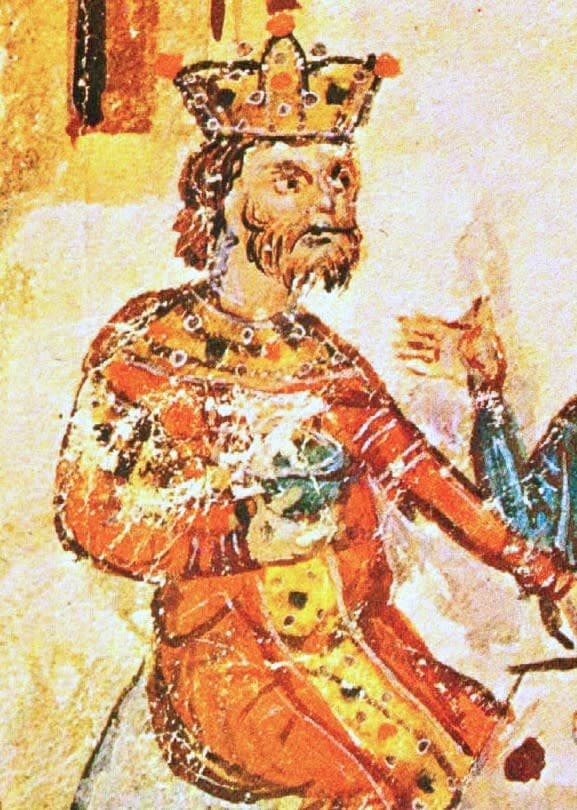

Krum's origins remain a subject of historical debate. According to one hypothesis, his roots can be traced to Pannonia, where his family served the Avars. A second theory, more widely accepted in historiography, suggests that Krum was born in Macedonia. Some researchers associate him with the legendary Dulo dynasty, considering him a descendant of Kuber, the brother of Bulgaria's founder, Asparuh, while others regard him as the founder of an entirely new ruling dynasty.
Krum emerged on the political stage as a brilliant strategist. Taking advantage of the fact that the Avar Khaganate had been exhausted by wars against Charlemagne's empire, the Bulgarian khan launched a devastating attack from the east. By 805, the Avar state had ceased to exist: its territories were divided between the Franks and the Bulgars, and a new frontier was established along the middle Danube.


This victory had not only territorial but also philosophical significance. The Byzantine encyclopedia Suda preserved a legend describing how Krum interrogated Avar prisoners, seeking to understand the reasons behind the collapse of their once-mighty empire. The captives explained that their downfall had been caused by internal conflicts, corruption, drunkenness, and dishonesty in trade. Deeply affected by their words, the khan used these lessons as the foundation for his famous legal reforms.
Krum became Bulgaria's first known lawgiver. To protect his people from the fate of the Avars, he introduced strict but clearly defined laws:
• Justice: No verdict could be issued based solely on an accusation without first questioning the accused. False accusations were punishable by death.
• Crime Prevention: Thieves had the bones of their legs broken, and their property was confiscated. Those who sheltered thieves or provided them with food also faced the loss of their possessions.
• Social Welfare: Assistance to the poor had to be provided strictly according to their needs, with the goal of eliminating poverty as a way of life.
• Sobriety: By the khan's order, vineyards throughout the country were destroyed, as drunkenness was considered the root of many social problems.
In 807, a prolonged Bulgarian-Byzantine war began, becoming the greatest challenge of Krum's reign. Initially, Emperor Nikephoros I held the initiative, but by 808, the Bulgars had seized it, defeating Byzantine forces in the valley of the Struma River and capturing an enormous amount of treasure — "100,000 litrai of gold" intended for the payment of soldiers' salaries.
In 809, Krum captured the strategically important fortress of Serdica (modern-day Sofia) through deception, massacring its garrison. Enraged, Nikephoros I responded by assembling a massive army. In 811, when Byzantine forces approached the fortress of Markellai, Krum, recognizing the scale of the threat, offered peace. However, the emperor rejected his proposal. The 50,000-strong Bulgarian army was defeated, and the Byzantines invaded Bulgarian territory.
Nikephoros demonstrated unprecedented brutality, slaughtering civilians, including women and infants. On July 20, 811, the capital, Pliska, fell and was destroyed. The emperor feasted in the khan's palace, ignoring Krum's repeated appeals for peace: "You have come and conquered. Take whatever you desire and depart in peace." But Krum refused to surrender. He mobilized the entire population, arming even women, and called upon the Avars and Slavs for assistance.
On July 23, 811, Nikephoros left the ruins of Pliska, only to discover that every exit from the mountain passes had been blocked by trenches and wooden fortifications. Foreseeing disaster, the emperor declared: "Even if we had wings, no one could hope to escape death."
At dawn on July 26, the Bulgars launched a devastating assault on the center of the Byzantine camp. The defeat was absolute. Almost the entire imperial army perished in the gorge or drowned in the river. Nikephoros himself was killed "in the most miserable manner." On Krum's orders, the emperor's skull was removed, lined with silver, and transformed into a drinking cup. During feasts, the khan drank from this cup alongside Slavic chieftains, celebrating the salvation of his country.
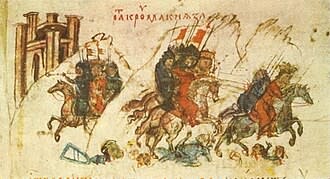
Krum's Warriors Pursuing Staurakios, Son of Nikephoros I (Miniature from the Chronicle of Constantine Manasses).

The victory at Vărbitsa Pass transformed the balance of power. In 812, Krum captured Mesembria using siege engines constructed by a talented Arab defector. For the first time, the Bulgars seized "Greek fire" and 36 siphons used to deploy the weapon.
In 813, the decisive Battle of Versinikia took place. The Byzantine army of the new emperor, Michael I, outnumbered the Bulgars, but due to the indecisiveness of its commanders and panic among its soldiers, it suffered a crushing defeat. The road to Constantinople was now open.

The new emperor, Leo V the Armenian, attempted to eliminate Krum through a treacherous assassination plot during peace negotiations outside the walls of the capital. The ambush by Byzantine archers failed — only the speed of his horse saved the khan. Enraged by this betrayal, Krum devastated the surroundings of Constantinople and captured Adrianople, forcibly relocating its inhabitants.
During the winter of 814, Krum began unprecedented preparations for an assault on Constantinople. He assembled Slavic and Avar forces and prepared an enormous arsenal of siege engines, which required 5,000 wagons for transportation. Terrified, the Byzantines reinforced their walls and appealed to the Franks for assistance.
At the height of these preparations, on April 13, 814, Khan Krum suddenly died. Chronicles describe his death as a mysterious event: blood reportedly poured from his mouth, nostrils, and ears. According to one theory, he may have fallen victim to ritual regicide in accordance with ancient Proto-Bulgarian customs. Another explanation suggests that he suffered a stroke.
Khan Krum died at the height of his power, leaving his successors, particularly Khan Omurtag, a strong, well-organized, and respected state.


