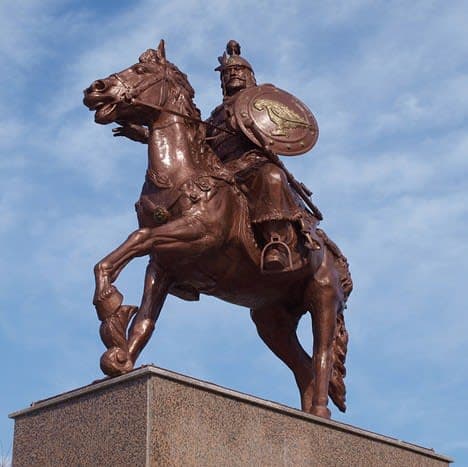

His journey began in 665, when, following the death of his father, the legendary Khan Kubrat, the mighty state known as Old Great Bulgaria faced imminent collapse. As the third son of Kubrat, Asparuh inherited leadership over the Onogundur tribe. However, along with power, he also inherited the heavy burden of war. Weakened by the division of the realm among five brothers, the Bulgar horde faced relentless pressure from the expanding Khazar Khaganate. Under this overwhelming threat, Asparuh made a fateful decision: he led his people westward in search of new lands beyond the Danube, toward the borders of the powerful Byzantine Empire.

Asparuh's father, Kubrat, together with his brothers.
Realizing that his horde, exhausted by the long migration and wars against the Khazars, desperately needed allies, Asparuh demonstrated exceptional diplomatic and strategic skills. In the territories of Thrace, Wallachia, and the Black Sea coast, he found support among the Slavic tribes. This political alliance became the foundation of the future state. The mutual benefits were clear: the Slavs gained reliable protection from the formidable Bulgar cavalry, while the Bulgars acquired a substantial infantry force and a strong base of support among the local population.
The decisive moment came in 679, when the Bulgars conquered Dobruja, dealing a significant blow to Byzantine territories. Emperor Constantine IV, unwilling to tolerate the presence of "barbarians" near his borders, launched a massive military campaign to subjugate the defiant horde. However, the Byzantine army suffered a crushing defeat at the Battle of Ongal. Asparuh's brilliant victory forced the empire to acknowledge the inevitable: in 681, Constantine IV signed a peace treaty, officially recognizing the existence of the First Bulgarian Empire.

The Byzantine chronicler Theophanes the Confessor described this event with bitterness, noting that the once-mighty Rome, which had conquered the peoples of both East and West, was now forced to pay an annual tribute to a "despicable, newly emerged people." Within this new state, a unique social structure developed: the Bulgars formed the ruling military elite, while the Slavs constituted the majority of the population. According to historians, this marked the beginning of a gradual but irreversible process of Slavicization among the Bulgars, which would eventually shape the modern identity of the Bulgarian nation.

Peace with Byzantium remained fragile. In 689, Asparuh, perceiving a threat to his interests, broke the treaty. The immediate cause was the ambitious military campaign launched by Emperor Justinian II in Macedonia. The Byzantines pursued a harsh objective: to forcibly relocate local Slavs to Asia Minor in order to weaken the demographic potential of the Bulgarian Empire. Initially, fortune favored Justinian. He managed to defeat the Slavic forces and likely encountered troops belonging to Khan Kuber, Asparuh's younger brother, who ruled over part of the Bulgar horde in Macedonia

However, the emperor's triumph was short-lived. On the return journey, as the Byzantine army, burdened with prisoners and plunder, made its way through the narrow mountain passes of Thrace, Asparuh was already lying in wait. The Bulgar ambush turned into a devastating massacre for the Byzantines. Surrounded on all sides, Justinian II barely escaped with his life, leaving behind a shattered army and numerous wounded soldiers. This victory firmly established Asparuh's reputation as one of Constantinople's most dangerous and respected adversaries.
Although the ancient Nominalia of the Bulgarian Khans attributes an extraordinary reign of 61 years to Asparuh, modern historians remain skeptical of this figure. The great khan's life ended just as it had unfolded — in battle for his people. According to the Bulgarian Apocryphal Chronicle of the 11th century, the founder of the empire was killed in battle against the Khazars on the banks of the Danube, defending the borders of the state he had created until his final breath.
For centuries, the location of his final resting place remained a mystery. However, in the early 20th century, a rich archaeological treasure was discovered near the village of Voznesenka, in present-day Zaporizhzhia. The Voznesenka archaeological complex contained numerous gold and silver artifacts, among which a silver eagle figurine stood out. Researchers identified symbols associated with the Dulo dynasty and an inscription reading "Espor," written in ancient Bulgar runes. These findings provided substantial grounds for the belief that the legendary khan's tomb might be located at this site.
In 2007, a sarcophagus containing soil from Voznesenka was ceremonially transferred to the Church of the Forty Holy Martyrs in Veliko Tarnovo. In 2010, a memorial plaque was unveiled in Zaporizhzhia in honor of the ruler who succeeded in uniting scattered tribes and laying the foundations of a state that continues to exist to this day.


