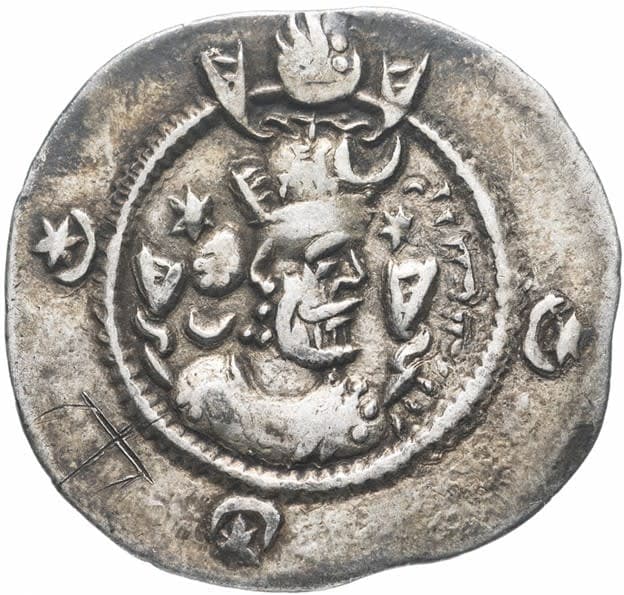

After the catastrophic death of Peroz in the war with the Hephthalites, the throne of the Sasanian Empire ended up in the hands of his son Kavad. Although some sources claim that Kavad was the only surviving relative of the king, the question of his accession to the throne immediately after his father’s death in 484 remains disputed. In that same year Peroz’s brother, Balash, established himself on the throne. However, it is known that Kavad was in captivity among the Hephthalites, where his father had sent him as a hostage for the unpaid indemnity. Thanks to this he formed friendly relations with the Hephthalite ruler, which subsequently played a key role in his fate.
In 488, after the overthrow of Balash, Kavad was raised to the throne. His accession became possible thanks to the support of the powerful nobility with whom he reached an agreement. His main supporter was the all-powerful Sukhra of the House of Karen, who in fact ruled the country, keeping Kavad in the shadows. Kavad was dissatisfied with this dependence and understood that the dominion of the nobility undermined the unity of the state. Therefore, he conceived a plan to get rid of Sukhra. According to the most widespread version, he turned for help to another influential house, the Mihrans. As a result, Sukhra was executed, but Kavad himself soon removed from power Shapur Mihran, his recent ally.

In search of new methods of struggle against the nobility, Kavad turned to the Mazdakite movement led by the preacher Mazdak, who advocated social justice and the redistribution of wealth. This doctrine, with its ideas of equality and the “community of goods,” found a lively response among the poor and allowed Kavad to set the people against the aristocracy.
Kavad drew Mazdak close to himself and even, according to hostile sources, allowed the Mazdakites to terrorize the nobility and even “share” women. These revolutionary ideas aroused the indignation of the aristocracy and the clergy, who, seeing that Kavad could not cope with uprisings on the outskirts of the state (in Armenia, Iberia, and among the Tmorites), united and in 498 or 499 removed him from the throne. In his place his brother Zamasp was seated.
Kavad was imprisoned in the “Castle of Oblivion,” but he managed to escape with the help of his faithful friend Seosa and his wife, who sacrificed herself to help him. Fleeing to the Hephthalites, Kavad turned for help to their king, who gave him his daughter in marriage and provided an army.
In 501, with the help of the Hephthalite army, Kavad regained the throne. He acted mercifully toward his enemies, executing only Gushnaspdad, who had called for his death. Kavad began to rule more cautiously, gradually moving away from the Mazdakites. He understood that their movement had played its role, but further adherence to their ideas could lead to the complete destruction of the state.
He secured submission from the rebellious tribes, and in 502 he began a war with Byzantium. The reason was the refusal of the Byzantine emperor Anastasius to pay for the defense of the Caucasus against the barbarians. Kavad personally led the troops, ravaged Armenia, and besieged Amida, which the Persians took after a three-month siege. The subsequent military operations ended in 506 with peace, under the terms of which Byzantium paid the Persians a huge amount of gold.
In the last years of his reign Kavad, wishing to secure the throne for his younger son Khosrow, turned to the Byzantine emperor Justin with a proposal to “adopt” Khosrow. The negotiations, however, failed, and this led to a conflict between Khosrow’s supporters and his opponents.
The culmination of Kavad’s reign was the crushing of the Mazdakite movement. In 528 or 529, at a staged disputation, Mazdak was declared a heretic, seized, and executed together with his followers. According to tradition, Prince Khosrow personally took part in the massacre. This event symbolized Kavad’s final break with revolutionary ideas and his reconciliation with the nobility and the clergy.

The last years of Kavad’s reign were marked by a new war with Byzantium, in which he achieved mixed success. He died in 531 at the age of about 82.
Despite all the upheavals, Kavad I was an outstanding ruler. It was precisely under him that the foundations of the great reforms later completed by his son Khosrow I Anushirvan were laid. He systematized the tax system and strengthened the army, which made it possible for the Sasanian Empire once again to become one of the leading world powers. His political talent, cunning, and determination brought him to the throne twice and allowed him to hold on to power, leaving behind a prosperous state.


